
10.2: The Three Key Elements of an Effective Conclusion
Tiffany Petricini
Learning Objectives
- Examine the three steps of an effective conclusion: restatement of the thesis, review of the main points, and concluding device.
- Differentiate among Miller’s (1946) ten concluding devices.
Figure 10.2: Three Essential Parts of a Conclusion
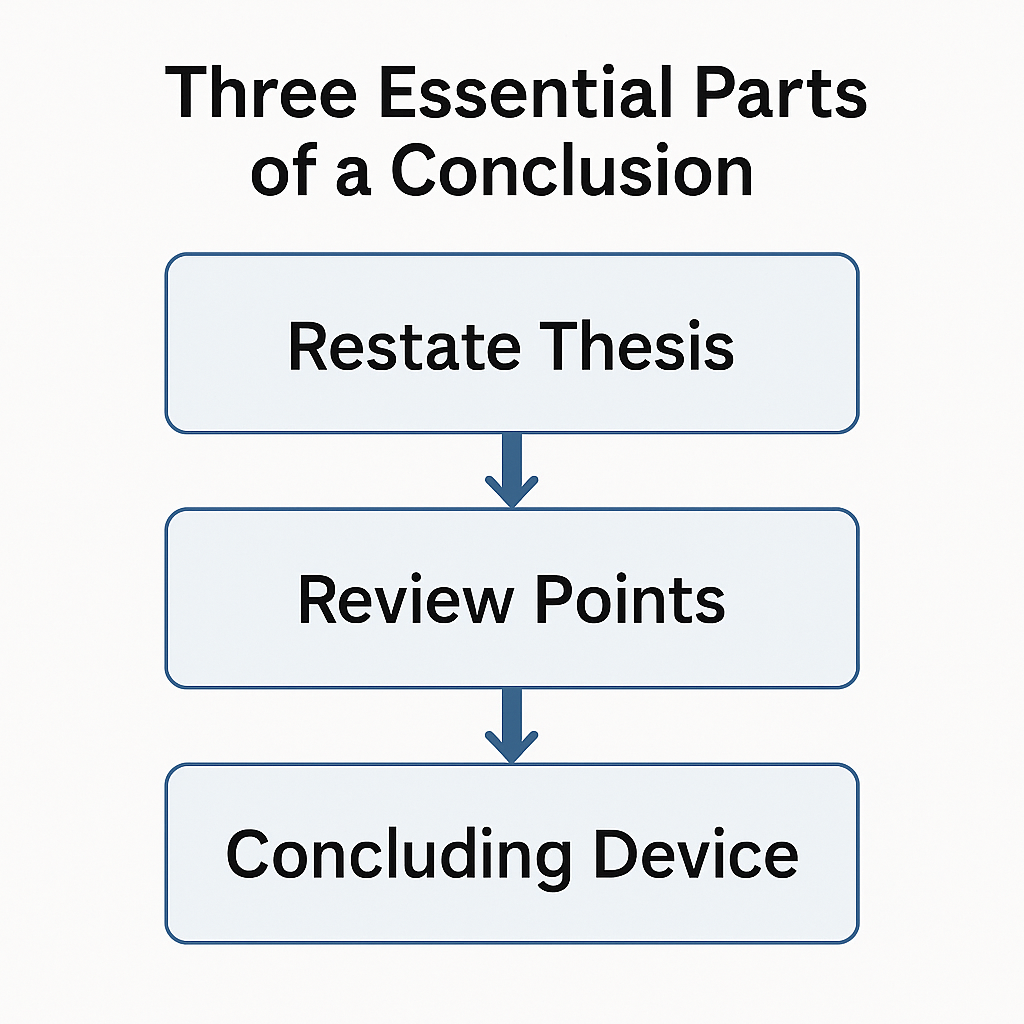
Image Description
The image is a vertical flowchart with three light-blue rectangular boxes connected by downward arrows. The chart illustrates the steps for constructing an effective conclusion in a speech or essay.
- Top Box: Restate Thesis – Reaffirm the central argument or purpose.
- Middle Box: Review Points – Summarize the main points covered.
- Bottom Box: Concluding Device – End with a memorable closing tool, such as a quote, call to action, or final thought.
The flow moves sequentially from top to bottom, showing the recommended order.
Text Transcription
Title: Three Essential Parts of a Conclusion
Flowchart Steps:
- Restate Thesis
- Review Points
- Concluding Device
A strong conclusion restates your thesis, reviews your main points, and ends with a memorable device.
A powerful conclusion does three essential things: it reminds the audience of the purpose of the speech, reinforces the key ideas, and leaves them with a final impression that resonates. These steps aren’t just formalities. They’re strategic tools that help your speech land with clarity and power.
1. Restate the Thesis
Start by restating your thesis in a clear and concise way. Your thesis is the central idea or claim you made in your introduction. It includes what your speech set out to prove, explain, or explore. But instead of repeating it verbatim, you can rephrase it in a way that reflects the journey your audience has just gone on.
Example:
Original Thesis:
“Social media platforms are reshaping how we form and maintain interpersonal relationships.”
Restated in conclusion:
“Over the last few minutes, we’ve seen that social media doesn’t just connect us—it redefines how we build and sustain relationships today.”
Restating the thesis shows your audience that your message has come full circle and reaffirms the importance of your central argument.
 AI Insight: “Test Drive” Your Thesis Restatement
AI tools can offer rewordings that match a more reflective tone. Ask, “Can you restate this thesis for a speech conclusion?” Then revise it to reflect your own voice and perspective. The goal is not to copy but to spark a clearer version of what your audience just heard.
2. Review the Main Points
Oral communication relies heavily on repetition. Unlike reading, your audience can’t flip back a few pages to check what you said. That’s why reviewing your main points at the end is so important. It helps solidify your message in their memory.
Example (reviewing three points): “Today, we looked at the evolution of social media platforms, the way they influence our communication habits, and their effects on intimacy and trust.”
You don’t need to recap every detail. Just reinforce the big takeaways. Keep the tone confident and concise.
3. Use a Concluding Device
The final step in an effective conclusion is to select a strong concluding device—something memorable, thought-provoking, or action-driven that wraps up your message. Think of it as your “mic drop” moment. The device should match your speech’s purpose and tone. This could be a powerful quotation, a call to action, a visualization, a rhetorical question, or another technique you’ll explore in the next section.
Your goal is not just to finish but to finish well.
AI Insight: Choosing a Concluding Device
Unsure how to end? Ask an AI tool for five ideas for how to close a speech on your topic. Then compare them to Miller’s strategies. Choose one that fits your audience and message, and revise it to feel authentic and intentional.
 Beyond the Podium Insight: Your Ending Builds Your Ethos
When you close with intention, you reinforce your credibility. A speaker who ends with purpose shows the audience that the message was designed, not improvised. A weak ending can undo a strong speech. A clear, confident one affirms trust.
Try It: The Three Essential Parts of a Speech Conclusion
Activity Introduction: Strong conclusions share three elements: restated thesis, reviewed points, and a closing device. Test your knowledge with this quick check.
Wrap-Up: Each element plays a distinct role. Together, they ensure your conclusion feels designed, not improvised, and your audience feels closure.
Concluding Devices: Strategies That Stick
Figure 10.3: Miller’s Ten Concluding Devices
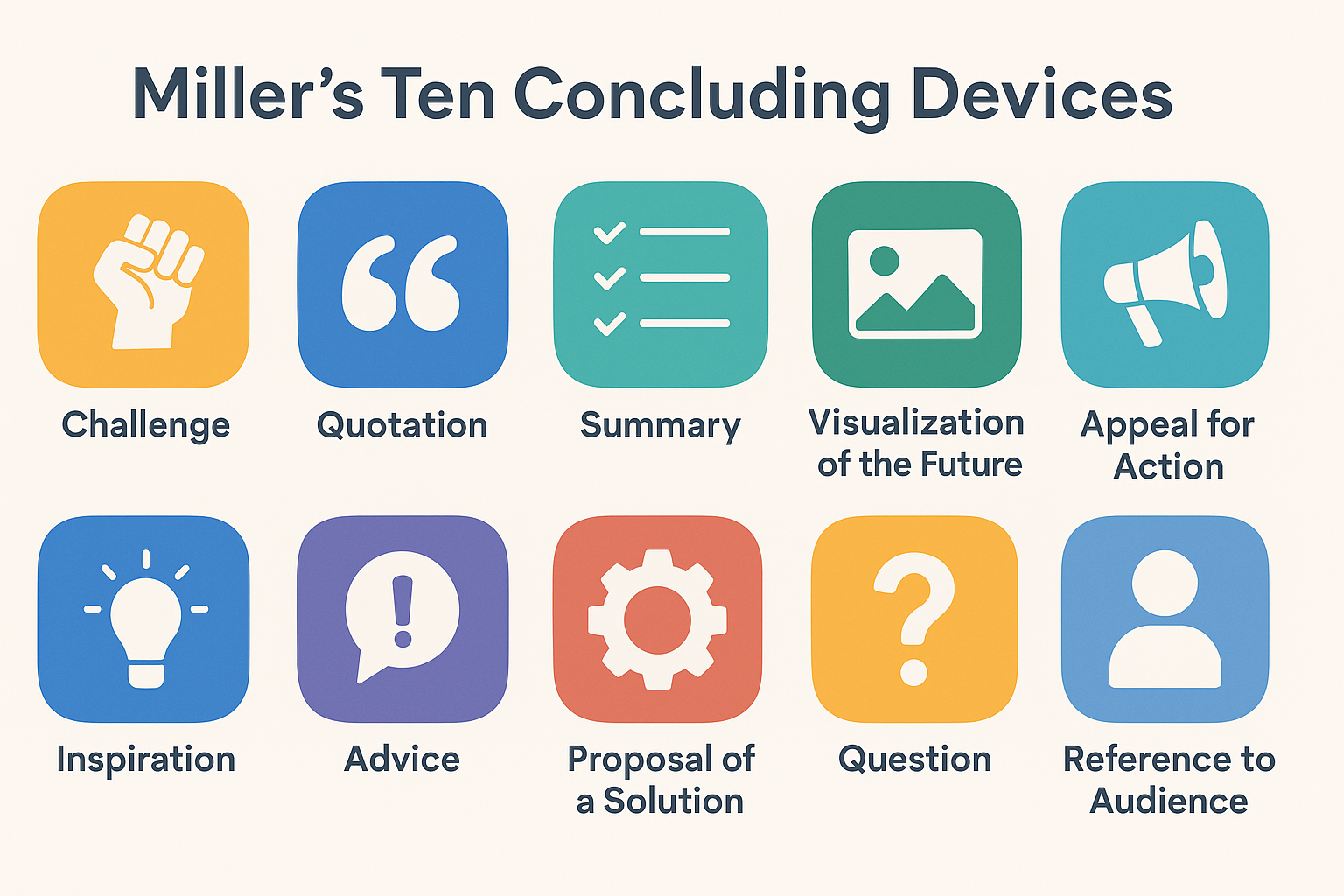
Image Description
The image presents ten colorful icons, each paired with a label, under the title “Miller’s Ten Concluding Devices.” These represent different strategies for effectively ending a speech.
Top Row (left to right):
- Challenge – Icon of a raised fist in a yellow square.
- Quotation – Icon of quotation marks in a blue square.
- Summary – Icon of a checklist in a green square.
- Visualization of the Future – Icon of a landscape photo in a teal square.
- Appeal for Action – Icon of a megaphone in a turquoise square.
Bottom Row (left to right):
- Inspiration – Icon of a light bulb in a light blue square.
- Advice – Icon of an exclamation point in a purple square.
- Proposal of a Solution – Icon of a gear in a red square.
- Question – Icon of a question mark in a yellow square.
- Reference to Audience – Icon of a person silhouette in a blue square.
The use of bright colors and simple symbols visually reinforces the variety of techniques available for closing a presentation or speech.
Text Transcription
Title: Miller’s Ten Concluding Devices
- Challenge
- Quotation
- Summary
- Visualization of the Future
- Appeal for Action
- Inspiration
- Advice
- Proposal of a Solution
- Question
- Reference to Audience
After restating your thesis and reviewing your main points, it’s time to leave your audience with something they won’t forget. This is where a concluding device comes in. A concluding device is a final strategy such as a sentence, image, question, challenge, or action. It helps your message linger long after your speech ends.
Communication scholar Elwood Murray Miller (1946) identified ten distinct types of concluding devices frequently used by speakers to create memorable endings. These strategies, published in his article Speech Introductions and Conclusions, remain foundational in public speaking instruction today.
Miller’s taxonomy helps students and professionals alike consider not just how to end a speech, but how that ending should feel to the audience.
1. Challenge
A challenge urges your audience to take action or adopt a new mindset. It requires effort and often appeals to motivation or values.
Example: “I challenge you to reduce your social media use by just 30 minutes a day—and see what changes.”
2. Quotation
Using a powerful or poetic quote can reinforce your message. Choose one that’s relevant, meaningful, and brief.
Example: “As Maya Angelou once said, ‘People will forget what you said… but they will never forget how you made them feel.’”
3. Summary
A summary is helpful when your speech has been long or technical. It extends your point review for clarity but should still be concise.
Use sparingly in short speeches.
4. Visualization of the Future
Help the audience imagine a changed world if your ideas are adopted—or if they are ignored. This is especially effective in persuasive speeches.
Example: “Imagine a world where every child has access to clean water, not as a luxury, but as a right.”
5. Appeal for Action
This device asks your audience to do something. It may be a physical action (signing a petition) or a cognitive one (changing a belief).
Example: “If you care about privacy, write to your local representative today. Don’t wait.”
6. Inspiration
This approach aims to stir the emotions and leave listeners uplifted. Often used in ceremonial or motivational speeches. Conclude with a moving poem, story, or call for hope that connects to your theme.
7. Advice
Offer a practical or expert recommendation, especially if your speech presents you as a knowledgeable guide.
Example: “If you’re struggling to find your voice, start by listening closely to the stories around you.”
8. Proposal of a Solution
End with a specific solution to a problem discussed in your speech. This works well when the body of the speech was diagnostic or problem-based.
Example: “Let’s begin by partnering with local organizations already doing this work.”
9. Question
Asking a rhetorical question can provoke reflection. It should invite the audience to think deeply without expecting an answer.
Example: “What kind of world do we want to leave for our grandchildren?”
10. Reference to Audience
Make the conclusion about your listeners—what the issue means for them personally or how it connects to their lives.
Example: “As students, you already have the power to shape change. The question is: will you?”
Try It: Match the Concluding Device to Its Example or Description
Activity Introduction: Miller identified ten memorable closing strategies. This activity lets you match each device with its description or example.
Wrap-Up: The best conclusions are chosen with intention. As you prepare, decide which device matches your speech purpose, tone, and audience.
Choosing the Right Device
Beyond the Podium Insight: Don’t Just Land the Plane, Open the Door
A conclusion is not only about ending smoothly. It is about opening a space for what comes next. A well-crafted final moment invites reflection, participation, or future conversation. It shows your audience that the message does not stop with you.
Not all concluding devices are equally suited for all types of speeches. A persuasive speech may lean toward a call to action or visualization of the future. An informative speech might end with a quotation or summary. A ceremonial speech might opt for inspiration.
The key is to select a closing strategy that reinforces your purpose, aligns with your audience’s expectations, and feels authentic to you as a speaker.