
9.2: Using Common Organizing Patterns
Tiffany Petricini
Learning Objectives
- Differentiate among the common speech organizational patterns: categorical/topical, comparison/contrast, spatial, chronological, biographical, causal, problem-cause-solution, and psychological.
- Understand how to choose the best organizational pattern, or combination of patterns, for a specific speech.
Organizing for Impact: Choosing a Structure That Works
Once you’ve identified your main points, the next step is to decide how to organize them. The way you sequence your ideas matters. It shapes how your audience understands, processes, and remembers what you say.
Think of your organizational pattern like a map for your message. You’re guiding listeners from one idea to the next, and the route you take should feel natural and intentional. There’s no single right path, but there are proven structures that help your ideas travel clearly.
Let’s explore some of the most common ways to organize a speech and how to choose one that fits your message—and your audience.
Figure 9.3 Common Ways to Organize a Speech
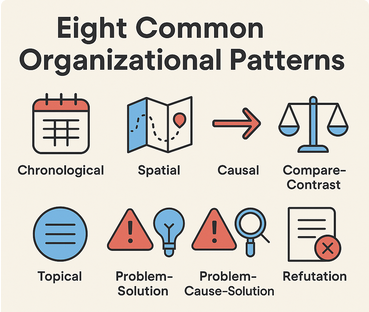
Image Description
The image presents eight icons, each representing a different method of organizing a speech, arranged in two rows beneath the title “Eight Common Organizational Patterns”. Each icon is accompanied by a label underneath it.
Top Row (left to right):
- Chronological – Icon of a calendar, indicating a time-based sequence.
- Spatial – Icon of a folded map with a location pin, suggesting geographic or physical arrangement.
- Causal – Icon of a right-facing arrow, symbolizing cause-and-effect relationships.
- Compare-Contrast – Icon of a balanced scale, illustrating the evaluation of similarities and differences.
Bottom Row (left to right):
- Topical – Icon of a circle with horizontal lines, representing a category-based or theme-driven structure.
- Problem-Solution – Icon of a warning triangle with an exclamation mark, representing issue and resolution.
- Problem-Cause-Solution – Icon of a triangle with a lightbulb, suggesting deeper analysis before proposing a fix.
- Refutation – Icon of a document with an “X,” symbolizing rebuttal or discrediting of opposing arguments.
The icons use red, blue, and black line art for visual clarity and differentiation.
Text Transcription
Title: Eight Common Organizational Patterns
Patterns (with icons):
- Chronological
- Spatial
- Causal
- Compare-Contrast
- Topical
- Problem-Solution
- Problem-Cause-Solution
- Refutation
1. Categorical / Topical Pattern
Best for: speeches where the main points are distinct but connected by a larger theme.
In a topical pattern, you organize your points by categories or chunks. Each section covers a unique part of your overall topic.
Example:
Specific Purpose: To persuade high school juniors to apply to Generic University
Main Points:
- Life in the dorms
- Life in the classroom
- Life on campus
These categories could be rearranged without losing clarity. It’s the structure you reach for when your speech covers different facets of the same idea.
2. Comparison / Contrast Pattern
Best for: showing similarities and differences between two things.
This pattern helps listeners weigh options or perspectives. It’s especially useful when you want to highlight key distinctions that matter.
Example:
Specific Purpose: To inform physicians about Drug X and Drug Y
Main Points:
- How the drugs are similar
- How they differ
Want to go deeper? Add a first point to introduce both options:
What are Drug X and Drug Y?
- Similarities
- Differences
This structure works well when helping people compare choices or shift opinions.
3. Spatial Pattern
Best for: topics involving physical space, location, or anatomy. In this pattern, you organize your ideas by where things are—north to south, left to right, inside to outside, etc.
Example (geographic):
Specific Purpose: To inform history students about Confederate states
Main Points:
- States near the Mason-Dixon Line
- Deep South states
- Western Confederate states
Example (body system):
Specific Purpose: To explain how the urinary system works
Main Points:
- Kidneys and ureters
- Bladder
- Urethra and sphincter
This pattern helps visual learners and makes complex systems easier to follow.
4. Chronological Pattern
Best for: anything with a timeline like history, process, or personal story. Here, you organize your speech based on time order. You can go forward (past → present → future) or backward (future → past).
Example:
Specific Purpose: To inform my audience about Churchill’s writings
Main Points:
- Writings before WWII
- Writings during WWII
- Writings after WWII
Chronological structures are intuitive. We’re wired to understand sequences—and this helps listeners track your story.
5. Biographical Pattern
Best for: telling the story of a person’s life or career. This can be your life, someone else’s, or a public figure. It often follows a timeline, but you can also organize by themes or turning points.
Example:
Specific Purpose: To inform about the early life of Marilyn Manson
Main Points:
- Early life and feud with Christianity
- Journalism career
- Creation of Marilyn Manson persona
This structure works well for entertainment, celebration, or reflection speeches.
6. Causal Pattern (Cause → Effect or Effect → Cause)
Best for: showing why something happens and what it leads to.
Causal structures help your audience understand relationships and implications.
Example (cause → effect):
Specific Purpose: To explain alcohol abuse in Native American communities
Main Points:
- History and prevalence (cause)
- Health and social effects (effect)
Example (effect → causes):
Specific Purpose: To explain high domestic violence arrests in one city
Main Points:
- Arrest data and patterns (effect)
- Possible causes (reporting, policing, community awareness)
This is a good fit for informative or analytical speeches.
7. Problem–Cause–Solution Pattern
Best for: persuasive speeches where you want to change minds or behaviors.
This pattern walks your audience through an issue:
- What’s the problem?
- What’s causing it?
- What should we do about it?
Example:
Specific Purpose: To persuade voters to support a citywide curfew
Main Points:
- Vandalism and violence among youth is increasing
- Most incidents happen after 10 p.m.
- A curfew would reduce those incidents
This structure works when you want to build urgency and offer clear solutions.
8. Psychological Pattern
Best for: arguments that follow a logical, persuasive flow—especially where A leads to B, and B leads to C.
Example:
Specific Purpose: To persuade nurses to use humor in healing
Main Points:
- Humor affects the body (A)
- These effects improve healing (B)
- Nurses can apply humor in practice (C)
Psychological patterns work well when you’re guiding people through a mental journey, especially in motivational or behavioral speeches.
Choosing the Right Pattern
 AI Insight: Try Structuring Prompts
Want help brainstorming an organization pattern? Ask your AI tool: “What’s a strong structure for a persuasive speech on [your topic] to [your audience]?” Use the response as a springboard—but revise for clarity, tone, and flow. Good organization is more than logic; it’s style, emphasis, and ethical intent.
There’s no perfect pattern, but there is the right pattern for this speech, this audience, and this moment. When deciding how to organize your points:
- Start with your purpose. Are you informing? Persuading? Entertaining?
- Think about your audience. What structure will help them understand your message best?
- Consider your material. Is your topic more about places, times, problems, or comparisons?
And remember: it’s okay to combine patterns. For example, a speech might start with a chronological overview, then shift into a problem-cause-solution structure.
Organization is about more than structure—it’s about strategy. It’s how you build understanding, earn trust, and lead people to action. The patterns we’ve explored here are tools—not rules.
 Beyond the Podium Insight: Patterns as Platforms
Organization isn’t just for the classroom. Platforms like YouTube and podcasts favor content with recognizable structure. Viewers are more likely to stay engaged—and algorithms are more likely to promote your content—when your ideas flow in clear, logical steps. To go beyond the podium is to communicate across mediums and systems.
Use them intentionally, adapt them creatively, and always come back to this question:
“What will help my audience connect with my message?”
That’s how your speech goes beyond the podium—and into people’s lives.