
9.3: Keeping Your Speech Moving
Tiffany Petricini
Learning Objectives
- Understand the importance of transitions within a speech.
- Identify and be able to use a variety of transition words to create effective transitions within a speech.
- Understand how to use a variety of strategies to help audience members keep up with a speech’s content: internal previews, internal summaries, and signposts.
How to Stay Clear, Connected, and Coherent
Have you ever listened to a speech and suddenly thought, “Wait… what are we talking about now?” If so, the speaker probably skipped a crucial part of communication: signposting. In a written essay, readers can pause, re-read, and track your argument visually. But in a speech, your words fly by in real time. Once they’re gone, they’re gone.
That’s why structure isn’t enough—you also need clarity. This section will help you use transitions, previews, summaries, and signposts to guide your listeners through your speech like a well-marked trail.
In short: you’re not just giving a speech—you’re leading a journey.
Figure 9.3: The Audience’s Journey
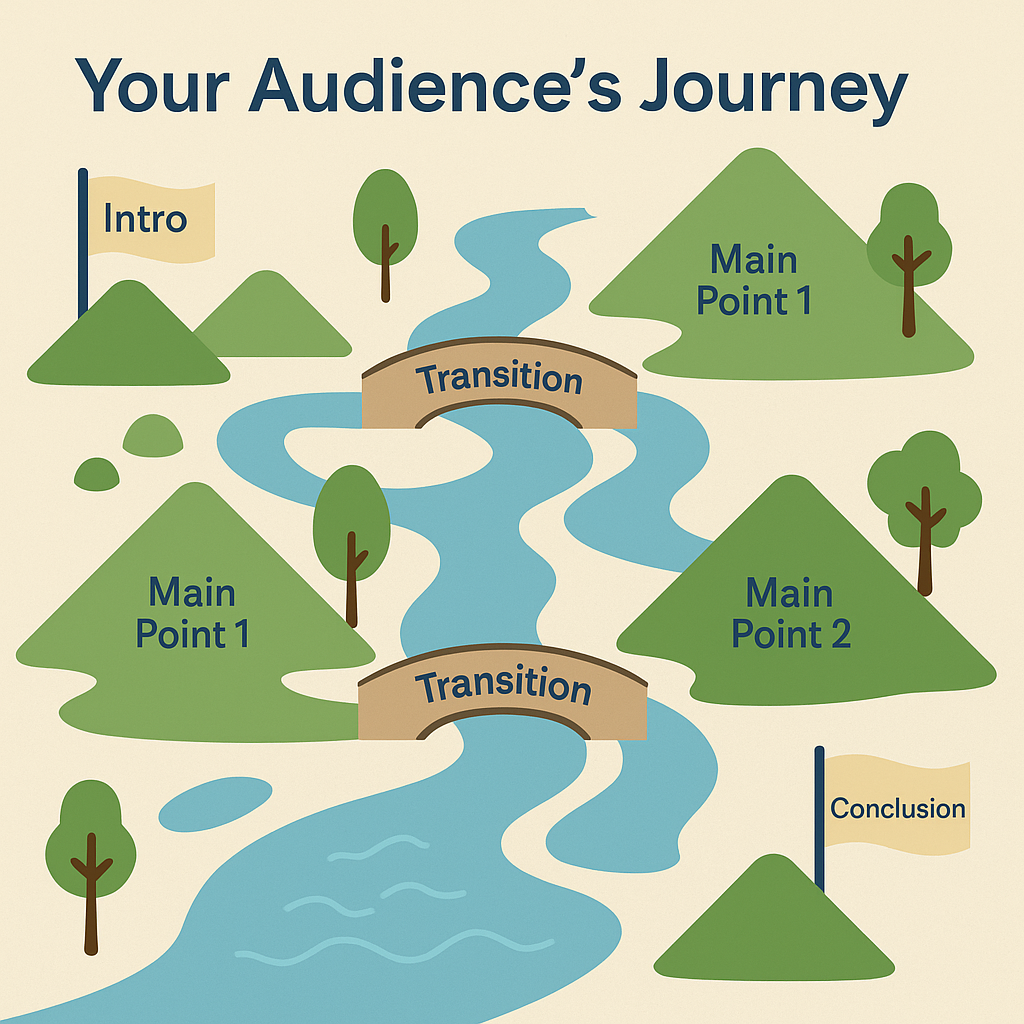
Image Description
This infographic visualizes a speech as a guided journey along a winding river. It is titled “Your Audience’s Journey” and uses a landscape-style illustration to represent the progression of a speech.
Starting point: A yellow flag labeled “Intro” is planted on a hill at the river’s origin.
Along the river: The river flows past green hills labeled “Main Point 1” (appears twice on opposite sides) and “Main Point 2.” Two arched bridges labeled “Transition” span the river between these sections, indicating smooth movement from one idea to the next.
End point: A final yellow flag labeled “Conclusion” appears on a hill at the end of the river.
The image includes trees and soft hills to evoke a natural, flowing path, reinforcing the idea that a well-structured speech should feel like a guided, coherent experience for the audience.
Image Transcription
Title: Your Audience’s Journey
Labels within the journey:
- Intro
- Main Point 1 (appears twice)
- Main Point 2
- Transition (appears twice on bridges)
- Conclusion
The Secret Sauce: Transitions
Think of transitions like verbal bridges: they help listeners move smoothly from one point to the next. Without them, your speech can feel like a series of disconnected ideas.
A good transition does two things:
- Reminds the audience what they just heard.
- Prepares them for what’s coming next.
Example:
“Now that we’ve explored the causes of food insecurity in urban neighborhoods, let’s turn to some innovative programs that are making a difference.”
This one sentence reorients your audience, reinforces structure, and renews their attention.
 AI Insight: Be Careful with AI Transitions
AI-generated transitions often sound formulaic or repetitive. If every paragraph begins with “Now that we’ve discussed…”, your speech may start to feel robotic. Use AI to draft—but always read it aloud and revise. Good transitions have rhythm and intention, not just clarity.
Transition Words and Phrases
Here’s a toolbox of useful transition types and examples:
|
Purpose |
Examples |
|---|---|
|
Add |
Also, furthermore, in addition, likewise |
|
Compare |
Similarly, just like, in the same way |
|
Contrast |
However, on the other hand, but, yet, in contrast |
|
Sequence |
First, next, then, finally, afterward |
|
Cause/Effect |
Because, as a result, therefore, thus |
|
Emphasize |
Above all, especially, most importantly |
|
Summarize |
In conclusion, to sum up, in short, overall |
Try It: Transitions that Work
Activity Introduction: Strong transitions are like the connective tissue of your speech. They keep your ideas linked and your audience oriented. In this quick exercise, you’ll identify the purpose of common transition phrases so you can choose and adapt them more effectively in your own speeches
Activity Instructions: Choose the best label for each transition phrase in the sentence.
Wrap Up: This activity strengthens students’ ability to recognize transition types, improving speech flow and clarity. Recognizing transition types makes it easier to build flow into your speech. The more you can vary and purposefully place your transitions, the more confident and connected your delivery will feel.
 Beyond the Podium Insight
Attention spans are shorter and competition for focus is higher. On platforms like TikTok, Instagram Reels, or video shorts, content lives or dies in the first few seconds. Transitions aren’t filler—they’re fuel. Learning to guide your audience from point to point with clarity is not just a speaking skill; it’s a digital literacy skill.
Internal Previews
Internal previews are like short “coming up next” trailers inside your speech. They help listeners know what to expect within a major section.
Example:
“To understand why climate action is urgent, we’ll first look at the latest scientific data, then we’ll examine the economic risks of inaction.”
This approach not only clarifies your structure—it gives your audience a reason to stay tuned.
Tip: Use internal previews when:
- You’re covering multiple ideas in one main point.
- You’re shifting into complex or unfamiliar material.
Try It: Make It Memorable: Practice Parallelism
Activity Introduction: Parallel structure isn’t just a grammar trick—it’s a memory tool. This short exercise will help you rewrite phrases so they have a consistent rhythm and style, making them easier for your audience to follow and remember.
Wrap Up: Parallel structure makes your main points easier to follow and more memorable.
When your points “sound” alike in structure, your audience can grasp them faster and recall them longer. Use this technique to reinforce your message’s clarity and impact.
|
Before (Non-Parallel) |
After (Parallel) |
|---|---|
|
|
|
|
|
|
|
|
|
|
|
|
|
|
|
Internal Summaries
Just like previews help listeners know where you’re going, internal summaries help them remember where they’ve been. These quick recaps reinforce memory and signal that you’re wrapping up a section.
Example:
“So far, we’ve seen how student debt affects mental health, academic success, and future career choices.”
This is especially useful before moving on to a new topic or argument. You’re reminding your audience: “Here’s what we’ve covered—don’t forget it.”
Signposts
Think of signposts like road signs: they’re short, simple cues that help people follow your path.
They often mark:
- The number of points: “First, second, third…
- The importance of a point: “What matters most here is…”
- A shift in tone or topic: “Let’s pivot,” “Now let’s explore…”
Examples:
“The first key to online credibility is consistency.”
“Next, let’s examine how visual design impacts trust.”
“Finally, we’ll talk about managing misinformation.”
Use signposts when you want your audience to track your structure in real time—especially in persuasive or instructional speeches.
Billboard Signposts: Emphasizing Key Ideas
While most signposts help with direction, some are more like billboards: they signal importance. These attention-grabbing cues say, “Hey, listen up—this matters.”
Examples:
“This is the turning point in our story.”
“Above all, remember this…”
“If you take nothing else from this talk, take this.”
These help your audience know when to lean in.
Putting It All Together
Let’s walk through an example to see how all four tools—transitions, previews, summaries, and signposts—might show up in a single speech:
“We’ve looked at the rise of burnout among remote workers. (summary) Now, let’s explore what employers are doing to prevent it. (transition) In this next section, we’ll first examine flexible scheduling policies, then explore strategies for digital detox. (preview)
The first solution is flexible scheduling. (signpost)…
The second solution is digital detox programs. (signpost)…
So far, we’ve seen two creative ways companies are rethinking remote work. (internal summary)”
See how smooth that flow is? It’s not flashy, but it keeps your audience grounded and connected.
You are your audience’s guide—not just a speaker, but a translator, navigator, and storyteller. These simple tools—transitions, previews, summaries, and signposts—are your way of saying:
“I’ve got you. You won’t get lost.”
When a speech flows well, it feels good to listen to. And when your audience can follow your ideas, they’re far more likely to remember—and act on—what you say.