
10.1: Why Conclusions Matter
Tiffany Petricini
Learning Objectives
- Understand the basic benefits of a strong conclusion.
- Explain the serial position effect and its importance on public speaking.
We’ve all experienced it: a speaker delivers a compelling and engaging message. That is, until the last few seconds, when it just ends. No final thought. No summary. No impact. Just a mumbled “So, yeah… that’s it.” As an audience member, this kind of conclusion feels disappointing. As a speaker, it’s a missed opportunity.
Your conclusion is not simply a signal that your speech is ending. It is your final chance to reinforce your message, re-engage your audience, and leave a meaningful impression. Conclusions matter because they shape what your audience remembers and how they feel about what you’ve said.
Why Do So Many Speakers Struggle with Conclusions?
Many novice speakers devote so much energy to their introductions and main points that the conclusion becomes an afterthought. Others simply feel relieved to be done and trail off. But the way a speech ends can significantly affect how it is received and remembered. If a speech lacks a strong closing, even the most compelling arguments can fade from the audience’s memory.
A well-crafted conclusion can tie everything together, remind listeners why the topic matters, and motivate them to think or act differently. Whether you’re delivering an informative talk or a persuasive appeal, your conclusion is your moment to anchor the message in your audience’s minds.
The Science Behind Memorable Endings: The Serial Position Effect
 Beyond the Podium Insight: Conclusions as Civic Anchors
A strong conclusion is not just about rhetorical closure. It offers a civic function. It helps your audience reflect, question, or act. In hybrid and digital settings, this matters even more. Your final words shape whether people keep thinking, take action, or move on.
There is psychological research to support the importance of conclusions. The serial position effect, discovered by German psychologist Hermann Ebbinghaus in 1885, refers to the tendency for people to better remember information presented at the beginning and end of a sequence. This means that the recency effect or our ability to recall the last thing we hear, can work in your favor when concluding a speech.
Ebbinghaus originally studied this phenomenon using lists of nonsense syllables, but his findings have been confirmed in many real-world settings, including public speaking. Additional research by Ray Ehrensberger in the 1940s extended this concept specifically to speeches. He found that people recall information from the conclusion of a speech even more reliably than the introduction or the middle. In other words, what you say last may be what your audience remembers most.
Figure 10.1: The Serial Position Effect
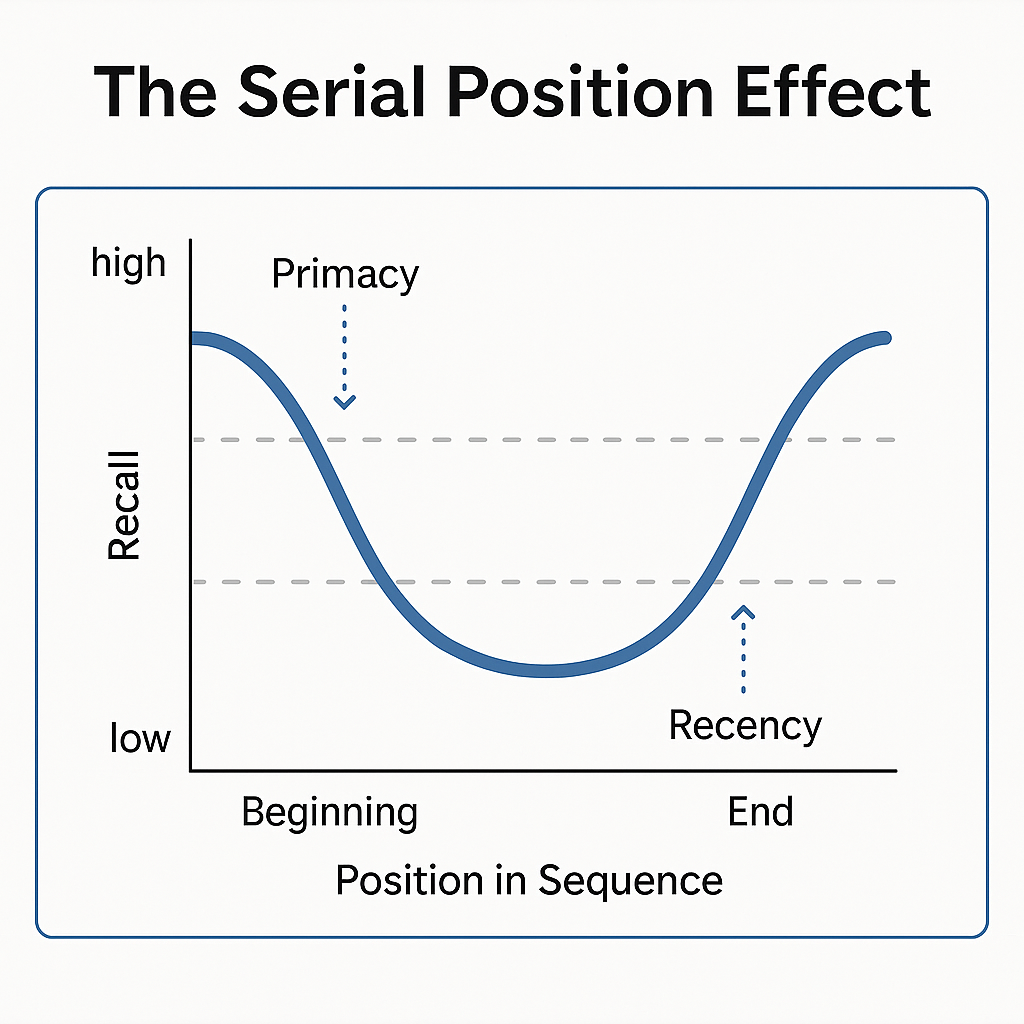
Image Description
The image is a line graph illustrating the Serial Position Effect, which describes how people remember items in a sequence.
- Y-axis (vertical): Labeled Recall, ranging from “low” at the bottom to “high” at the top.
- X-axis (horizontal): Labeled Position in Sequence, running from “Beginning” to “End.”
The curve shows:
- High recall at the beginning (labeled Primacy)
- A sharp drop to low recall in the middle
- A rise back to high recall at the end (labeled Recency)
- Dashed horizontal lines mark reference levels of recall. Arrows point to the beginning (primacy) and end (recency) to highlight these effects.
Text Transcription
Title: The Serial Position Effect
Axes:
- Y-axis: Recall (high to low)
- X-axis: Position in Sequence (Beginning → End)
Labels on Graph:
- Primacy (near the beginning, high recall)
- Recency (near the end, high recall)
- Audiences recall beginnings and endings more than the middle, which makes your conclusion a powerful memory anchor.
Try It: Conclusions Matter Knowledge Check
You’ve just learned why conclusions matter—and the research that proves it. Let’s check your understanding with a quick true/false quiz.
Wrap-Up: Conclusions aren’t optional. They anchor memory and impact. Think of them as your final opportunity to make your speech unforgettable.
A Final Impression That Sticks
Think of your speech as a story. You wouldn’t want a novel to end abruptly or without resolution. A strong ending offers closure, coherence, and impact. The same applies to your speech. When you plan and practice your conclusion as carefully as your introduction, you set your audience up to understand and remember your core message.
Let’s return to the image of a bridge. The introduction welcomes your audience onto the bridge, the body walks them across your key points, and the conclusion brings them back to solid ground. A strong conclusion helps the audience disembark safely with something valuable to take with them.