
17.1: Special-Occasion Speeches
Delia Conti
Learning Objectives
- Identify the different types of ceremonial speaking.
- Describe the different types of inspirational speaking.
Many entertaining speeches fall under the category of special-occasion speeches. All the speeches in this category are given to mark the significance of particular events. Common events include weddings, bar mitzvahs, awards ceremonies, funerals, and political ceremonies There are two groups of special occasion speeches: ceremonial speaking and inspirational speaking.
Ceremonial Speaking
Ceremonial speeches are speeches given during a ceremony or a ritual marked by observance of formality or etiquette. These ceremonies tend to be very special for people, heightening the importance of delivering a meaningful speech. Let’s examine each of the eight types of ceremonial speaking: introductions, presentations, acceptances, dedications, toasts, roasts, eulogies, and farewells.
Speeches of Introduction
The first type of speech is the speech of introduction, which is a short speech given by the host of a ceremony that introduces another speaker. Few things are worse than when the introducer of a speaker stands up and says, “This is Joe Smith, he’s going to talk about stress.” While we did learn the speaker’s name and the topic, the introduction falls flat. Audiences won’t be the least bit excited about listening to Joe’s speech.
Just like any other speech, a speech of introduction should be a complete speech and have a clear introduction, body, and conclusion—and you should do it all in under two minutes. This brings up another “few things are worse” scenario: an introductory speaker who rambles on for too long or who talks about himself or herself instead of focusing on the person being introduced.
For an introduction, think of a hook that will make your audience interested in the upcoming speaker. Did you read a news article related to the speaker’s topic? Have you been impressed by a presentation you’ve heard the speaker give in the past? You need to find something that can grab the audience’s attention and make them excited about hearing the main speaker.
The body of your introductory speech should be devoted to telling the audience about the speaker’s topic, why the speaker is qualified, and why the audience should listen (notice we now have our three body points). First, tell your audience in general terms about the overarching topic of the speech. Most of the time as an introducer, you’ll only have a speech title and maybe a paragraph of information to help guide this part of your speech. That’s all right. You don’t need to know all the ins and outs of the main speaker’s speech; you just need to know enough to whet the audience’s appetite. Next, you need to tell the audience why the speaker is a credible speaker on the topic. Has the speaker written books or articles on the subject? Has the speaker had special life events that make him or her qualified? Lastly, you need to briefly explain to the audience why they should care about the upcoming speech.
The final part of a good introduction is the conclusion, which is generally designed to welcome the speaker to the lectern. Many introducers will conclude by saying something like, “I am looking forward to hearing how Joe Smith’s advice and wisdom can help all of us today, so please join me in welcoming Mr. Joe Smith.” We’ve known some presenters who will even add a notation to their notes to “start clapping” and “shake speakers hand” or “give speaker a hug” depending on the circumstances of the speech.
Now that we’ve walked through the basic parts of an introductory speech, let’s see one outlined:
Specific Purpose: To entertain the audience while preparing them for Janice Wright’s speech on rituals.
Introduction: Mention some common rituals people in the United States engage in (Christmas, sporting events, legal proceedings).
Main Points:
- Explain that the topic was selected because understanding how cultures use ritual is an important part of understanding what it means to be human.
- Janice Wright is a cultural anthropologist who studies the impact that everyday rituals have on communities.
- All of us engage in rituals, and we often don’t take the time to determine how these rituals were started and how they impact our daily routines.
Conclusion: I had the opportunity to listen to Dr. Wright at the regional conference in Springfield last month, and I am excited that I get to share her with all of you tonight. Please join me in welcoming Dr. Wright (start clapping, shake speaker’s hand, exit stage).
Speeches of Presentation
The second type of common ceremonial speech is the speech of presentation. A speech of presentation is a brief speech given to accompany a prize or honor. Speeches of presentation can be as simple as saying, “This year’s recipient of the Schuman Public Speaking prize is Wilhelmina Jeffers,” or could last up to five minutes as the speaker explains why the honoree was chosen for the award.
When preparing a speech of presentation, it’s always important to ask how long the speech should be. Once you know the time limit, then you can set out to create the speech itself. First, you should explain what the award or honor is and why the presentation is important. Second, you can explain what the recipient has accomplished in order for the award to be bestowed. Did the person win a race? Did the person write an important piece of literature? Did the person mediate conflict? Whatever the recipient has done, you need to clearly highlight his or her work. Lastly, if the race or competition was conducted in a public forum and numerous people didn’t win, you may want to recognize those people for their efforts as well. While you don’t want to steal the show away from winner, you may want to highlight the work of the other competitors or nominees.
Speeches of Acceptance
The complement to a speech of presentation is the speech of acceptance. The speech of acceptance is a speech given by the recipient of a prize or honor. There are three typical components of a speech of acceptance: thank the givers of the award or honor, thank those who helped you achieve your goal, and put the award or honor into perspective. First, you want to thank the people who have given you the award or honor and possibly those who voted for you. We see this done every year during the Oscars, “First, I’d like to thank the academy and all the academy voters.” Second, you want to give credit to those who helped you achieve the award or honor. No person accomplishes things in life on his or her own. We all have families and friends and colleagues who support us and help us achieve what we do in life, and a speech of acceptance is a great time to graciously recognize those individuals. Lastly, put the award in perspective. Tell the people listening to your speech why the award is meaningful to you.
Speeches of Dedication
The fourth ceremonial speech is the speech of dedication. A speech of dedication is delivered when a new store opens, a building is named after someone, a plaque is placed on a wall, a new library is completed, and so on. These speeches are designed to highlight the importance of the project and possibly those to whom the project has been dedicated. Maybe your great-uncle has died and left your college a significant amount of money, so the college has decided to rename one of the dorms after your great-uncle. In this case, you may be asked to speak at the dedication.
When preparing the speech of dedication, start by explaining how you are involved in the dedication. If the person to whom the dedication is being made is a relative, note the relationship. Second, you want to explain what is being dedicated. If the dedication is a new building or a preexisting building, you want to explain what is being dedicated and the importance of the structure. You should then explain who was involved in the project. If the project is a new structure, talk about the people who built the structure or designed it. If the project is a preexisting structure, talk about the people who put together and decided on the dedication. Lastly, explain why the structure is important for the community where it’s located. If the dedication is for a new store, talk about how the store will bring in new jobs and new shopping opportunities. If the dedication is for a new wing of a hospital, talk about how patients will be served and the advances in medicine the new wing will provide for the community.
Toasts
At one time or another, almost everyone is going to be asked to deliver a toast. A toast is a speech designed to congratulate, appreciate, or remember. First, toasts can be delivered for the purpose of congratulating someone for an honor, a new job, or getting married. You can also toast someone to show your appreciation for something they’ve done. Lastly, we toast people to remember them and what they have accomplished.
 Beyond the Podium Insight
A joke that unites can build trust, but a joke that divides can close off dialogue. Beyond the podium, speakers must consider whether their humor uplifts or alienates.
When preparing a toast, the first goal is always to keep your remarks brief. Toasts are generally given during the middle of some kind of festivities (e.g., wedding, retirement party, farewell party), and you don’t want your toast to take away from those festivities for too long. Second, the goal of a toast is to focus attention on the person or persons being toasted—not on the speaker. As such, while you are speaking you need to focus your attention on the people being toasted, both by physically looking at them and by keeping your message about them. You should also avoid any inside jokes between you and the people being toasted because toasts are public and should be accessible for everyone who hears them. This prohibition against inside jokes applies to all public speeches, and it is wise to remember to you use caution when using all forms of humor. Safe humor, aka “Dad” jokes, is fine. Ribald humor is not.
To conclude a toast, simply say something like, “Please join me in recognizing Joan for her achievement” and lift your glass. When you lift your glass, this will signal to others to do the same and then you can all take a drink, which is the end of your speech.
Humor can connect or divide. Ethical speakers choose strategies that include, uplift, and respect their audience.
Figure 17.2: The Ethics of Humor
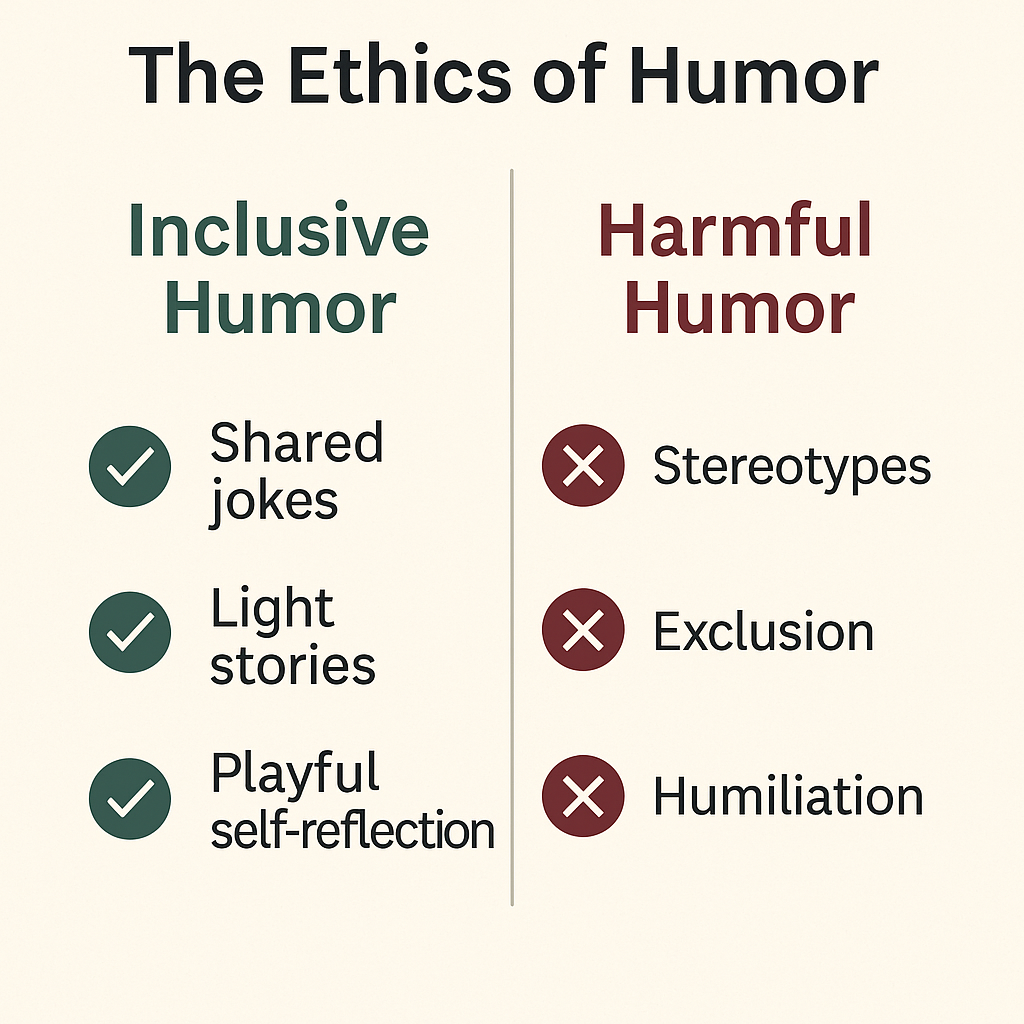
Image Long Description
- Shared jokes
- Light stories
- Playful self-reflection
- Stereotypes
- Exclusion
- Humiliation
Text Transcription
- Shared jokes
- Light stories
- Playful self-reflection
- Stereotypes
- Exclusion
- Humiliation
Roasts
The roast speech is a very interesting and peculiar speech because it is designed to both praise and good-naturedly insult a person being honored. Generally, roasts are given at the conclusion of a banquet in honor of someone’s life achievements. The television station Comedy Central has been conducting roasts of various celebrities for a few years.
A good example is Stephen Colbert’s roast of President George W. Bush, which you can view online. In this clip, you’ll notice that the humor doesn’t pull any punches. The goal of the roast is to both praise and insult in a good-natured manner. You’ll also see that the roaster, in this case Stephen Colbert, is standing behind a lectern while the roastee, President George W. Bush, is clearly on display for the audience to see, and periodically you’ll see the camera pan to President Bush to take in his reactions. Half the fun of a good roast is watching the roastee’s reactions during the roast, so it’s important to have the roastee clearly visible by the audience.
How does one prepare a roast? First, you want to really think about the person who is being roasted. Do they have any strange habits or amusing stories in their past that you can discuss? When you think through these things you want to make sure that you cross anything off your list that is truly private information or will really hurt the person. The goal of a roast is to poke at them, not massacre them. Second, when selecting which aspects to poke fun at, you need to make sure that the items you choose are widely known by your audience. Roasts work when the majority of people in the audience can relate to the jokes being made. If you have an inside joke with the roastee, bringing it up during roast may be great fun for the two of you, but it will leave your audience unimpressed. Lastly, end on a positive note. While the jokes are definitely the fun part of a roast, you should leave the roastee knowing that you truly do care about and appreciate the person.
Eulogies
A eulogy is a speech given in honor of someone who has died. (Don’t confuse “eulogy” with “elegy,” a poem or song of mourning.) Unless you are a minister, priest, rabbi, imam, or other form of religious leader, you’ll probably not deliver too many eulogies in your lifetime. However, when the time comes to deliver a eulogy, it’s good to know what you’re doing and to adequately prepare your remarks. Then-Senator Barack Obama’s eulogy at the funeral of civil rights activist Rosa Parks in November of 2005 is an example of a well-written eulogy, delivered well (you can find it online on YouTube). In this eulogy, Senator Obama emphasizes Rosa Parks’ importance and legacy in American history.
When preparing a eulogy, first you need to know as much information about the deceased as possible. The more information you have about the person, the more personal you can make the eulogy. While you can rely on your own information if you were close to the deceased, it is always a good idea to ask friends and relatives of the deceased for their memories, as these may add important facets that may not have occurred to you. Of course, if you were not very close to the deceased, you will need to ask friends and family for information. Second, although eulogies are delivered on the serious and sad occasion of a funeral or memorial service for the deceased, it is very helpful to look for at least one point to be lighter or humorous. In some cultures, in fact, the friends and family attending the funeral will expect the eulogy to be entertaining and amusing. While eulogies are not roasts, one goal of the humor or lighter aspects of a eulogy is to relieve the tension that is created by the serious nature of the occasion. Lastly, remember to tell the deceased’s story. Tell the audience about who this person was and what the person stood for in life. The more personal you can make a eulogy, the more touching it will be for the deceased’s friends and families. The eulogy should remind the audience to celebrate the person’s life as well as mourn their death.
Excellent eulogies you can view online and read their manuscripts include Ted Kennedy Jr.’s eulogy of his father, Senator Ted Kennedy, Reagan’s eulogy of the Challenger astronauts, and Princess Diana’s eulogy delivered by her brother, Charles Spencer. There are two TED talks that highlight the significance and functions of eulogies: Andrea Driessen’s “Eulogies for the Living,” and Susan Ann Koenig’s “The Energy of Eulogy.”
Speeches of Farewell
A speech of farewell allows someone to say good-bye to one part of his or her life as he or she is moving on to the next part of life. Maybe you’ve accepted a new job or you’re graduating from college and entering the workforce. Whatever the case may be, periods of transition are often marked by speeches of farewell. One example is Derek Jeter’s 2008 speech saying farewell to Yankee Stadium, built in 1923, before the New York Yankees moved to the new stadium that opened in 2009. In this speech, Derek Jeter is not only saying good-bye to Yankee Stadium but also thanking the fans for their continued support.
When preparing a speech of farewell, the goal should be to thank the people in your current position and let them know how much you appreciate them. In Derek Jeter’s speech, he starts by talking about the history of the 1923 Yankee Stadium and then thanks the fans for their support. Second, you want to express to your audience how much the experience has meant to you. A farewell speech is a time to commemorate and think about the positive experiences you’ve had. As such, you should avoid negativity during this speech. Lastly, you want to make sure that you end on a high note. Derek Jeter concludes his speech by saying, “On behalf of this entire organization, we just want to take this moment to salute you, the greatest fans in the world!” at which point Jeter and the other players take off their ball caps and hold them up toward the audience.
Inspirational Speaking
The goal of an inspirational speech is to elicit or arouse an emotional state within an audience. In Section 18.2.1 “Ceremonial Speaking”, we looked at ceremonial speeches. Although some inspirational speeches are sometimes tied to ceremonial occasions, there are also other speaking contexts that call for inspirational speeches. For our purposes, we are going to look at two types of inspirational speeches: speeches to ensure goodwill and speeches for commencements.
Speeches to Ensure Goodwill
Goodwill is an intangible asset that concerns the reputation of an individual or organization. Speeches of goodwill are often given in an attempt to get audience members to view the person or organization more favorably. Although speeches of goodwill are clearly persuasive, they try not to be obvious about the persuasive intent and are often delivered as information-giving speeches that focus on an individual or organization’s positive attributes. There are three basic types of speeches of goodwill: public relations, justification, and apology.
Speeches for Public Relations
In a public relations speech, the speaker is speaking to enhance one’s own image or the image of his or her organization. You can almost think of these speeches as cheerleading speeches because the ultimate goal is to get people to like the speaker and what he or she represents. It is imperative to balance the public interest and the private interest in these situations. If your organization has truly erred, an apology is necessary and should be accompanied by corrective actions. As an additional critical point, the head of an organization should address the situation and often visit the site. Presidents, for example, are expected to address the nation during crises and visit the scene. One such situation is the 2010 oil spill in the Gulf of Mexico. The CEO of British Petroleum spoke to reporters about his organization’s actions, emphasizing their efforts to correct the problem.
Speeches of Justification
The second common speech of goodwill is the speech of justification, which is given when someone attempts to defend why certain actions were taken or will be taken. In these speeches, speakers have already enacted (or decided to enact) some kind of behavior and are now attempting to justify the behavior’s appropriateness. Presidential speeches often illustrate this type of speech. For example, President Bill Clinton discussed his decision to bomb key Iraqi targets after uncovering a plot to assassinate former President George H. W. Bush and outlined his reasons for bombing Iraq to the American people and the world. Sincerity is key; rationalizing should be avoided.
Speeches of Apology
The final speech of goodwill is the speech of apology. Whether our more ever-present media exposes more faux-pas or people are truly behaving more reprehensibly, these speeches have become more commonplace. In fact, the speech of apology has quickly become fodder for humor as well. One such speech was delivered by professional golfer Tiger Woods.
When you need to make an apology speech, there are three elements that you need to include: be honest and take responsibility, say you’re sorry, and offer restitution. First, a speaker needs to be honest and admit to doing something wrong. The worst apology speeches are those in which the individual tries to sidestep the wrongdoing. Even if you believe you didn’t do anything wrong, it is often best to take responsibility from a public perception perspective. Second, say that you are sorry. People need to know that you are remorseful. One of the problems many experts saw with Tiger Woods’s speech is that he didn’t seem remorseful. While the words coming out of his mouth are appropriate, he looks like a robot forced to read from a manuscript written by his press agent. Remember that nonverbal communication is the primary channel for emotions, and your facial expressions and tone of voice need to match the substance of your speech. Lastly, you need to offer restitution. Restitution can come in the form of correcting your mistakes or a promise not to engage in such behavior in the future. People in society are very willing to forgive and forget when they are asked.
Speeches for Commencements
The second type of inspirational speech is the speech of commencement, which is designed to recognize and celebrate the achievements of a graduating class. Nearly all of us have sat through commencement speeches and you’ve heard good ones and bad ones. The good ones convey a meaningful message for the graduates and for the audience, and the bad ones are trite and commonplace or fail to address the occasion. One well-thought-out commencement speech was given by famed Harry Potter author J. K. Rowling at Harvard University in 2008, having the perfect balance of humor and inspiration which are two of the main ingredients of a great commencement speech. Henry Winkler’s Commencement speech at Georgetown in 2025 is a second great example.
If you’re ever asked to deliver a commencement speech, there are some key points to think through when deciding on your speech’s content.
If there is a specific theme for the graduation, make sure that your commencement speech addresses that theme. If there is no specific theme, come up with one for your speech. Some common commencement speech themes are commitment, competitiveness, competence, confidence, decision making, discipline, ethics, failure (and overcoming failure), faith, generosity, integrity, involvement, leadership, learning, persistence, personal improvement, professionalism, reality, responsibility, and self-respect. The theme of Winkler’s commencement address is “All Things are Possible.”
Talk about your life and how graduates can learn from your experiences to avoid pitfalls or take advantage of life. How can your life inspire graduates in their future endeavors?
Make the speech humorous. Commencement speeches should be entertaining and make the audience laugh.
Be brief! Nothing is more painful than a commencement speaker who drones on and on. Remember, the graduates are there to get their diplomas; their families are there to watch the graduates walk across the stage.
Remember, while you may be the speaker, you’ve been asked to impart wisdom and advice for the people graduating and moving on with their lives, so keep it focused on them.
Place the commencement speech into the broader context of the graduates’ lives. Show the graduates how the advice and wisdom you are offering can be used to make their own lives better.
Remember to avoid trite themes and overused expressions. A speech is effective to the extent that it stimulates thought, and thus it should present information from a fresh perspective.
Overall, it’s important to make sure that you have fun when delivering a commencement speech. Remember, it’s a huge honor and responsibility to be asked to deliver a commencement speech, so take the time to really think through and prepare your speech.
Try It: AI Ceremonial Speeches: Tone & Audience Adaptation
Activity Introduction: Ceremonial speeches depend on tone and audience adaptation. This exercise shows how the same theme can shift dramatically across contexts
Wrap Up: Notice how AI adjusted tone, language, and focus, but also where it fell flat. Beyond the podium, your voice makes ceremonial moments meaningful.