
3.2 What is Communication
Stephanie Morrow
Learning Objectives
- Explain the nature of communication apprehension.
- List the physiological symptoms of communication apprehension
- Identify different misconceptions about communication anxiety
“Speech is a mirror of the soul,” commented Publilius Syrus, a popular writer in 42 BCE (Bartlett, 1919). Other people come to know who we are through our words. Many different social situations, ranging from job interviews to dating to public speaking, can make us feel uncomfortable as we anticipate that we will be evaluated and judged by others. How well we communicate is intimately connected to our self-image, and the process of revealing ourselves to the evaluation of others can be threatening whether we are meeting new acquaintances, participating in group discussions, or speaking in front of an audience.
Definition of Communication Apprehension
According to James McCroskey, communication apprehension is the broad term that refers to an individual’s “fear or anxiety associated with either real or anticipated communication with another person or persons” (McCroskey, 2001). At its heart, communication apprehension is a psychological response to evaluation. This psychological response, however, quickly becomes physical as our body responds to the threat the mind perceives. Our bodies cannot distinguish between psychological and physical threats, so we react as though we were facing a Mack truck barreling in our direction. The body’s circulatory and adrenal systems shift into overdrive, preparing us to function at maximum physical efficiency—the “flight or fight” or freeze response (Sapolsky, 2004). Yet instead of running away or fighting, all we need to do is stand and talk, but that doesn’t help with freezing up in front of your audience. In fact, if we cannot fight or flee we often freeze up because we are overwhelmed by stimuli and unable to process information or keep a clear mind. This often happens when it comes to communication apprehension because our physical responses are often not well adapted to the nature of the threat we face. This is why we tend to “freeze up” in front of an audience, as the excess energy created by our body can make it harder for us to be effective public speakers. But because communication apprehension is rooted in our minds, if we understand more about the nature of the body’s responses to stress, we can better develop mechanisms for managing the body’s misguided attempts to help us cope with our fear of social judgment.
Physiological Symptoms of Communication Apprehension
There are a number of physical sensations associated with communication apprehension. We might notice our heart pounding or our hands feeling clammy. We may break out in a sweat. We may have “stomach butterflies” or even feel nauseated. Our hands and legs might start to shake, or we may begin to pace nervously. Our voices may quiver, and we may have a “dry mouth” sensation that makes it difficult to articulate even simple words. Breathing becomes more rapid and, in extreme cases, we might feel dizzy or light-headed. Anxiety about communicating is profoundly disconcerting because we feel powerless to control our bodies. Furthermore, we may become so anxious that we fear we will forget our name, much less remember the main points of the speech we are about to deliver.
The physiological changes produced in the body at critical moments are designed to contribute to the efficient use of muscles and expand available energy. Circulation and breathing become more rapid so that additional oxygen can reach the muscles. Increased circulation causes us to sweat. Adrenaline rushes through our body, instructing the body to speed up its movements. If we stay immobile behind a lectern, this hormonal urge to speed up may produce shaking and trembling. Additionally, digestive processes are inhibited so we will not lapse into the relaxed, sleepy state that is typical after eating. Instead of feeling sleepy, we feel butterflies in the pit of our stomach. By understanding what is happening to our bodies in response to the stress of public speaking, we can better cope with these reactions and channel them in constructive directions.
Figure 3.1: The Cycle of Communication Anxiety
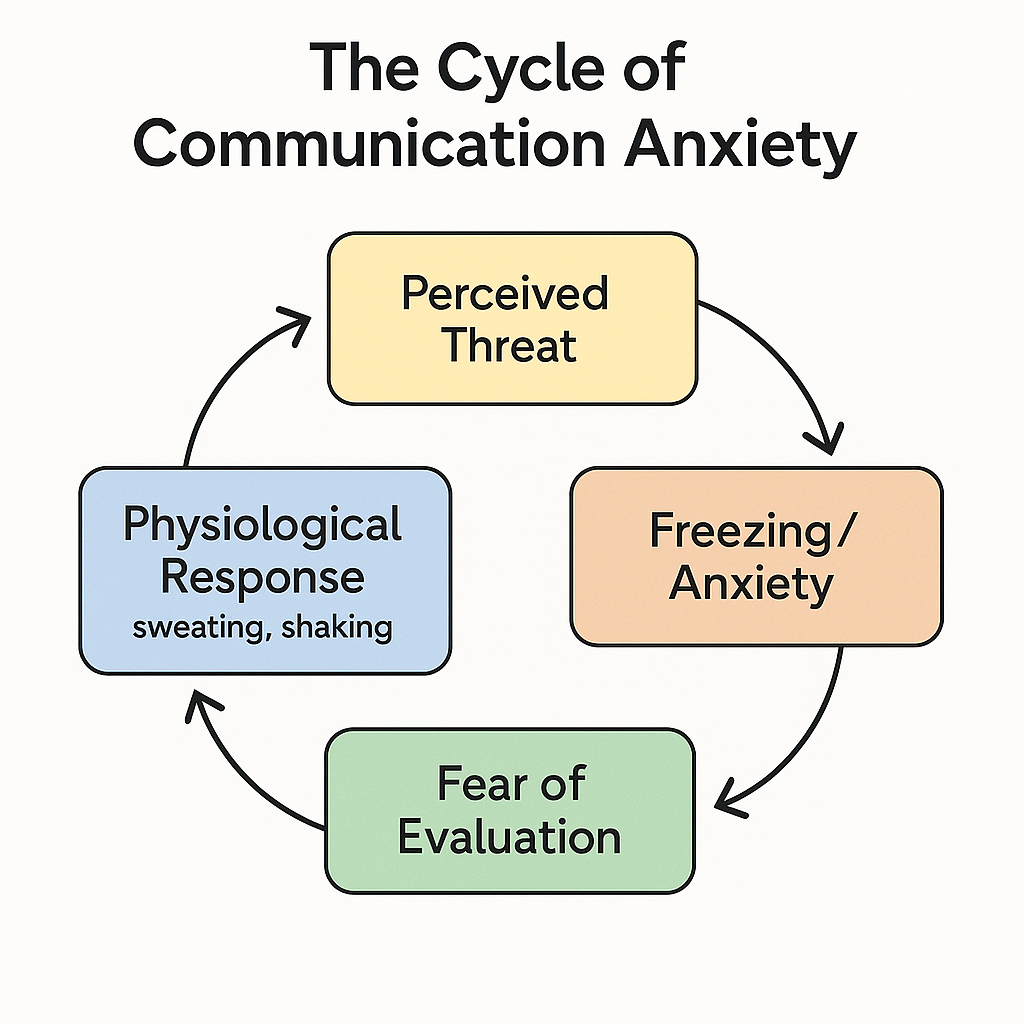
Image Long Description
This diagram illustrates a continuous cycle titled “The Cycle of Communication Anxiety.” It uses a circular flowchart with arrows connecting four labeled boxes, each representing a stage in the anxiety cycle related to communication:
- Perceived Threat – The individual identifies a situation as threatening.
- Freezing / Anxiety – The threat triggers a state of mental freezing or heightened anxiety.
- Fear of Evaluation – Anxiety leads to fear of being judged or evaluated by others.
- Physiological Response – Physical symptoms such as sweating and shaking emerge as a result.
The final arrow loops from “Physiological Response” back to “Perceived Threat,” emphasizing the repetitive, self-reinforcing nature of the cycle.
Each stage is color-coded:
- Perceived Threat: light yellow
- Freezing/Anxiety: peach
- Fear of Evaluation: light green
- Physiological Response: light blue (includes subtext: “sweating, shaking”)
Text Transcription
Title: The Cycle of Communication Anxiety
Cycle Stages (clockwise):
- Perceived Threat
- Freezing / Anxiety
- Fear of Evaluation
- Physiological Response
sweating, shaking
 AI Insight
AI voice analysis tools can detect filler words, pace, and pitch—often before you’re even aware of them. Use these patterns to see what your anxiety “sounds like” and where to adjust.
Any conscious emotional state such as anxiety or excitement consists of two components: a primary reaction of the central nervous system and an intellectual interpretation of these physiological responses. The physiological state we label as communication anxiety does not differ from ones we label rage or excitement. Even experienced, effective speakers and performers experience some communication apprehension. What differs is the mental label that we put on the experience. Effective speakers have learned to channel their body’s reactions, using the energy released by these physiological reactions to create animation and stage presence.
Myths about Communication Apprehension
Before we can discuss tips on how to overcome communication apprehension, we must dispel some very common myths. A wealth of conventional wisdom surrounds the discomfort of speaking anxiety, as it surrounds almost any phenomenon that makes us uncomfortable. Most of this “folk” knowledge misleads us, directing our attention away from effective strategies for thinking about and coping with anxiety reactions.
- MYTH: People who suffer from speaking anxiety are neurotic. As we have explained, speaking anxiety is a normal reaction. Good speakers can get nervous just as poor speakers do. Winston Churchill, for example, would get physically ill before major speeches in Parliament. Yet he rallied the British people in a time of crisis. Many people, even the most professional performers, experience anxiety about communicating. Such a widespread problem, Dr. Joyce Brothers contends, “cannot be attributed to deep-seated neuroses” (Brothers, 2008).
- MYTH: Telling a joke or two is always a good way to begin a speech. Humor is some of the toughest material to deliver effectively because it requires an exquisite sense of timing. Nothing is worse than waiting for a laugh that does not come. Moreover, one person’s joke is another person’s slander. It is extremely easy to offend when using humor. The same material can play very differently with different audiences. For these reasons, it is not a good idea to start with a joke, particularly if it is not well related to your topic. Humor is just too unpredictable and difficult for many novice speakers. If you insist on using humor, make sure the “joke” is on you, not on someone else. Another tip is never to pause and wait for a laugh that may not come. If the audience catches the joke, fine. If not, you’re not left standing in awkward silence waiting for a reaction.
- MYTH: Imagine the audience is naked. This tip just plain doesn’t work because imagining the audience naked will do nothing to calm your nerves. As Malcolm Kushner noted, “There are some folks in the audience I wouldn’t want to see naked—especially if I’m trying not to be frightened” (Kushner, 1999). The audience is not some abstract image in your mind. It consists of real individuals who you can connect with through your material. To “imagine” the audience is to misdirect your focus from the real people in front of you to an “imagined” group. What we imagine is usually more threatening than the reality that we face.
- MYTH: Any mistake means that you have “blown it.” We all make mistakes. What matters is not whether we make a mistake but how well we recover. One of the authors of this book was giving a speech and wanted to thank a former student in the audience. Instead of saying “former student,” she said, “former friend.” After the audience stopped laughing, the speaker remarked, “Well, I guess she’ll be a former friend now!”—which got more laughter from the audience. A speech does not have to be perfect. You just have to make an effort to relate to the audience naturally and be willing to accept your mistakes.
- MYTH: Avoid speaking anxiety by writing your speech out word for word and memorizing it. Memorizing your speech word for word will likely make your apprehension worse rather than better. Instead of remembering three to five main points and subpoints, you will try to commit to memory more than a thousand bits of data. If you forget a point, the only way to get back on track is to start from the beginning. You are inviting your mind to go blank by overloading it with details. In addition, audiences do not like to listen to “canned,” or memorized, material. Your delivery is likely to suffer if you memorize. Audiences appreciate speakers who talk naturally to them rather than recite a written script.
- MYTH: Audiences are out to get you. With only a few exceptions, which we will talk about in Section 3.2 “All Anxiety Is Not the Same: Sources of Communication Apprehension”, the natural state of audiences is empathy, not antipathy. Most face-to-face audiences are interested in your material, not in your image. Watching someone who is anxious tends to make audience members anxious themselves. Particularly in public speaking classes, audiences want to see you succeed. They know that they will soon be in your shoes and they identify with you, most likely hoping you’ll succeed and give them ideas for how to make their own speeches better. If you establish direct eye contact with real individuals in your audience, you will see them respond to what you are saying, and this response lets you know that you are succeeding.
- MYTH: You will look to the audience as nervous as you feel. Empirical research has shown that audiences do not perceive the level of nervousness that speakers report feeling (Clevenger, 1959). Most listeners judge speakers as less anxious than the speakers rate themselves. In other words, the audience is not likely to perceive accurately the level of anxiety you might be experiencing. Some of the most effective speakers will return to their seats after their speech and exclaim they were so nervous. Listeners will respond, “You didn’t look nervous.” Audiences do not necessarily perceive our fears. Consequently, don’t apologize for your nerves. There is a good chance the audience will not notice if you do not point it out to them.
- MYTH? A little nervousness helps you give a better speech. This “myth” is true! Nervousness is NORMAL, as professional speakers, actors, and other performers consistently rely on the heightened arousal of nervousness to channel extra energy into their performance. People would much rather listen to a speaker who is alert and enthusiastic than one who is relaxed to the point of boredom. Many professional speakers say that the day they stop feeling nervous is the day they should stop speaking in public. The goal is to control those nerves and channel them into your presentation. In fact, nervousness is not a sign of being unprepared or that you won’t succeed, but is a sign that you CARE about the presentation. So being nervous isn’t bad or inappropriate – it means you care.
AI Insight
Many AI-generated speaking tips oversimplify (“just imagine success!”). Cross-check advice from AI against evidence-based strategies to avoid reinforcing myths.
Try It: Myths vs. Facts about Communication Apprehension
Activity Introduction: Many people have misconceptions about public speaking anxiety. This activity will help you separate common myths from facts so you can better understand communication apprehension.
Activity Instructions: Drag each statement to the correct category: Myth or Fact.
Wrap Up: By identifying what is true and what is misleading, you’ll be better prepared to recognize effective strategies for managing anxiety and avoid advice that doesn’t work.