
3.4 Reducing Communication Apprehension
Stephanie Morrow
Learning Objectives
- Explain steps for managing anxiety in the speech preparation process
- Identify effective techniques for coping with anxiety during delivery.
- Explore how technology tools can help mitigate public speaking anxiety
- Recognize the general option available for stress reduction and anxiety management
Experiencing some nervousness about public speaking is normal. The energy created by this physiological response can be functional if you harness it as a resource for more effective public speaking. In this section, we suggest a number of steps that you can take to channel your stage fright into excitement and animation. We will begin with specific speech-related considerations and then briefly examine some of the more general anxiety management options available.
Speech-Related Considerations
Communication apprehension does not necessarily remain constant throughout all the stages of speech preparation and delivery. One group of researchers studied the ebb and flow of anxiety levels at four stages in the delivery of a speech. They compared indicators of physiological stress at different milestones in the process:
- anticipation (the minute prior to starting the speech),
- confrontation (the first minute of the speech),
- adaptation (the last minute of the speech), and
- release (the minute immediately following the end of the speech) (Witt, et. al., 2006).
These researchers found that anxiety typically peaked at the anticipatory stage. In other words, we are likely to be most anxious right before we get up to speak. As we progress through our speech, our level of anxiety is likely to decline. Planning your speech to incorporate techniques for managing your nervousness at different times will help you decrease the overall level of stress you experience. We also offer a number of suggestions for managing your reactions while you are delivering your speech. Then we will give you a number of AI technology tools that you can use to practice our strategies in front of virtual audiences that mirror your real-life speaking situation.
Figure 3.3: Anxiety Across the Speaking Process
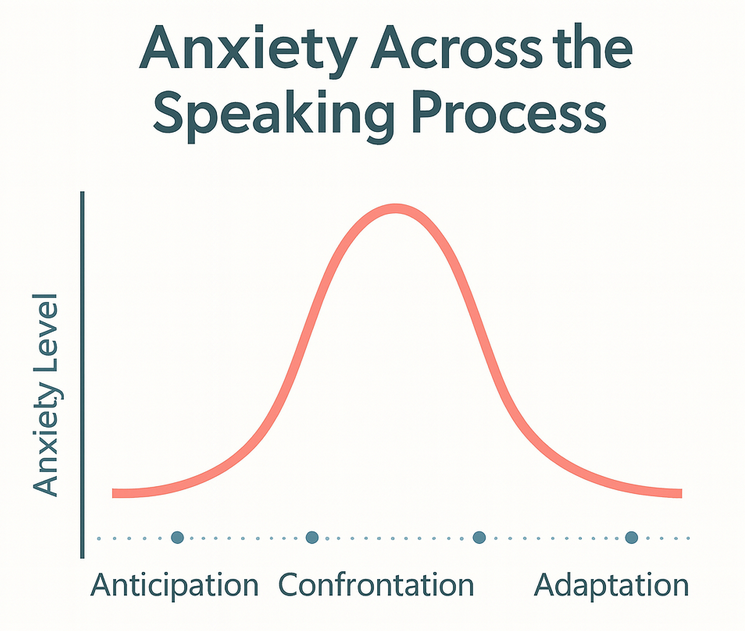
Image Long Description
This image is a simple line graph titled “Anxiety Across the Speaking Process.” It illustrates how anxiety levels change over three phases of public speaking:
Anticipation: Anxiety begins low but starts to increase.
Confrontation: Anxiety peaks during the moment of speaking.
Adaptation: Anxiety decreases as the speaker continues.
The graph features a bell-shaped curve representing anxiety levels on the vertical axis (labeled “Anxiety Level”) and the three stages—Anticipation, Confrontation, and Adaptation—on the horizontal axis.
The line begins low, curves upward steeply during anticipation, peaks at confrontation, and gradually curves downward through adaptation.
Text Transcription
Title: Anxiety Across the Speaking Process
Y-axis label (vertical): Anxiety Level
X-axis labels (horizontal): Anticipation, Confrontation, Adaptation
Think Positively
As we mentioned earlier, communication apprehension begins in the mind as a psychological response. This underscores the importance of a speaker’s psychological attitude toward speaking. To prepare yourself mentally for a successful speaking experience, we recommend using a technique called cognitive restructuring. Cognitive restructuring is simply changing how you label the physiological responses you will experience. Rather than thinking of public speaking as a dreaded obligation, make a conscious decision to consider it an exciting opportunity. The first audience member that you have to convince is yourself, by deliberately replacing negative thoughts with positive ones. If you say something to yourself often enough, you will gradually come to believe it.
We also suggest practicing what communication scholars Metcalfe, Beebe, and Beebe call positive self-talk rather than negative self-talk (Metcalfe, 1994; Beebe, 2000). If you find yourself thinking, “I’m going to forget everything when I get to the front of the room,” turn that negative message around to a positive one. Tell yourself, “I have notes to remind me what comes next, and the audience won’t know if I don’t cover everything in the order I planned.” The idea is to dispute your negative thoughts and replace them with positive ones, even if you think you are “conning” yourself. By monitoring how you talk about yourself, you can unlearn old patterns and change the ways you think about things that produce anxiety.
Reducing Anxiety through Preparation
 Beyond the Podium Insight
Preparation isn’t just about control—it’s about respect. Beyond the podium, preparation signals to others that you value their time and attention.
As we have said earlier in this chapter, uncertainty makes for greater anxiety. Nothing is more frightening than facing the unknown. Although no one can see into the future and predict everything that will happen during a speech, every speaker can and should prepare so that the “unknowns” of the speech event are kept to a minimum. You can do this by gaining as much knowledge as possible about whom you will be addressing, what you will say, how you will say it, and where the speech will take place.
Analyze Your Audience
 AI Insight
Virtual reality tools like can let you practice in simulated environments, helping you desensitize to the actual stress of a live audience.
The audience that we imagine in our minds is almost always more threatening than the reality of the people sitting in front of us. The more information you have about the characteristics of your audience, the more you will be able to craft an effective message. Since your stage fright is likely to be at its highest in the beginning of your speech, it is helpful to open the speech with a technique to prompt an audience response. You might try posing a question, asking for a show of hands, or sharing a story that you know is relevant to your listeners’ experience. When you see the audience responding to you by nodding, smiling, or answering questions, you will have directed the focus of attention from yourself to the audience. Such responses indicate success; they are positively reinforcing, and thus reduce your nervousness.
Clearly Organize Your Ideas
Being prepared as a speaker means knowing the main points of your message so well that you can remember them even when you are feeling highly anxious, and the best way to learn those points is to create an outline for your speech. With a clear outline to follow, you will find it much easier to move from one point to the next without stumbling or getting lost.
A note of caution is in order: you do not want to react to the stress of speaking by writing and memorizing a manuscript. Your audience will usually be able to tell that you wrote your speech out verbatim, and they will tune out very quickly. You are setting yourself up for disaster if you try to memorize a written text because the pressure of having to remember all those particulars will be tremendous. Moreover, if you have a momentary memory lapse during a memorized speech, you may have a lot of trouble continuing without starting over at the beginning.
What you do want to prepare is a simple outline that reminds you of the progression of ideas in your speech. What is important is the order of your points, not the specifics of each sentence. It is perfectly fine if your speech varies in terms of specific language or examples each time you practice it.
It may be a good idea to reinforce this organization through visual aids. When it comes to managing anxiety, visual aids have the added benefit of taking attention off the speaker.
Adapt Your Language to the Oral Mode
Another reason not to write out your speech as a manuscript is that to speak effectively you want your language to be adapted to the oral, not the written, mode. You will find your speaking anxiety more manageable if you speak in the oral mode because it will help you to feel like you are having a conversation with friends rather than delivering a formal proclamation.
Appropriate oral style is more concrete and vivid than written style. Effective speaking relies on verbs rather than nouns, and the language is less complex. Long sentences may work well for novelists such as William Faulkner or James Joyce, where readers can go back and reread passages two, three, or even seven or eight times. Your listeners, though, cannot “rewind” you in order to catch ideas they miss the first time through.
Don’t be afraid to use personal pronouns freely, frequently saying “I” and “me”—or better yet, “us” and “we.” Personal pronouns are much more effective in speaking than language constructions, such as the following “this author,” because they help you to build a connection with your audience. Another oral technique is to build audience questions into your speech. Rhetorical questions, questions that do not require a verbal answer, invite the audience to participate with your material by thinking about the implications of the question and how it might be answered. If you are graphic and concrete in your language selection, your audience is more likely to listen attentively. You will be able to see the audience listening, and this feedback will help to reduce your anxiety.
Practice in Conditions Similar to Those You Will Face When Speaking
It is not enough to practice your speech silently in your head. To reduce anxiety and increase the likelihood of a successful performance, you need to practice out loud in a situation similar to the one you will face when actually performing your speech. Practice delivering your speech out loud while standing on your feet. If you make a mistake, do not stop to correct it but continue all the way through your speech; that is what you will have to do when you are in front of the audience.
If possible, practice in the actual room where you will be giving your speech. Not only will you have a better sense of what it will feel like to actually speak, but you may also have the chance to practice using presentation aids and potentially avoid distractions and glitches like incompatible computers, blown projector bulbs, or sunlight glaring in your eyes.
Two very useful tools for anxiety-reducing practice are a clock and a mirror. Use the clock to time your speech, being aware that most novice speakers speak too fast, not too slowly. By ensuring that you are within the time guidelines, you will eliminate the embarrassment of having to cut your remarks short because you’ve run out of time or of not having enough to say to fulfill the assignment. Use the mirror to gauge how well you are maintaining eye contact with your audience; it will allow you to check that you are looking up from your notes. It will also help you build the habit of using appropriate facial expressions to convey the emotions in your speech. While you might feel a little absurd practicing your speech out loud in front of a mirror, the practice that you do before your speech can make you much less anxious when it comes time to face the audience.
Figure 3.4 Practical Strategies for Managing Speaking Anxiety
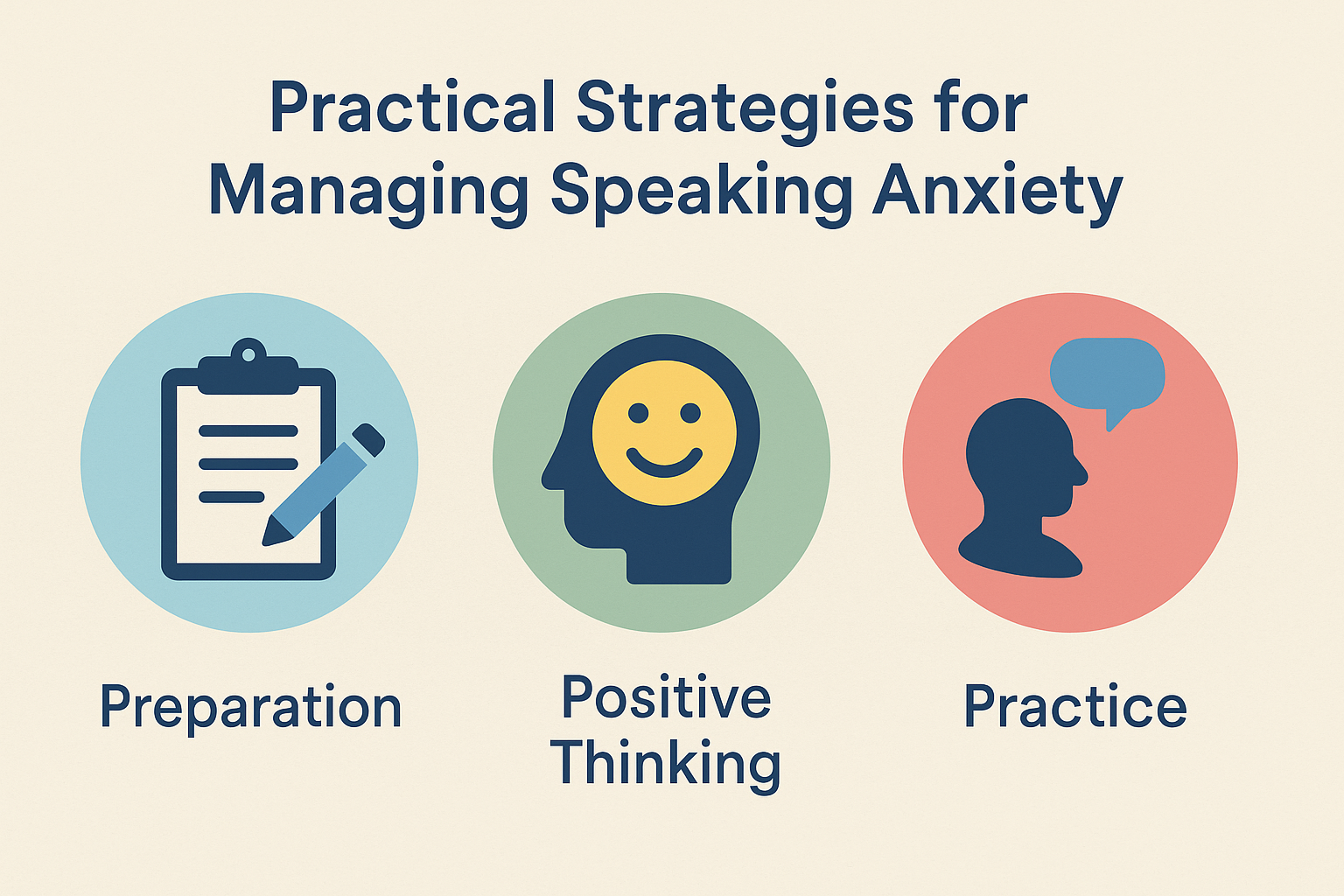
Image Long Description
Title: Anxiety Strategies
Main node in the center, with six connected strategy bubbles:
- 5-4-3-2-1 Grounding
- Notice 5 things you can see
- Notice 4 things you can feel
- Notice 3 things you can hear
- Notice 2 things you can smell
- Notice 1 thing you can taste
- Breathing Exercises
- Take slow, deep breaths
- Focus on inhale and exhale rhythm
- Self-Care Activities
- Exercise or movement
- Journaling or writing
- Creative outlets such as art or music
- Positive Affirmations
- Repeat calming or reassuring statements
- Use “I can handle this” type phrases
- Mindfulness and Meditation
- Focus attention on the present moment
- Practice meditation or guided awareness
- Reach Out for Support
- Talk to friends or family
- Seek professional help if needed
Design Elements
- Calming pastel background in teal, yellow, and peach tones.
- Strategies shown in circular “bubble” shapes branching from the center title.
Text Transcription
Title: Anxiety Strategies
- 5-4-3-2-1 Grounding
- Breathing exercises
- Self-care activities
- Positive affirmations
- Mindfulness and meditation
- Reach out for support
Using AI to Mirror Your Speaking Conditions
Can AI help you with your public speaking anxiety? Undoubtedly, yes! You can use AI to practice in conditions similar to those you will face when speaking so that you are prepared for the audience and situation before speech day. For example, a Reddit user commented on how he had horrible social anxiety – he even walked off the stage in the middle of giving a speech at a wedding! After researching beta blockers he found a much more natural solution: AI.
So I spent the week using this AI tool that basically lets you have a live conversation with someone in a customized scenario, so I customized my scenario to a public speech where the audience gives feedback, and after each attempt it would give me customized feedback to improve on. A big part of it for me was just being able to rehearse in a realistic, lifelike scenario really helped my confidence. So yesterday I just delivered the best public speech of my life, all thanks to this AI tool. Just wanted to share my success!
This is one success story of many that illustrates how can AI help you with your own communication apprehension. This is because when you are practicing your speech at home, you are missing one important component. You are not addressing what is causing your communication apprehension in the first place, which is the apprehension of speaking in front of an audience. There is a big difference between presenting to yourself in front of a mirror and practicing in front of people. AI can help fix that.
Overcoming public speaking anxiety requires both time and practice, but there are several other strategies you can incorporate into your routine to get over this common fear. This is because AI gives you something you will not get from a human audience: judgment-free feedback. Most if not all college students cannot afford a professional speaker coach, but luckily AI gives you the next best thing (usually at a low price, or even free!) (Puri, 2023).
Today’s AI programs can generate human-like content and then respond to specific situations (like giving a speech in a classroom). Simply put, using AI can help you become a better communicator, in the classroom and in life, through private, judgment-free speech coaching in real time. Not only does AI give you a virtual reality practice environment and audience-specific content, but also a personal analysis of your speech patterns and then suggestions for improvement (Puri, 2023)
Yes, AI can be your own personal practice coach, giving you tools to overcome your public speaking fears while analyzing your speech patterns and then offering personalized feedback in real time. All while giving you a safe place to combat your public speaking anxiety. Here are some more benefits of using AI to help with your public speaking anxiety:
- Audience engagement: If you have dealt with communication apprehension and public speaking anxiety, you know that standing in front of an audience can feel overwhelming and uncontrollable. This is why the main benefit of using AI to combat public speaking anxiety is that you can use its tools to present in front of a virtual audience. This allows you to immerse yourself into a “real life” speaking situation and then use AI’s analysis and feedback to tryout different speaking styles, language, and vocals. This can boost your confidence considerably before you are graded in front of a live audience since you are essentially experiencing the sensation of presenting to your audience.
- A no-pressure, judgment free zone: Practice is essential to becoming a better public speaker and reducing communication apprehension. Yet, even practicing in front of your parents, siblings, roommates, or pets could bring on cold sweat inducing anxiety. Luckily, AI gives you the time needed to practice your speech and different calming strategies without the pressure of presenting in front of an actual human being.
- “Simulated” context and feedback: You can use AI to develop your own specific context and situation, including the event and audience. That way, you can practice your speaking skills, language, breathing techniques, and anything else in as close to a real-life situation as possible. Then, the AI platform will collect these details for more informed feedback on your presentation. This goes beyond telling you to have more eye contact or gestures; instead, AI will evaluate both your presentation skills and the words you are using depending on the situation.
- “On-demand” access at a low cost: You can use AI on your schedule since you don’t need an actual audience. This means you can practice before or after class, on weekends, morning or night. And the cost of AI has come down dramatically, with some options even being totally free or offering a free trial (for your semester!).
Here are Six AI Tools to Combat Public Speaking Anxiety:
To do your best work and combat communication apprehension, you need to invest in the right tools. This is especially true when it comes to using AI to battle the anxiety that comes with standing and speaking in front of a live audience. AI tools allow students to practice their speeches in real time in front of a virtual audience. Then, they get personalized feedback to help them improve their public speaking, become more confident, and minimize the communication apprehension that arises during speeches.
It is important to know the differences between the many different AI tools out there today. Depending on what spurs your public speaking anxiety, you will need to choose an AI tool that best matches your specific needs. We touch on six AI tools below that have helped students in 2025, and some are free while others give free trials to help you better prepare for your upcoming speeches (Cook, 2025; Perelman, 2024).
Best for speech feedback – YOODLI: Yoodli was found to be the best for immediate analysis and feedback to help you overcome your public speaking anxiety and develop as a public speaker.
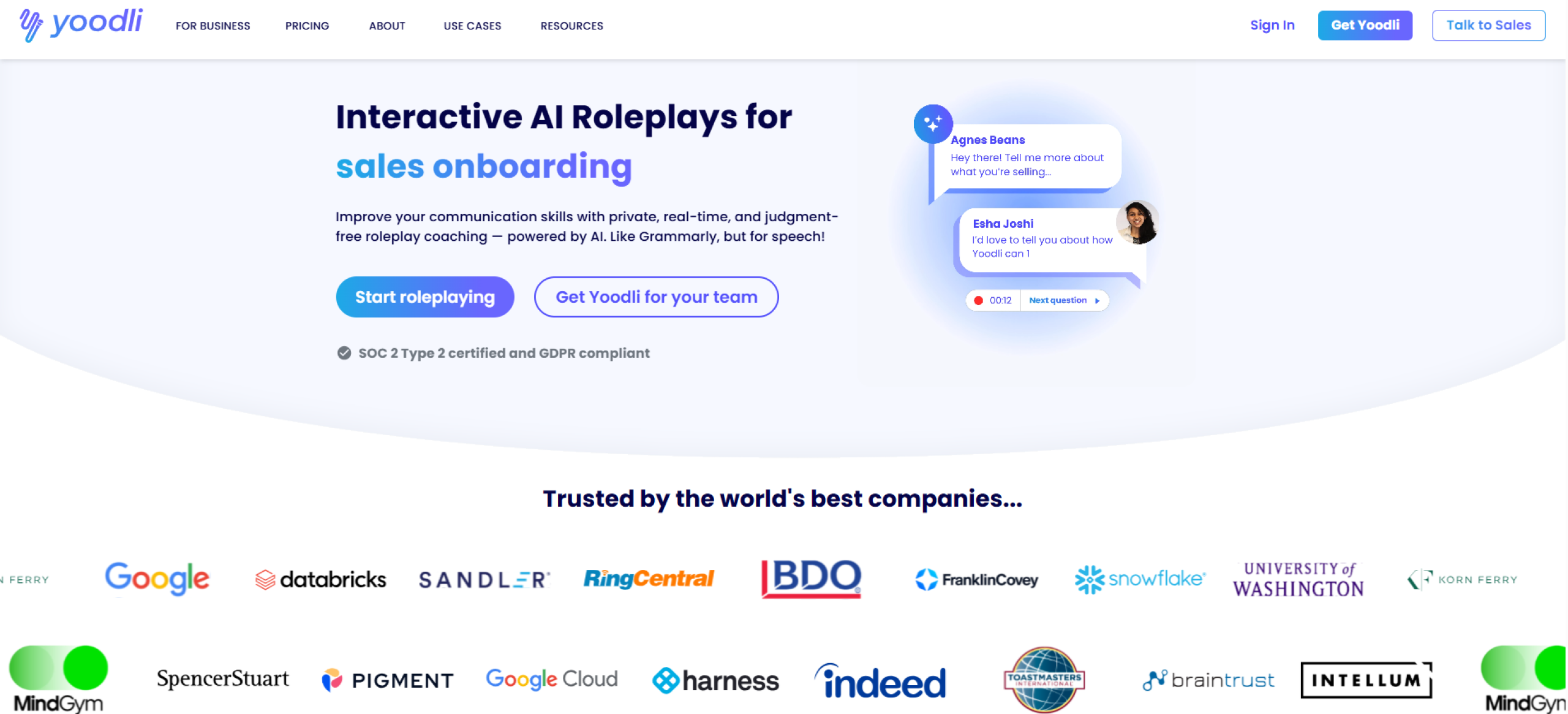
Image Long Description
This is a screenshot of the homepage for Yoodli, a company offering interactive AI roleplays for sales onboarding. The page promotes private, real-time, judgment-free roleplay coaching powered by AI, described as “like Grammarly, but for speech.”
Key Sections:
- Header (top navigation):
- Links: For Business, Pricing, About, Use Cases, Resources
- Buttons: Sign In, Get Yoodli!, Talk to Sales
- Main headline (centered):
- Interactive AI Roleplays for sales onboarding
- Subtext: Improve your communication skills with private, real-time, and judgment-free roleplay coaching — powered by AI. Like Grammarly, but for speech!
- Call-to-action buttons:
- Start roleplaying (blue button)
- Get Yoodli for your team (outlined button)
- Compliance note:
- SOC 2 Type 2 certified and GDPR compliant
- Chat bubble illustration:
- Left bubble (Agnes Beane): “Hey there! Tell me more about what you’re selling…”
- Right bubble (Echo Joshi): “I’d love to tell you about how Yoodli can…”
- Bottom section:
- Text: “Trusted by the world’s best companies…”
- Company logos shown in rows, including:
- Google, Databricks, Sandler, RingCentral, BDO, FranklinCovey, Snowflake, University of Washington, Korn Ferry, MindGym, SpencerStuart, PIGMENT, Google Cloud, Harness, Indeed, Toastmasters, Braintrust, INTELLUM
Text Transcription
Interactive AI Roleplays for sales onboarding
- Improve your communication skills with private, real-time, and judgment-free roleplay coaching — powered by AI. Like Grammarly, but for speech!
- [Buttons] Start roleplaying | Get Yoodli for your team
- SOC 2 Type 2 certified and GDPR compliant
- Chat example:
- Agnes Beane: “Hey there! Tell me more about what you’re selling…”
- Echo Joshi: “I’d love to tell you about how Yoodli can…”
- Trusted by the world’s best companies…
- [Logos] Google, Databricks, Sandler, RingCentral, BDO, FranklinCovey, Snowflake, University of Washington, Korn Ferry, MindGym, SpencerStuart, PIGMENT, Google Cloud, Harness, Indeed, Toastmasters, Braintrust, INTELLUM
This platform allows you to upload your speech recordings or present your speech live in a simulated environment and then gives you the best immediate analysis and feedback. You can use the communication apprehension tools discussed throughout this chapter in this simulated environment to help you develop as a public speaker.
Signing up for Yoodli is easy. You just enter your name, email address, and create a password. You will then be asked to do a 45-second “elevator pitch.” This video will be used as a baseline for your metrics and improvement. You’ll start getting in-depth, clear, detailed and actionable feedback about your public speaking, including your speaking style, content, filler words, pacing, eye contact, gestures, vocal elements, everything that is graded in class.
Best simulated audience for engagement – VIRTUAL ORATOR: If you are looking for a fully immersive experience to combat your communication apprehension in as close to real life as possible (and you already have a VR headset available), Virtual Orator is the best choice. This platform is a full AI simulator specifically designed to connect to your VR headset to replicate real-life speaking situations.
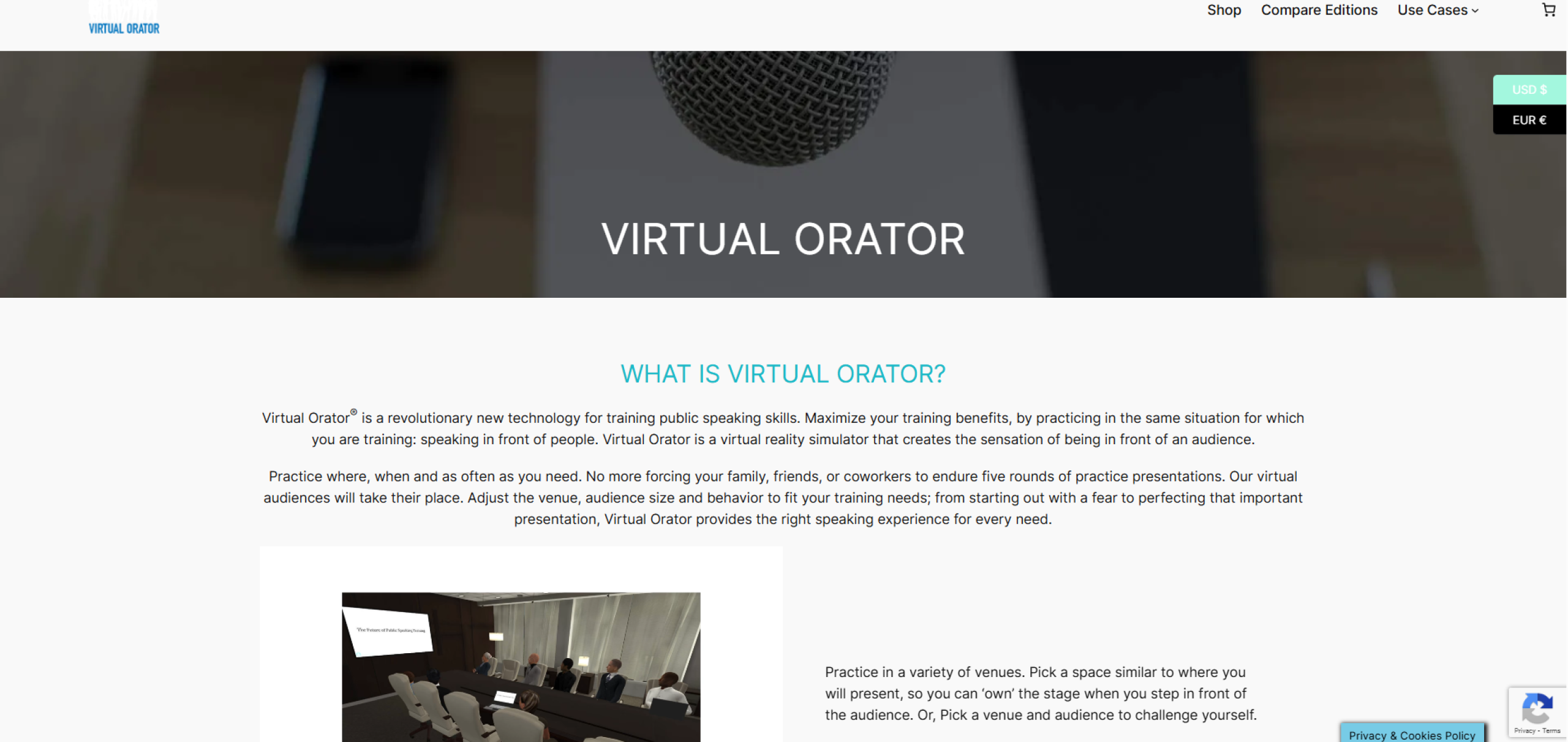
Image Long Description
This screenshot features the homepage of Virtual Orator, a virtual reality-based public speaking training tool. The layout includes:
Top Section:
- Large image of a microphone from above, centered over a blurred background with text overlay: “VIRTUAL ORATOR” in bold white font.
Headline & Intro Text:
- Title: “What is Virtual Orator?” in turquoise blue font.
- Body text (brief summary): Virtual Orator® is a revolutionary new technology for training public speaking skills. It creates the sensation of being in front of a real audience using virtual reality. The platform allows users to practice anytime, anywhere, with customizable venues, audience sizes, and behaviors to match their training needs.
Key Message:
- Emphasizes that there’s no need to rely on family or friends for practice—virtual audiences provide realistic feedback scenarios.
Bottom Section (Two-column layout):
- Left image: A virtual meeting room scene with digital avatars seated, simulating an audience watching a presentation.
- Right caption:
“Practice in a variety of venues. Pick a space similar to where you will present, so you can ‘own’ the stage…”
Top Navigation Links:
- Shop, Compare Editions, Use Cases
Currency Switcher:
- USD ↔ EUR toggle in the upper-right corner
Bottom Right:
- Cookie policy notice and ReCAPTCHA widget visible
Text Transcription
VIRTUAL ORATOR
What is Virtual Orator?
Virtual Orator® is a revolutionary new technology for training public speaking skills. Maximize your training benefits, by practicing in the same situation for which you are training: speaking in front of people. Virtual Orator is a virtual reality simulator that creates the sensation of being in front of an audience.
Practice where, when, and as often as you need. No more forcing your family, friends, or coworkers to endure five rounds of practice presentations. Our virtual audiences will take their place. Adjust the venue, audience size and behavior to fit your training needs; from starting out with a fear to perfecting that important presentation, Virtual Orator provides the right speaking experience for every need.
Practice in a variety of venues. Pick a space similar to where you will present, so you can ‘own’ the stage when you step in front of the audience. Or, pick a venue and audience to challenge yourself.
You simply create your account and then choose your settings – the venue, audience size, even audience behaviors. This is a very helpful immersive experience to practice public speaking anxiety tips and strategies because it gives the best audience engagement with a “human” audience. It also helps you battle both the audience and situational anxiety discussed earlier in the chapter. You can adjust the settings to fit your audience and situation needs and use its fully-integrated recording set up so you can record both the virtual setting and the presentation to rewatch later. If you already have a VR headset, this is a great AI tool to minimize or fully combat your public speaking anxiety.
Best for overall confidence building – ORAI: This AI platform may not have all the bells and whistles of Virtual Orator, but Orai is specifically designed to boost your confidence as a public speaker. This, in turn, will help minimize your communication apprehension.
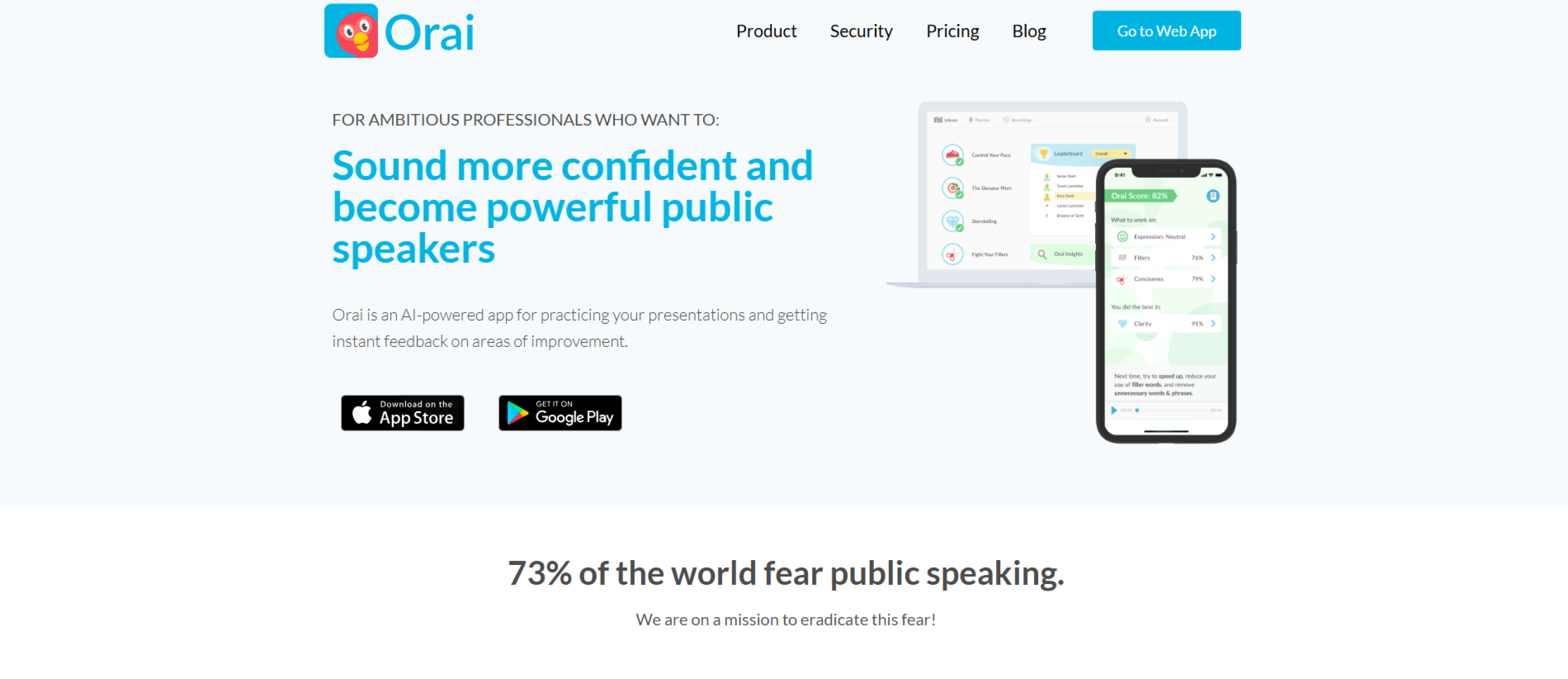
Image Long Description
This screenshot captures the homepage for Orai, a mobile and web app focused on building public speaking confidence through AI-powered feedback.
Top Section:
- Logo: Orai’s colorful circular logo with a speech bubble icon, next to the brand name “Orai”.
- Navigation bar:
Links include: Product, Security, Pricing, Blog, and a Go to Web App button (bright blue, top-right).
Main Heading:
- For ambitious professionals who want to:
- Large blue text: “Sound more confident and become powerful public speakers”
Supporting Text:
- Orai is an AI-powered app for practicing your presentations and getting instant feedback on areas of improvement.
App Download Buttons:
- Apple App Store button
- Google Play Store button
Device Previews:
- Laptop screen mockup showing the Orai dashboard interface
- Smartphone mockup with a sample speaking feedback screen
Bottom Section:
- Large bold statement:
“73% of the world fear public speaking.” - Subtext:
“We are on a mission to eradicate this fear!”
Text Transcription
Orai
For ambitious professionals who want to:
Sound more confident and become powerful public speakers
Orai is an AI-powered app for practicing your presentations and getting instant feedback on areas of improvement.
[App Store Button] [Google Play Button]
73% of the world fear public speaking.
We are on a mission to eradicate this fear!
Orai gives you personalized lessons designed to do one thing: improve your confidence. It helps you eradicate filler words, fix problems with pacing, pitch, and tone, and improve the clarity of your message. This is all done through fun, interactive daily lessons that will gradually push you to step outside of your comfort zone and improve your confidence as a public speaker.
Best language and vocabulary tool – GABBLE: This chapter already discussed the importance of adapting to oral versus written mode, yet many times communication apprehension arises when we stumble over words, replace pauses with filler words, or simply forget what we are supposed to say. Gabble is an AI tool for vocabulary enhancement; that is, it will analyze your word choices as a public speaker and then use real-time AI analysis for highly personalized feedback. This AI tool is perfect when it comes to adapting your speech to oral mode so that you sound confident and conversational in front of your audience.
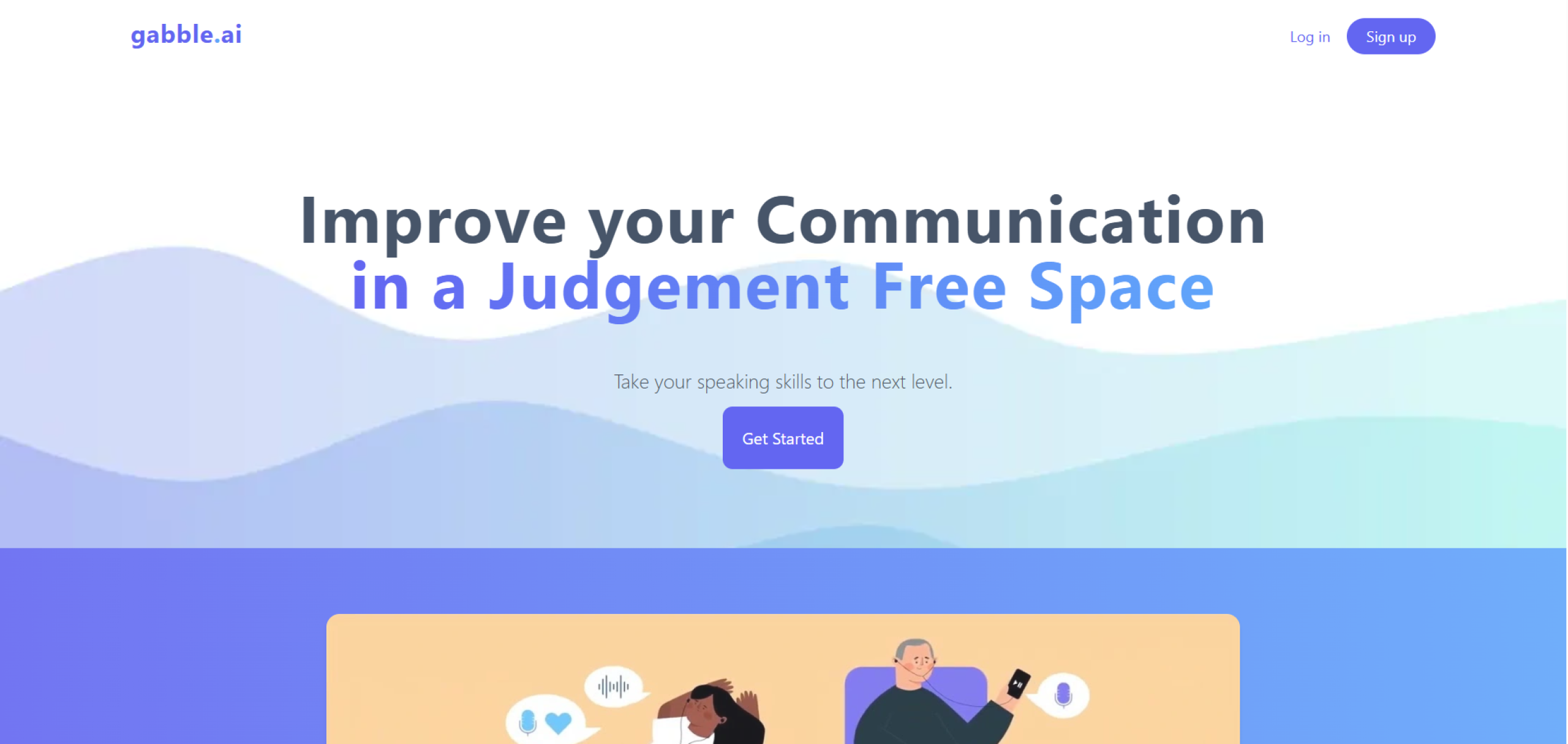
Image Long Description
This screenshot shows the homepage of Gabble.ai, a platform focused on improving communication and speaking skills in a supportive, judgment-free space.
Header:
- Logo (top left): Text reads “gabble.ai” in purple lowercase letters.
- Top-right navigation:
- Links: Log in, Sign up (both in blue text with “Sign up” in a button style)
Main Tagline (centered and prominent):
- Large, bold text:
“Improve your Communication in a Judgement Free Space” - “Judgement Free Space” is highlighted in a gradient blue to stand out.
- Subheading text:
“Take your speaking skills to the next level.” - Call-to-action button:
Purple button labeled “Get Started”
Background Design:
The header section features flowing, overlapping blue gradients that suggest calm and openness.
Lower Section (partially visible):
- Cartoon-style illustration of two people engaging with mobile devices.
- One person appears to be speaking into a phone; the other is listening or responding.
Text Transcription
gabble.ai
Improve your Communication in a Judgement Free Space
Take your speaking skills to the next level.
[Get Started Button]
[Top navigation] Log in | Sign up.
Not only that, but Gabble tracks your improvements as a public speaker over time so you can see how you are developing with your presentation skills, word choices, style, and movements as a speaker. How does this help combat communication apprehension and public speaking anxiety? Gabble encourages your confidence as a speaker by celebrating your growth while emphasizing a judgement-free experience.
Most accessible for students – Microsoft Reading Coach: Many students don’t realize Microsoft PowerPoint has its own AI coach available through PowerPoint! Anyone with a Microsoft PowerPoint account can use this AI tool by selecting ‘slideshow’ in the top of the toolbar and then clicking the ‘rehearse with coach’ button.
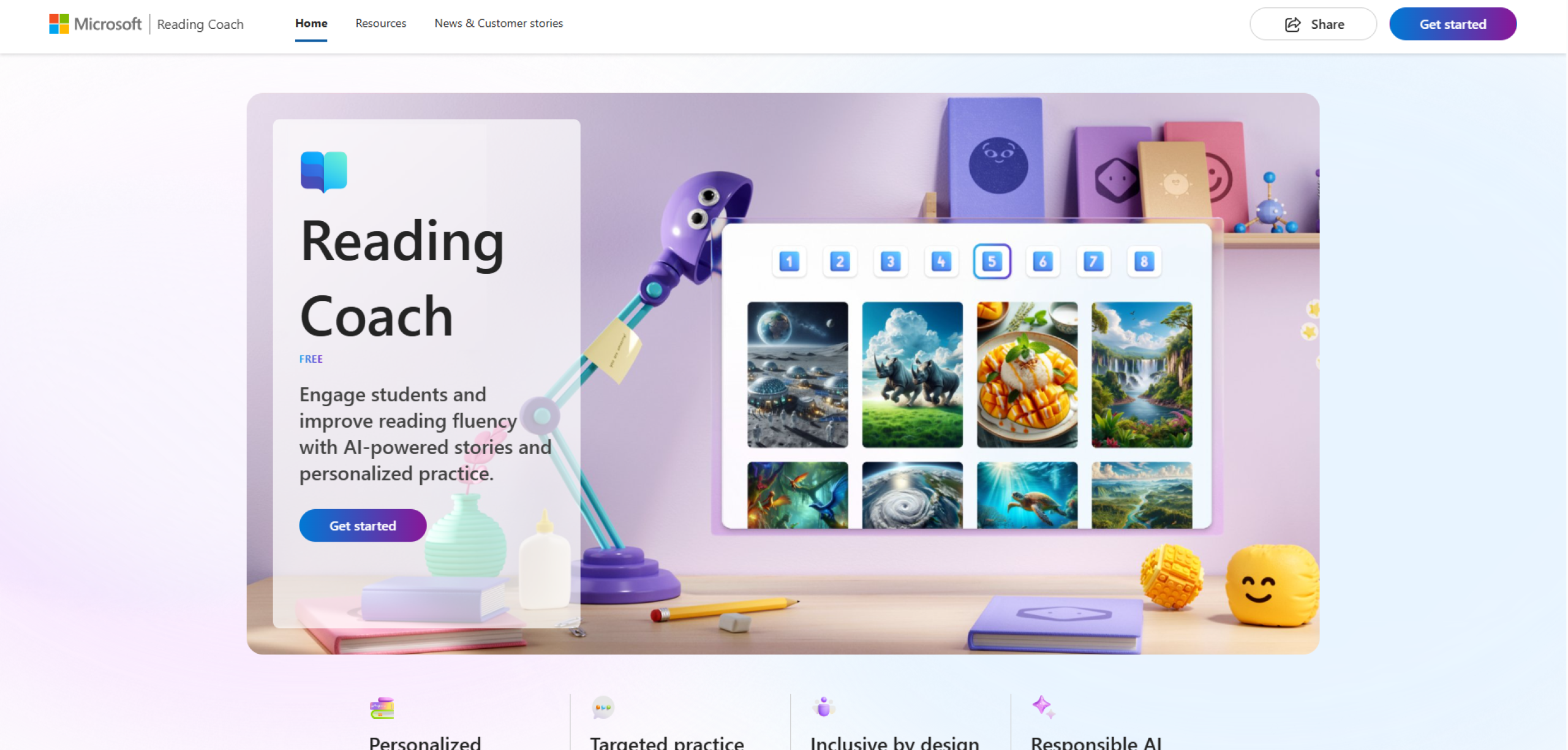
Image Long Description
This is a screenshot of the Microsoft Reading Coach homepage, promoting an AI-powered platform designed to enhance student reading fluency through engaging and personalized tools.
Header & Navigation:
- Top-left logo: Microsoft branding followed by “Reading Coach.”
- Navigation bar includes links:
- Home, Resources, News & Customer stories
- Top-right corner includes:
- Share button
- Get started button (highlighted in blue)
Main Content Area (Left Panel):
- Card with headline text:
- Reading Coach
- Subtext: “Engage students and improve reading fluency with AI-powered stories and personalized practice.”
- Label: FREE
- Purple “Get started” button
Main Visual (Right Panel):
- Stylized, playful digital classroom scene with a reading assistant robot pointing to a selection of fantasy-themed image cards.
- Image grid includes fantasy artwork such as:
- Planets, rhinoceroses, an orange floating island, ocean scenes, a dolphin, a whirlpool, and more.
- Numbered tabs across the top (1 to 7), suggesting reading levels or story categories.
- Decorative objects on a desk, including books, pencils, an emoji ball, and a glass orb lamp.
- Shelves above show colorful books and character blocks with faces.
Bottom Highlights (partially visible):
Four tiles feature core values:
- Personalized
- Targeted practice
- Inclusive by design
- Responsible AI
Text Transcription
- Microsoft Reading Coach
- Reading Coach
- FREE
- Engage students and improve reading fluency with AI-powered stories and personalized practice.
- [Get Started Button]
- Navigation: Home | Resources | News & Customer stories
- Buttons: Share | Get Started
Microsoft Reading Coach will analyze some of the most important aspects of public speaking delivery and then will provide a report on the following: originality (i.e., not reading off your PowerPoint slides), pacing, timing, pitch, filler words, and repetition.
This AI tool is great for speeches that require PowerPoint presentations, as it will tell you if your language is original or if you are simply reiterating what is on the slides. It also focuses on your rate, filler words, and variance of inflection, pitch and tone. However, there is no video element with this AI tool, so you won’t get feedback on eye contact, body language, or facial expressions. In addition, don’t close PowerPoint before saving your rehearsal report! Once you close out, it is gone forever because there isn’t an option to review reports later to monitor your progress.
Best way to prepare for distractions – VIRTUALSPEECH: This final AI choice connects perfectly with the last section of this chapter: coping with the unexpected. VirtualSpeech doesn’t give the best personalized feedback as the other AI options, but it does help you control your communication apprehension when real-life, unexpected distractions arise.
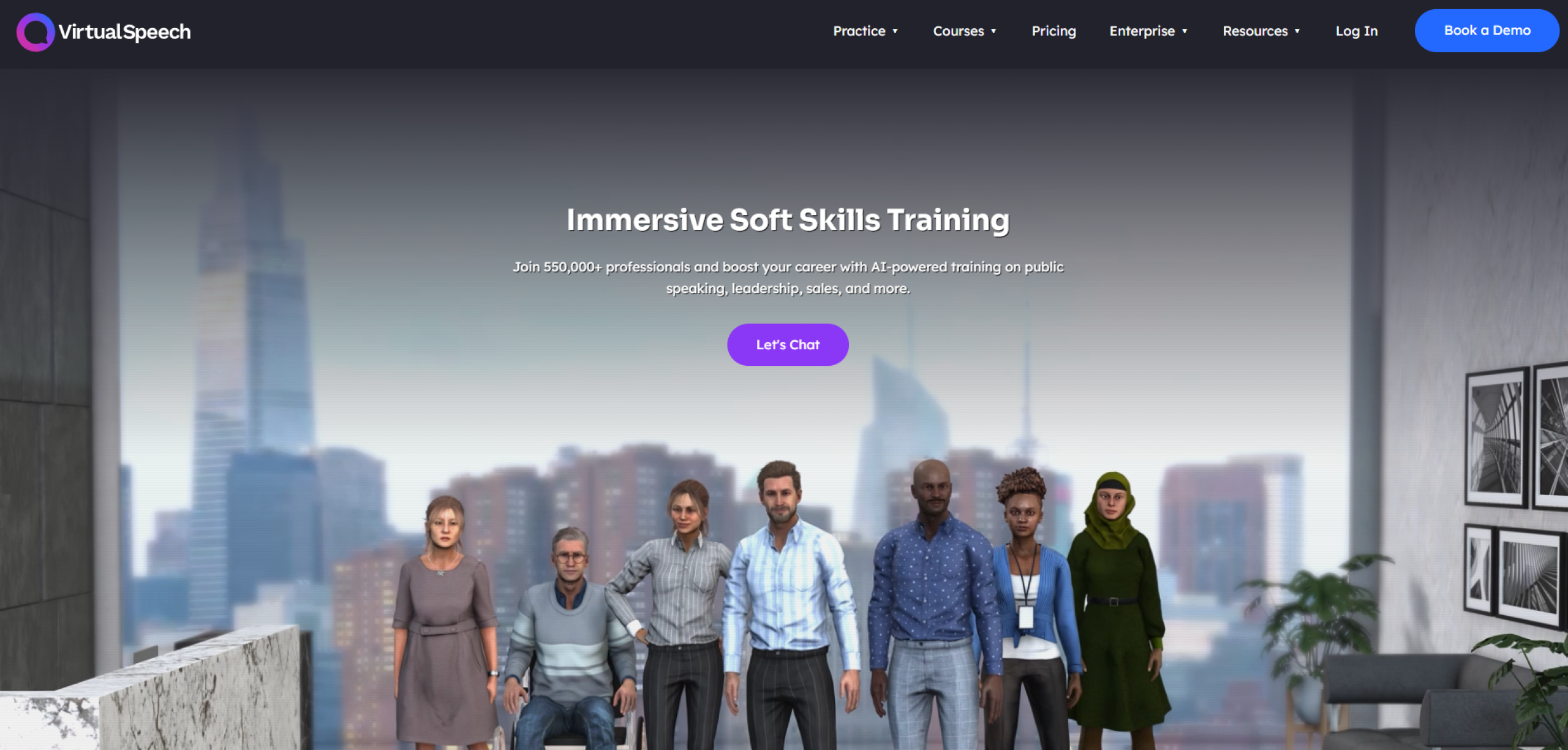
Image Long Description
This is a screenshot of the VirtualSpeech homepage, showcasing its platform for immersive soft skills training using virtual environments and AI.
Top Section:
- Logo (top left): Text reads “VirtualSpeech” with a purple circular speech icon.
- Navigation bar (top right):
- Practice
- Courses
- Pricing
- Enterprise
- Resources
- Log In
- Book a Demo (blue button)
Main Heading and Call to Action (centered):
- Large heading text:
“Immersive Soft Skills Training” - Supporting sentence below:
Join 550,000+ professionals and boost your career with AI-powered training on public speaking, leadership, sales, and more. - Button:
Purple “Let’s Chat” button
Background Visual:
- Stylized virtual cityscape visible through a large window, suggesting a high-rise office environment.
- Seven virtual human avatars of diverse race, gender, and clothing styles are lined up, facing forward. They represent users or trainers of the VirtualSpeech platform.
- Right-side wall: Monochrome abstract artwork in black frames.
- Lower right: Indoor plants and modern office seating.
Text Transcription
- VirtualSpeech
- Immersive Soft Skills Training
- Join 550,000+ professionals and boost your career with AI-powered training on public speaking, leadership, sales, and more.
- [Let’s Chat Button]
- Top Menu: Practice | Courses | Pricing | Enterprise | Resources | Log In | [Book a Demo]
VirtualSpeech lets you immerse yourself in the setting of your choice and then you can enable interruptions to see how you deal with them. For example, what would happen to your public speaking anxiety if a student’s cell phone goes off or a classmate arrives late in the middle of your speech? What about an excessive “cougher” in the front row? You can make these distractions possible while you are practicing, helping you better prepare for any real-life unexpected distractions that may arise.
Yes the feedback is limited with VirtualSpeech and focuses generally on eye contact, pausing, and body language, but knowing how to control your anxiety when distractions arise can be very helpful with communication apprehension.
REMEMBER: The goal of using AI is not to replace your unique voice or (worse) write your speech for you! The goal is to use it as a powerful tool to strengthen your public speaking skills and minimize your communication apprehension by practicing in front of a virtual audience, addressing any weaknesses, and then making the improvements necessary before speech day. With its simulated audience and real-time feedback, AI can ensure you are confident and prepared for any speeches that come your way.
There are also tools that are timeless (the software above may not be around forever!) such as Google Scholar and The Penn State University Library, which students can use anytime to help prepare and practice speeches to alleviate speech anxiety. Both Google Scholar and the Penn State University library have sources available from all over the world to help with speech feedback, apprehension, confidence, and language use.
Try It: Exploring AI Tools for Public Speaking Confidence
Watch What You Eat
A final tip about preparation is to watch what you eat immediately before speaking. The butterflies in your stomach are likely to be more noticeable if you skip normal meals. While you should eat normally, you should avoid caffeinated drinks because they can make your shaking hands worse. Carbohydrates operate as natural sedatives, so you may want to eat carbohydrates to help slow down your metabolism and to avoid fried or very spicy foods that may upset your stomach. Especially if you are speaking in the morning, be sure to have breakfast. If you haven’t had anything to eat or drink since dinner the night before, dizziness and light- headedness are very real possibilities.
Reducing Nervousness during Delivery Anticipate the Reactions of Your Body
There are a number of steps you can take to counteract the negative physiological effects of stress on the body. Deep breathing will help to counteract the effects of excess adrenaline. Some students have found that using the syllable “VU” and trying to say it long, low, and slow while focusing on the “gut” can be calming. You also can place symbols in your notes, like “slow down” or ☺, that remind you to pause and breathe during points in your speech. It is also a good idea to pause a moment before you get started to set an appropriate pace from the onset. Look at your audience and smile. It is a reflex for some of your audience members to smile back. Those smiles will reassure you that your audience members are friendly.
Physical movement helps to channel some of the excess energy that your body produces in response to anxiety. If at all possible, move around the front of the room rather than remaining imprisoned behind the lectern or gripping it for dear life (avoid pacing nervously from side to side, however). Move closer to the audience and then stop for a moment. If you are afraid that moving away from the lectern will reveal your shaking hands, use note cards rather than a sheet of paper for your outline. Note cards do not quiver like paper, and they provide you with something to do with your hands.
Vocal warm-ups are also important before speaking. Just as athletes warm up before practice or competition and musicians warm up before playing, speakers need to get their voices ready to speak. Talking with others before your speech or quietly humming to yourself can get your voice ready for your presentation. You can even sing or practice a bit of your speech out loud while you’re in the shower (just don’t wake the neighbors), where the warm, moist air is beneficial for your vocal mechanism. Gently yawning a few times is also an excellent way to stretch the key muscle groups involved in speaking.
Immediately before you speak, you can relax the muscles of your neck and shoulders, rolling your head gently from side to side. Allow your arms to hang down your sides and stretch out your shoulders. Isometric exercises that involve momentarily tensing and then relaxing specific muscle groups are an effective way to keep your muscles from becoming stiff.
Focus on the Audience, Not on Yourself
During your speech, make a point of establishing direct eye contact with your audience members. By looking at individuals, you establish a series of one-to-one contacts similar to interpersonal communication. An audience becomes much less threatening when you think of them not as an anonymous mass but as a collection of individuals.
A colleague once shared his worst speaking experience when he reached the front of the room and forgot everything he was supposed to say. When I asked what he saw when he was in the front of the room, he looked at me like I was crazy. He responded, “I didn’t see anything. All I remember is a mental image of me up there in the front of the room blowing it.” Speaking anxiety becomes more intense if you focus on yourself rather than concentrating on your audience and your material.
Maintain Your Sense of Humor
No matter how well we plan, unexpected things happen. That fact is what makes the public speaking situation so interesting. When the unexpected happens to you, do not let it rattle you. At the end of a class period late in the afternoon of a long day, a student raised her hand and asked me if I knew that I was wearing two different colored shoes, one black and one blue. I looked down and saw that she was right; my shoes did not match. I laughed at myself, complimented the student on her observational abilities and moved on with the important thing, the material I had to deliver.
Stress Management Techniques
Even when we employ positive thinking and are well prepared, some of us still feel a great deal of anxiety about public speaking. When that is the case, it can be more helpful to use stress management than to try to make the anxiety go away.
One general technique for managing stress is positive visualization. Visualization is the process of seeing something in your mind’s eye; essentially it is a form of self-hypnosis. Frequently used in sports training, positive visualization involves using the imagination to create images of relaxation or ultimate success. Essentially, you imagine in great detail the goal for which you are striving, say, a rousing round of applause after you give your speech. You mentally picture yourself standing at the front of the room, delivering your introduction, moving through the body of your speech, highlighting your presentation aids, and sharing a memorable conclusion. If you imagine a positive outcome, your body will respond to it as through it were real. Such mind-body techniques create the psychological grounds for us to achieve the goals we have imagined. As we discussed earlier, communication apprehension has a psychological basis, so mind-body techniques such as visualization can be important to reducing anxiety. It’s important to keep in mind, though, that visualization does not mean you can skip practicing your speech out loud. Just as an athlete still needs to work out and practice the sport, you need to practice your speech in order to achieve the positive results you visualize.
Systematic desensitization is a behavioral modification technique that helps individuals overcome anxiety disorders. People with phobias, or irrational fears, tend to avoid the object of their fear. For example, people with a phobia of elevators avoid riding in elevators—and this only adds to their fear because they never “learn” that riding in elevators is usually perfectly safe. Systematic desensitization changes this avoidance pattern by gradually exposing the individual to the object of fear until it can be tolerated.
First, the individual is trained in specific muscle relaxation techniques. Next, the individual learns to respond with conscious relaxation even when confronted with the situation that previously caused them fear. James McCroskey used this technique to treat students who suffered from severe, trait-based communication apprehension (McCroskey, 1972). He found that “the technique was eighty to ninety percent effective” for the people who received the training (McCroskey, 2001). If you’re highly anxious about public speaking, you might begin a program of systematic desensitization by watching someone else give a speech. Once you are able to do this without discomfort, you would then move to talking about giving a speech yourself, practicing, and, eventually, delivering your speech.
The success of techniques such as these clearly indicates that increased exposure to public speaking reduces overall anxiety. Consequently, you should seek out opportunities to speak in public rather than avoid them. As the famous political orator William Jennings Bryan once noted, “The ability to speak effectively is an acquirement rather than a gift” (Carnegie, 1955).