
4.2: Listening vs. Hearing
Janie Harden Fritz
Learning Objectives
- Understand the differences between listening and hearing.
- Analyze AI-generated transcripts and identify potential errors or biases.
- Analyze how algorithms contribute to information overload and noise in digital communication
- Explain the benefits of listening
Listening vs. Hearing
 Beyond the Podium Insight
Beyond the podium, distinguishing listening from hearing matters in every relationship. Nodding while scrolling is not the same as being present.
Hearing is an accidental and automatic brain response to sound that requires no effort. We are surrounded by sounds most of the time. For example, we are accustomed to the sounds of airplanes, lawn mowers, furnace blowers, the rattling of pots and pans, and so on. We hear those incidental sounds and, unless we have a reason to do otherwise, we train ourselves to ignore them. We learn to filter out sounds that mean little to us, just as we choose to hear our ringing cell phones and other sounds that are more important to us.
Figure 4.2.2: Hearing vs. Listening
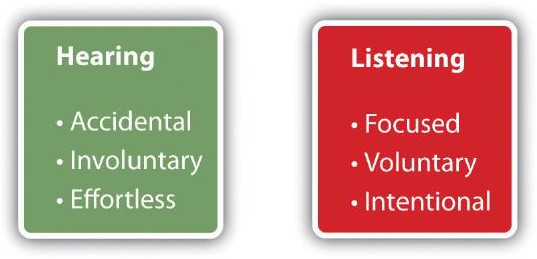
Image Long Description
The image compares Hearing and Listening in two adjacent boxes:
Left Box (Green, labeled “Hearing”):
- Accidental
- Involuntary
- Effortless
This section highlights that hearing is a passive act of perceiving sound, often without conscious effort or intent.
Right Box (Red, labeled “Listening”):
- Focused
- Voluntary
- Intentional
This section emphasizes that listening is an active process involving attention and mental engagement.
Both boxes are visually separated but presented side by side to clearly contrast the passive nature of hearing with the active skill of listening.
Text Transcription
Hearing
- Accidental
- Involuntary
- Effortless
Listening
- Focused
- Voluntary
- Intentional
 AI Insight
AI tools like Otter.ai or Zoom transcripts can capture words but not tone, irony, or emotion. This reminds us that hearing words isn’t the same as listening to meaning.
Listening, on the other hand, is purposeful and focused rather than accidental. As a result, it requires motivation and effort. Listening is active, focused, concentrated attention for the purpose of understanding the meanings expressed by a speaker. Listening takes place in multiple contexts (Varner, Stoltz, & Cates, 2024). We do not always listen at our best, however, and later in this chapter we will examine some of the reasons why and some strategies for becoming more active and critical listeners.
Benefits of Listening
Listening should not be taken for granted. Before the invention of writing, people conveyed all knowledge through some combination of showing and telling. Elders recited tribal histories to attentive audiences. Listeners received religious teachings enthusiastically. Myths, legends, folktales, and stories for entertainment survived only because audiences were eager to listen. Nowadays, however, we gain information and entertainment through reading and electronic recordings rather than through real-time listening. If we become distracted and let our attention wander, we can go back and replay a recording. Despite that fact, we can still gain at least four compelling benefits by becoming more active and competent at real-time listening.
Become a Better Student
When we focus on the material presented in a classroom, we will be able to identify not only the words used in a lecture but their emphasis and their more complex meanings. We will take better notes and will remember more accurately the instructor’s claims, information, and conclusions. Many times, instructors give verbal cues about what information is important, specific expectations about assignments, and even what material is likely to be on an exam, so careful listening can be beneficial.
Become a Better Friend
When we give our best attention to people expressing thoughts and experiences that are important to them, those persons are likely to see us as someone who cares about their well-being. This fact is especially true when we give our attention only and refrain from interjecting opinions, judgments, and advice.
Others Will View Thoughtful Listeners as Intelligent and Perceptive
When we listen well to others, we reveal ourselves as being interested in people and events. In addition, our ability to understand the meanings of what we hear will make us more knowledgeable and thoughtful people.
Good Listening Can Help Public Speaking
When we listen well to others, we start to pick up more on the stylistic components related to how people form arguments and present information. As a result, we have the ability to analyze what we think works and doesn’t work in others’ speeches, which can help us transform our speeches in the process. For example, really paying attention to how others cite sources orally during their speeches may give us ideas about how to cite sources in our presentations more effectively.
Alternative Listening Modes: The Deaf Community
For some persons, listening does not involve sounds. The deaf community hears differently, listening by means of visual cues. Siple (1994) notes, “For the Deaf [person], the very nature of deafness shifts the primary channel for information exchange from auditory to visual” (p. 348). The visual channel becomes the primary mechanism for message exchange. In fact, according to Siple, the deaf community can be viewed as a culture, with its own rules and norms. For many public speaking events, it is possible to enlist the services of persons who can use sign language to translate audible messages into sign language or to have the speech projected through video with closed captioning.
Try It: Listening vs. Hearing
Try It: Spot the Errors in AI Transcripts
Activity Introduction: In this activity, you’ll examine a short AI-generated transcript of a classroom speech. However, AI transcription tools are not always perfect — they can introduce spelling mistakes, awkward phrasing, or even biased wording.
Wrap Up: AI tools can help us capture and review what people say, but they aren’t flawless. By spotting errors or bias in AI transcripts, you practiced critical listening and learned how technology can create new forms of “noise” in communication. Strong listeners double-check information, correct misunderstandings, and remain aware of how AI may distort messages. This skill will make you not only a more ethical listener but also a stronger communicator.