
5.1: Introduction to Audience Analysis
Angela Pettitt
What is an Audience Analysis?
A communicator, when either writing or speaking, should be highly motivated to ensure their message is received as intended by an audience. To do so, it helps to understand the characteristics the define a given audience and will affect what an audience is likely to think or understand about the topic. For instance, a heart surgeon speaking about the importance of a new screening test for heart disease should probably use different language to describe the test when addressing other doctors at a medical conference than when they are speaking to the general public at a health expo. The medical field is full of jargon, specialized language within a closed group, and if the speaker doesn’t adapt to the audience, they may fail to communicate the benefits and importance of the new test. An audience of doctors and an audience of potential patients will also likely be interested in different details about the test and have different questions the speaker will need to consider.
Audience analysis is also important when an audience is unfamiliar with, skeptical about, or downright hostile toward the topic. A proposal to ban cell phones in a school or district is more likely to be immediately welcomed by teachers and parents, whereas students might not like the idea of losing access to their phones throughout the day. Therefore, a speech highlighting the benefits of the new policy for teachers probably won’t be effective in persuading students. In fact, it may sound downright insulting to students. If the speaker wants to elicit student support for the policy, they will have to think about the policy from students’ perspective and adjust their speech to address students’ concerns. In other words, they need to consider their audience.
Demographic categories such as race, gender, religion, sexuality, location, and education level may also impact how an audience responds to a topic. In the 1990s and early 2000s, same-sex marriage was a highly controversial and divisive topic, and a majority of Americans opposed it. Efforts to persuade people to support gay and lesbian couples’ right to marry utilized a variety of approaches that considered the perspective of different audiences. For instance, a speaker might focus on the legal benefits of marriage when addressing heterosexual couples who hadn’t considered that without the benefit of marriage, same-sex couples couldn’t make medical decisions for their partners, file joint tax returns, receive health benefits, and were denied myriad other benefits that married couples take for granted. Their heterosexual identity sometimes created a blind spot that prevented them from understanding why the issue was so important to same-sex couples. However, that same approach was often not as effective with people who were motivated by their religious beliefs. In those cases, it sometimes helped to ask them to consider various contradictions or outdated edicts in their religious texts that are no longer relevant today, such as the acceptance of slavery or death by stoning in the Bible. By considering the values and perspective of different demographics, the effort to increase acceptance of marriage equality was successful, and today, more than three-quarters of people support it.
Figure 5.2: Demographic Factors to Consider
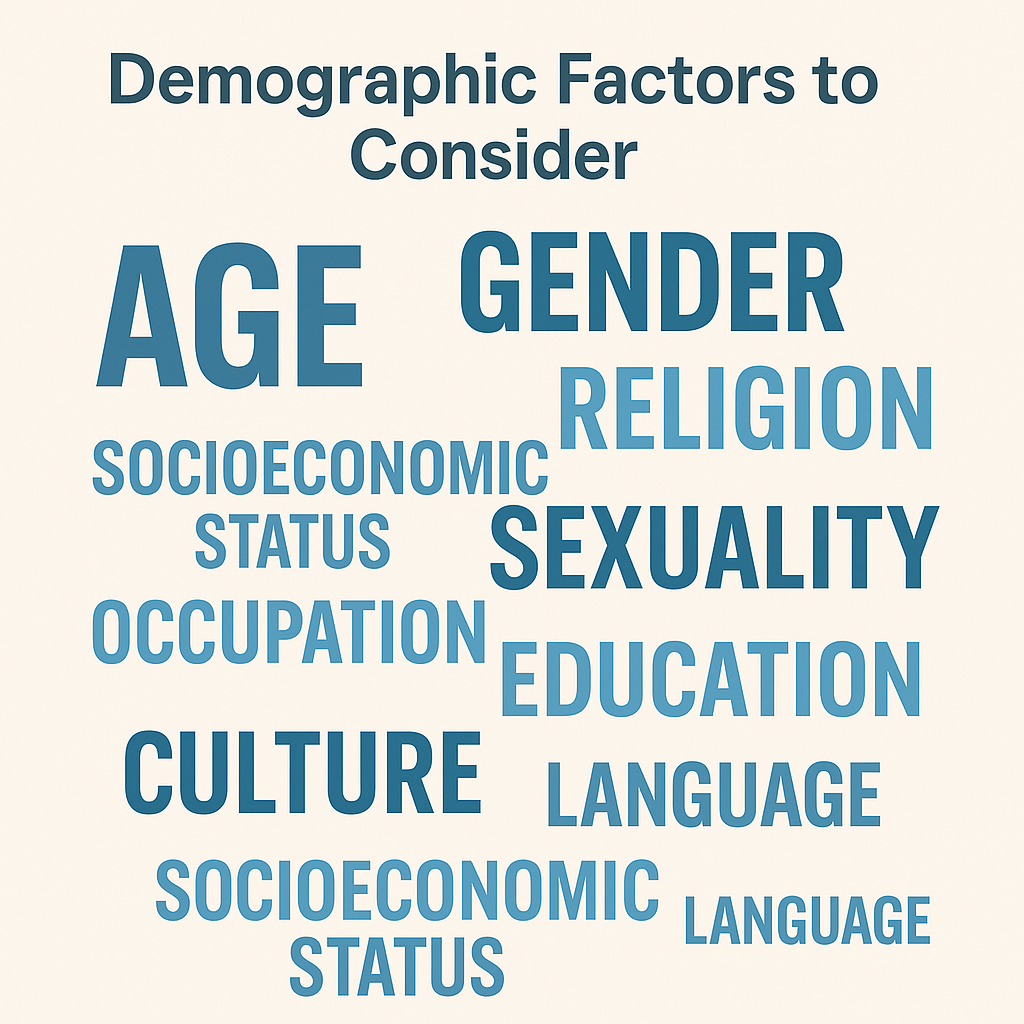
Image Long Description
The image displays the heading “Demographic Factors to Consider” followed by a visual cluster of words, each representing a different demographic variable. The words vary in size and boldness, drawing emphasis to some over others. The terms included are:
- AGE
- GENDER
- RELIGION
- SEXUALITY
- SOCIOECONOMIC STATUS (appears twice)
- OCCUPATION
- EDUCATION
- CULTURE
- LANGUAGE (appears twice)
These factors are arranged in a scattered, cloud-like layout, possibly to emphasize their equal importance or overlapping nature when considering audience or population characteristics.
Text Transcription
Demographic Factors to Consider
- AGE
- GENDER
- RELIGION
- SEXUALITY
- SOCIOECONOMIC STATUS
- OCCUPATION
- EDUCATION
- CULTURE
- LANGUAGE
- SOCIOECONOMIC STATUS
- LANGUAGE
Effective communication is based on mutual respect, which is more easily achieved when a speaker creates a relationship with their listeners. Scholars Sprague, Stuart, and Bodary explain, “Speakers do not give speeches to audiences; they jointly create meaning with audiences” (Sprague, et al., 2010). The success of a speech rests in large part on how an audience receives and understands it. The best way to reduce the risk of offending, alienating, or even just boring an audience is to conduct an audience analysis as you prepare your speech.
The Role of Respect in Communication
“Speakers do not give speeches to audiences; they jointly create meaning with audiences”
Audience analysis is the process of gathering information about the people in your audience so that you can understand their needs, expectations, beliefs, values, attitudes, and likely opinions. In this chapter, we will first examine some reasons why audience analysis is important. We will then describe three different types of audience analysis and some techniques to use in conducting audience analysis. Finally, we will explain how you can use your audience analysis not only during the creation of your speech but also while you are delivering it.
Figure 5.3: The Audience Analysis Process
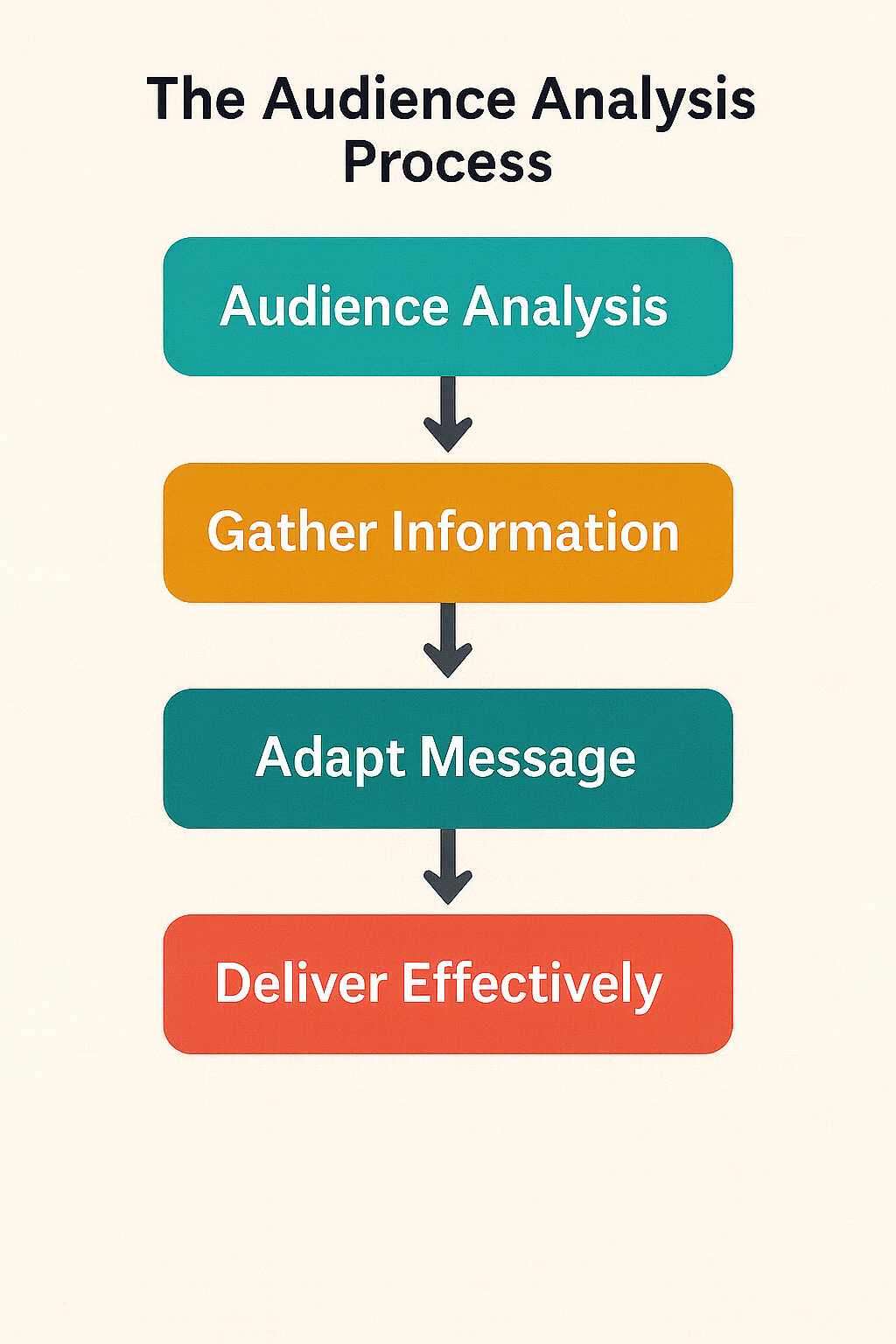
Image Long Description
The image is a vertical flowchart titled “The Audience Analysis Process”. It consists of four colored boxes, each containing a step in the process. Each box is connected with a downward-pointing arrow, indicating sequential order.
- Audience Analysis – Teal-colored box.
- Gather Information – Orange-colored box.
- Adapt Message – Teal-colored box.
- Deliver Effectively – Red-colored box.
This flow visually represents the logical progression of analyzing an audience: starting with recognizing the need for analysis, collecting relevant data, adjusting communication to fit the audience, and finally delivering the message appropriately.
Text Transcription
The Audience Analysis Process
- Audience Analysis
- Gather Information
- Adapt Message
- Deliver Effectively