
6.1 What Is Research?
Terri Stiles
Learning Objectives
- Explain why research is interesting and useful.
- Differentiate between primary and secondary research.
 Beyond the Podium Insight
Research is more than a task to complete; it is how speakers build credibility, curiosity, and confidence. What you learn becomes what you teach when you speak.
As you embark on the journey of crafting a compelling speech, remember that a strong foundation is built upon diligent research. This chapter, “Researching Your Speech,” will equip you with the essential tools and strategies to navigate the vast landscape of information effectively. You will develop an understanding of the fundamentals of research, learn how to identify various source types, and develop a robust research strategy. Furthermore, with the growing integration of artificial intelligence in content creation, we’ve included a discussion of AI to help you critically evaluate, ethically integrate, and properly cite AI-generated resources, ensuring your speeches are not only well-informed but also responsibly constructed.
The Research Process: A Journey of Discovery
Why is research important?
Academic research is essential because it cultivates critical thinking and problem-solving abilities, which are vital for understanding and addressing complex issues in the world. It provides a structured approach to exploring new ideas, validating existing knowledge, and contributing to the collective understanding of various phenomena. Engaging in research allows individuals to move beyond surface-level comprehension, fostering a deeper appreciation for evidence-based reasoning and intellectual rigor.
What is academic research?
Academic research is a journey of discovery, extending beyond just information gathering. It’s a cyclical process involving several key stages: identifying a topic, reviewing existing literature, developing research questions, choosing a research method, collecting and analyzing data, drawing conclusions, and sharing findings. Students in a public speaking class often undertake research collaboratively or independently, developing critical skills such as problem-solving and building confidence that will be highly valued by employers. Research is driven by curiosity and acts as a catalyst for understanding in diverse fields, including AI ethics, climate science, and mental health. Through research, we gain clarity, depth, and ultimately, new knowledge, which can then inspire further inquiry. (Mitra & Wagner, 2021; Bustillo, et. al., 2023)
Why is Identifying a Topic Important?
Identifying a topic for your speech is the first step because it lays the groundwork for the entire research process. A well-defined topic provides, preventing the researcher from getting lost in a sea of information. It determines what literature will be reviewed, what questions will be asked, and what methods will be employed. Without a clear topic, research efforts would be aimless, inefficient, and likely lead to inconclusive or irrelevant findings. Essentially, it’s the compass that guides the journey of discovery, ensuring the research remains relevant, manageable, and ultimately, contributes meaningfully to existing knowledge. To make your research project personally meaningful, select a topic relevant to your academic major.
- Computer Science students might explore artificial intelligence, cybersecurity, or data analytics.
- Business students could investigate management practices, sustainable business, or consumer behavior.
- Criminal Justice students might research best practices in law enforcement, cybercrime, or racial disparities within the justice system.
- Psychology majors could study topics such as depression, online behaviors, or factors contributing to happiness.
(Lim et al., 2022; Wang et al., 2024)
The Literature Review
Beyond the Podium Insight
Reading what others have discovered connects you to an ongoing conversation. Every strong speech begins as a dialogue with the thinkers who came before you.
A literature review is important because you want to craft your speech with an awareness of the current literature. During the literature review you will participate in a critical analysis of scholarly sources (such as books and journal articles) relevant to a particular topic or research question. It synthesizes current knowledge, identifies gaps in existing research, and establishes the theoretical framework for a new study. Literature reviews are crucial in research because they establish a comprehensive understanding of existing knowledge on a given topic. They help researchers avoid duplicating previous studies, identify gaps in current research, and recognize common themes, theories, and methodologies. By synthesizing and critically evaluating prior work, a literature review also helps frame the research question, provides a theoretical foundation, and informs the selection of appropriate research methods. By undertaking a literature review, the researcher ensures the new research is grounded in scholarly context and contributes meaningfully to the ongoing academic conversation. Remember that university librarians are invaluable resources for identifying scholarly articles. Librarians possess expertise in information organization, database navigation, advanced search strategies, and citation management. Once articles are collected, organize them by topic and take thorough notes during your reading. (Lim et al., 2022; Nightingale, 2009)
Try It: Spot the Purpose of a Literature Review
Wrap-up: A strong literature review anchors your ideas within existing scholarship, ensuring your work adds to—not repeats—the conversation.
Developing Research Questions
Developing a good research question is important because it serves as an anchor for the entire research part of your speech. A well-formulated question provides clarity and precision, defining the exact scope and focus of the study. It dictates what specific information needs to be gathered, what methodology is most appropriate, and how the collected data will be analyzed and interpreted. Without a clear and focused research question, the research can become unfocused, inefficient, and fail to generate meaningful or actionable insights, ultimately hindering its ability to contribute new knowledge or address a specific problem effectively. (Lim, Wong, and Visessuvanapoom., 2024)
Effective research questions narrow your topic to its core and guide your entire research process. For example, if you’re interested in how students use AI in English classes, your central question could be: “How do students use AI to develop their papers for English classes?”
Follow-up questions can further refine your inquiry:
- “What part of the writing process do you use AI for: brainstorming, information gathering, rough drafts, and/or final drafts?”
- “Do you use ChatGPT, Microsoft Copilot, Google Gemini, Ask AI, or another platform?”
- “How do you feel when you use AI to assist you with English papers?”
Consider your research questions as the foundational topics for the different sections of your speech as the answers you gather will form these sections. (Goldschmidt & Matthews, 2022)
Choosing a Quantitative, Qualitative, or Combined Study
Beyond the Podium Insight
A clear research question is a compass that guides your curiosity and ensures your work leads to meaningful discoveries.
The nature of your research question will guide your choice of methodology:
- Quantitative studies focus on numerical data. Modern survey platforms like Qualtrics and Google Forms can provide quantitative information in the form of graphs. For more formal studies, statistical analyses such as regressions and t-tests are employed. (Barroga & Matanguihan, 2022)
- Qualitative studies explore in-depth understanding and rich descriptions. While numbers provide part of the story, incorporating qualitative elements like essays, short-answer questions, and interviews can offer deeper insights and perspectives. (Barroga & Matanguihan, 2022)
Choosing a Research Method: Surveys and Interviews
For class assignments, studying responses from your classmates through surveys and interviews is typically acceptable. However, for research conducted outside of a class setting, you must obtain approval from your institution’s Institutional Review Board (IRB). The IRB ensures that your research adheres to ethical guidelines.
Surveys: Surveys are a systematic method for collecting data (facts, figures, or opinions) from a sample to understand the broader population. Survey administration has evolved significantly. While postal surveys often have low response rates, online platforms provide sophisticated and cost-effective ways to reach diverse audiences, though securing participation can still be a challenge. Face-to-face surveys tend to yield higher completion rates within specific communities, and mobile-based survey applications are also popular. (Hadler, 2025; Kraft and Shah, 2021; Lim, 2022)
What to Consider When Designing a Survey.
- “Do you know what you want to ask?” Clear and well-defined research questions are crucial for obtaining usable data; ambiguous questions lead to unclear results.
- “Do you really need to collect data?” With vast online resources available, ensure the information you seek isn’t already readily accessible or that your study expands upon existing research.
- “Do your participants know the information you want to find out, or if they do know, will they tell you?” Be cognizant and mindful of privacy concerns and data sensitivity. Intrusive questions are unlikely to elicit honest responses. Also, consider digital literacy and access to your target population to ensure equitable participation.
- “Is your goal generalizable?” In our diverse and interconnected world, it is important to ensure representation across demographics, considering socioeconomic status, cultural background, and technological access. Your surveyed population should be large enough to represent the population you are studying. (Hadler, 2025; Kraft and Shah, 2021; Lim, 2022)
Interviews: Interviews, whether one-on-one or in focus groups, provide rich qualitative data through direct conversation. The interviewer’s ability to ask follow-up questions allows for deeper exploration of perspectives.
You may be instructed to interview a professor or student at your institution who is knowledgeable about the subject you are studying. While in-person interviews remain valuable, video conferencing offers a convenient and cost-effective way to reach participants globally. However, be mindful of technological barriers and ensure equitable access.
Choose interview participants who can best help answer your research questions. For example, if you are preparing a speech on fostering innovation in student startups, interviewing successful student entrepreneurs and conducting focus groups with those who faced difficulties can provide valuable firsthand qualitative data to strengthen your recommendations. (Taherdoost, 2022)
After your interview, remember to code the answers you received to correspond with your research questions. Coding means connecting your research questions with the information you have discovered. This connection between research questions and collected data simplifies analysis and conclusion drawing. (Knott et al., 2022)
Analyzing Data and Drawing Conclusions
Beyond the Podium Insight
Information alone does not persuade. The speaker’s task is to turn data into understanding and evidence into insight.
After collecting survey and interview data, organize your results by separating quantitative and qualitative data. Then, employ various analysis methods, such as descriptive statistics and hypothesis testing, to draw meaningful conclusions. Finally, present your findings clearly and consider how they relate to your research goals. (Barroga & Matanguihan, 2022)
- Descriptive Statistics: This involves studying the range, mean, median, and mode of your quantitative data, and calculating the standard deviation. Advanced survey software like Qualtrics often provides this information automatically. (Qualtrics)
- Hypothesis Testing: After analyzing your data, test your hypothesis. Did the study confirm your expectations? Did it support a null hypothesis that was the opposite of what you expected? Or did it reveal something entirely unexpected or an alternate hypothesis? (Pugh and Milinaro, 2016)
Research transcends simply answering questions; it often unveils unexpected perspectives and fosters intellectual growth. The research process frequently leads to surprising ideas and facts that reshape our understanding of a topic. This is evident in fields like quantum computing, space exploration, and personalized medicine. Research can ignite new passions and even redirect life trajectories. (Emmert-Streib & Dehmer, 2019)
Try It: The Research Process: From Idea to Impact
Wrap-up: Every research journey follows this rhythm. Understanding where you are in the cycle helps you stay organized and purposeful.
Discovery, Revision, and Reporting
Let’s examine research through the lens of discovery, revision, and reporting of resulting theories and applications.
Discovery: Discovery in research involves exploring topics, testing ideas, analyzing evidence, and uncovering entirely new knowledge. A prime example is Alexander Fleming’s 1928 discovery of penicillin, the first antibiotic, which revolutionized medicine and saved countless lives. (Gaynes, 2017) Similarly, the discoveries of insulin for diabetes and chemotherapy for cancer patients have significantly extended lives. (Vecchio, 2018)
Revision: Revising research means improving upon or building existing knowledge. For instance, researchers leveraged previous vaccine studies of SARS-CoV, MERS-CoV, and other viruses to accelerate the development of COVID-19 vaccines. Wilhelm Roentgen’s discovery of X-rays, through experiments with cathode ray tubes, was built upon existing knowledge of electricity and radiation. (Brakefield et al., 2022)
Reporting: Reporting involves gathering and sharing information, enabling others to learn from research. Many researchers publish their findings in academic journals or books within their field. There’s also a growing trend of researchers publishing their findings in Open Educational Resources, making them accessible to everyone. Additionally, researchers often present their findings at conferences, frequently through poster sessions. (Cheung, 2023; Neylon et al., 2021)
Facts, Theories, and Applications: The Results of Research
Facts: Facts are verified; measurable truths are established through rigorous investigation.
- The distance from Earth to the Moon is approximately 238,900 miles.
- The Mariana Trench reaches a depth of about 36,000 feet (11,000 meters).
- Mount Everest’s height is 8,848.86 meters (29,031 feet 8+1⁄2 inches).
Theories: Theories are foundational frameworks that explain phenomena, guiding future research and expanding scientific understanding. In technology, current theories are rapidly evolving around the possibilities and limitations of autonomous AI and the diverse applications of Virtual Reality (VR) and Augmented Reality (AR). Researchers actively work to understand, challenge, or support existing theories. (Abreu & Stiles, 2024; AlGerafi, 2023)
A scientific theory is a well-substantiated explanation of the natural world, built on extensive evidence and repeated testing. Scientists rigorously examine theories under diverse conditions, striving to replicate findings and identify limitations. For instance, the enduring theory of universal gravitation not only describes phenomena like keys falling from a table but also delves into how it happens. Physicists continue to explore quantum gravity and other models for a more complete understanding. Ongoing research at facilities like LIGO (Laser Interferometer Gravitational-Wave Observatory) and the James Webb Telescope constantly refines our grasp of gravity and the universe. From a researcher’s perspective, science is an ever-evolving field, continually adapting in the face of new knowledge. (James Webb Telescope; Cal Tech, 2025; NASA, 2025; LIGO; Sutton & Staw, 1995)
Applications: Applications are the real-world tools and solutions derived from research, encompassing new medicines, technologies, and practices. Researchers frequently seek innovative uses for existing substances. Take botulism, for example. Once a dreaded bacterium that caused widespread food poisoning and many deaths in the U.S., its perception shifted dramatically. In the 1980s, ophthalmologist Allan Scott began using a modified version of botulism to treat muscle spasms, resulting in the drug Onabotulinumtoxin A—better known as Botox (Williamson, 2011). In 1989, plastic surgeon Richard Clark reported that the drug also had the surprising side effect of decreasing wrinkles (Clark & Berris, 1989). Today, Botox treats a wide range of medical conditions, from chronic migraines to overactive bladder, and ongoing research is exploring even more potential uses. (Mayo Clinic, 2025) This exemplifies the continuous evolution of scientific discovery.
Considering Primary and Secondary Sources
Figure 6.1: Primary and Secondary Sources
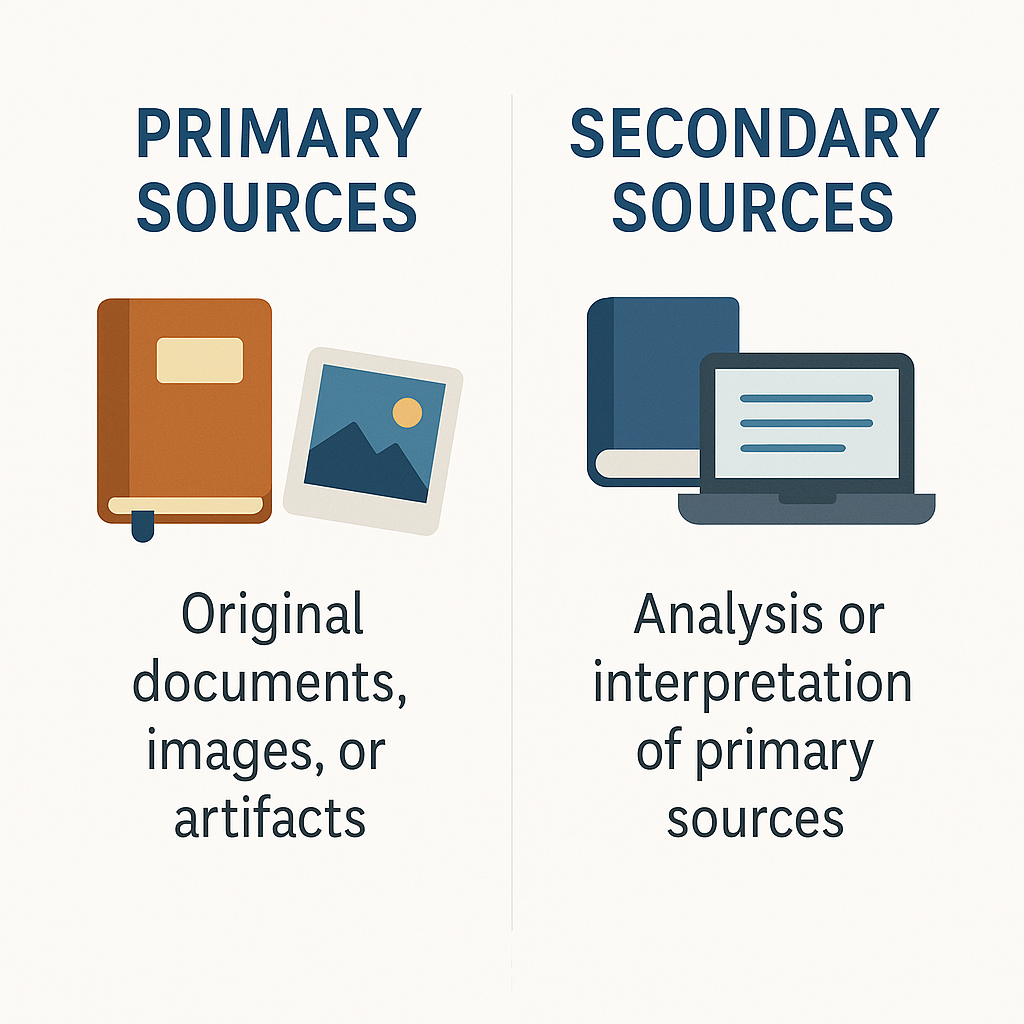
Image Description
Left Side – Primary Sources
- Heading: “PRIMARY SOURCES” (in dark blue, all caps)
- Icon: An orange-brown closed book next to a photo of mountains and a sun.
- Text: “Original documents, images, or artifacts”
- Description: Primary sources are firsthand evidence or original records such as diaries, photographs, historical documents, or artifacts.
Right Side – Secondary Sources
- Heading: “SECONDARY SOURCES” (in dark blue, all caps)
- Icon: A dark blue book behind a laptop screen showing lines of text.
- Text: “Analysis or interpretation of primary sources”
- Description: Secondary sources involve commentary, discussion, or analysis of primary materials—examples include academic articles, critiques, and biographies.
Text Transcription
PRIMARY SOURCES
- Original documents, images, or artifacts
SECONDARY SOURCES
- Analysis or interpretation of primary sources
- Research Relies on two types of sources: Primary and Secondary
Primary sources are first-hand accounts or original materials directly from the time or event being studied. They offer direct evidence and haven’t been interpreted or analyzed by anyone else. Think of them as raw data or original expressions.
Examples include:
- Historical documents: Diaries, letters, government records, birth certificates, trial transcripts, speeches, original manuscripts.
- Creative works: Novels, poems, paintings, sculptures, musical compositions, films (if you’re analyzing the work itself).
- Research data: Results of experiments, statistical data, surveys, field notes.
- Eyewitness accounts: Autobiographies, memoirs, oral histories, newspaper reports written by reporters who witnessed an event.
- Artifacts: Clothing, tools, photographs, physical objects from a specific time.
- (Penn State University Libraries)
Beyond the Podium Insight
Whether you draw from ancient texts or social media posts, the heart of research is discernment—knowing which voices to trust and why.
Secondary sources are one step removed from the original event or information. They analyze, interpret, summarize, or comment on primary sources. These sources provide context, critique, and different perspectives on the original material.
Examples include:
- Academic works: Scholarly journal articles (that interpret research), textbooks, dissertations, books that analyze historical events or literature.
- Reviews: Book reviews, film critiques, literary criticism.
- Reference materials: Encyclopedias, dictionaries (though these can sometimes be tertiary).
- Biographies: While a person’s autobiography is a primary source, a biography written by someone else about that person is a secondary source.
- Documentaries: While they often incorporate primary source elements (like historical footage), the overall documentary itself, with its narrative and analysis, is typically a secondary source.
(Penn State University Libraries)
Can an Individual’s Social Media Sites Be Considered Primary Sources?
 AI Insight: Research as Algorithmic Discovery
AI can accelerate the research process, but it should never replace the curiosity that drives it. Use AI tools to locate sources or summarize ideas, then apply your own interpretation to move from information retrieval to real understanding.
Social media platforms can indeed serve as primary sources for research on an individual, as they often contain direct, first-hand expressions from the person being studied. Any platform where an individual creates and shares their own content—such as posts, tweets, photos, videos, or direct messages—can be considered a primary source, much like a personal diary or letters. This includes currently popular sites like X (formerly Twitter), Facebook, Instagram, TikTok, YouTube, and personal blogs. These platforms offer unique insights into a person’s thoughts, opinions, daily life, and interactions, often in real-time, providing a raw and immediate perspective. However, utilizing social media for research necessitates navigating significant ethical and practical challenges, including respecting public versus private content boundaries, ensuring participant anonymity and confidentiality, obtaining informed consent, adhering to platform terms of service, and carefully evaluating the authenticity and context of the information, typically under the oversight of an Institutional Review Board (IRB). (Taylor, N.et al., 2023)
Academic research is essential because it cultivates critical thinking and problem-solving abilities, which are vital for understanding and addressing complex issues in the world. It provides a structured approach to exploring new ideas, validating existing knowledge, and contributing to the collective understanding of various phenomena. Engaging in research allows individuals to move beyond surface-level comprehension, fostering a deeper appreciation for evidence-based reasoning and intellectual rigor.