
7.1 Using Supporting Material to Make Your Case
Erika Berlin
Learning Objectives:
- Define the term “supporting material.”
- Understand three reasons we use support in speeches.
- Understand how speakers can use statistics to support their speeches.
- Differentiate among the five types of definitions.
- Differentiate among four types of supportive examples.
- Explain how narratives can be used to support informative, persuasive, and entertaining speeches.
- Differentiate between the two forms of testimony.
- Differentiate between two types of analogies that can be used as support.
Picture this: You’re in a heated discussion with your classmates about whether your campus should ban single-use plastics. You feel strongly that it’s necessary, but when you say, “It would really help the environment,” someone immediately responds, “How do you know that? What’s your proof?” Suddenly, your passionate opinion isn’t enough. To speak effectively, whether in casual conversations, class presentations, or campus debates, you need more than just strong feelings. You need to support your claim with evidence, examples, and clear reasoning that your audience can trust and understand.
In this chapter, support refers to the material you use to develop and strengthen your speech (facts and statistics, definitions, narratives, testimony, and analogies) and how you choose to deliver it. This supporting material serves three crucial functions: it clarifies complex ideas, enhances your credibility, and makes your speech more compelling to your specific audience.
Strong, research-cited support is information that is credible, ethically sourced, and strategically selected for your audience and purpose. This definition matters more than ever as you navigate an era where both human experts and AI tools generate content at unprecedented scales. But having good evidence is only half the battle, you also need to connect that evidence to your claims through sound reasoning, helping your audience follow the logical path from your support to your conclusions.
As a civic-minded communicator, whether you’re speaking beyond the traditional podium in classrooms, workplaces, or digital spaces, you have a responsibility to think critically about your sources and your reasoning process. This means evaluating how information is created and shared, distinguishing between credible and questionable sources, and constructing clear logical pathways that demonstrate how your evidence supports your claims.
Throughout this chapter, we’ll explore how to gather, evaluate, and integrate supporting material into your speeches, then transform that evidence into compelling arguments through strategic reasoning.
Supporting material: evidence that develops and strengthens a speech by clarifying content, establishing credibility, and engaging the audience
Why We Use Supporting Material
Figure 7.1 Why We Use Supporting Material
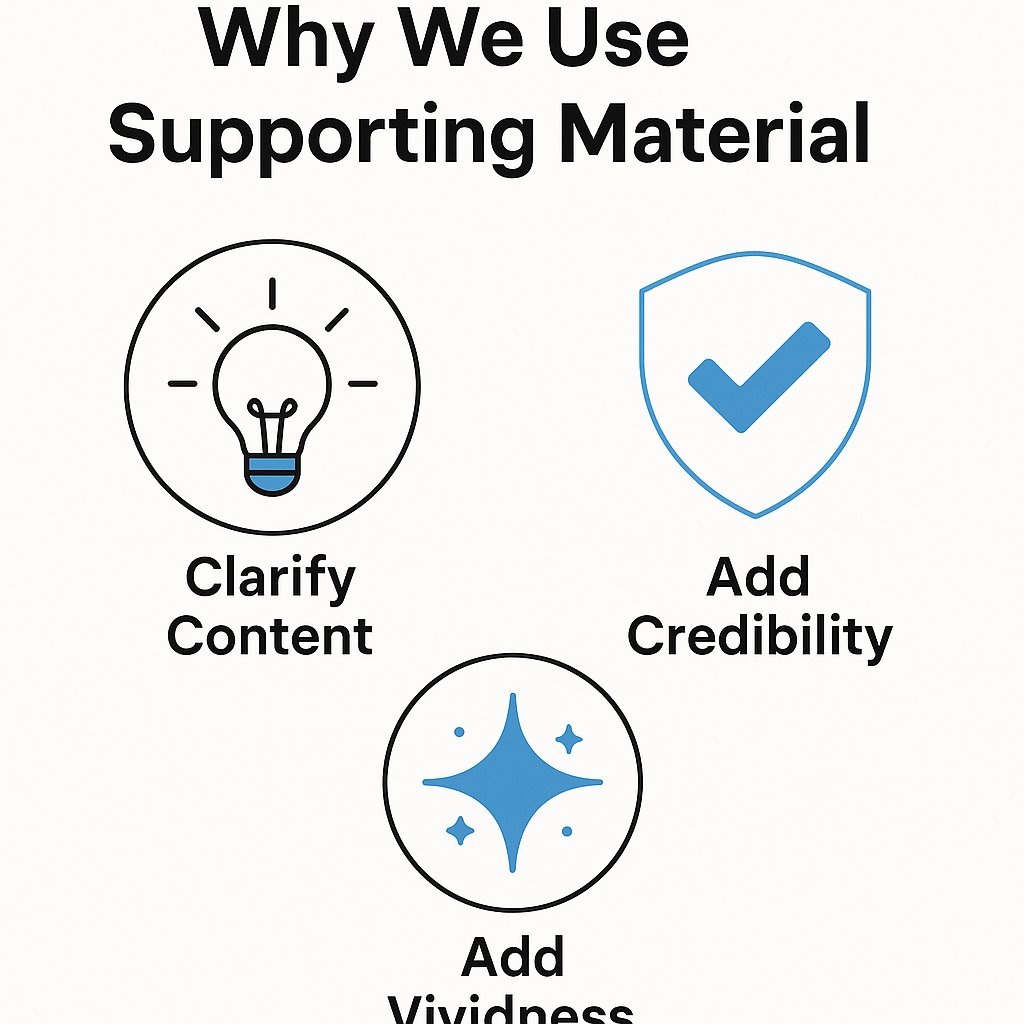
Image Long Description
The image presents the title “Why We Use Supporting Material” in bold black text at the top, followed by three icons arranged in a triangle formation with corresponding labels:
- Clarify Content – Represented by a light bulb icon, symbolizing illumination or understanding.
- Add Credibility – Represented by a checkmark inside a shield, symbolizing trustworthiness and reliability.
- Add Vividness – Represented by a sparkle or star-like icon, indicating enhanced visual interest or memorability.
The design uses simple black and blue line icons on a white background, emphasizing clarity and direct communication.
Text Transcription
Why We Use Supporting Material
- Clarify Content
- Add Credibility
- Add Vividness
Think of supporting material as the foundation that keeps your message from collapsing. Without evidence, examples, and expert voices backing up your claims, even your best arguments can sound like empty opinions. A claim is your statement that you want to prove and the audience to accept; it can be as broad as your thesis or as specific as a subpoint.
Supporting material serves three key purposes in your speeches: they clarify your content, boost your credibility, and make your message memorable.
To Clarify Content: Sometimes, you need specific supporting material simply to help your audience understand what you’re talking about. If you’re giving a speech about cyberbullying, you first need to define the term. If presenting to classmates, you might say:
“According to our university’s 2024 student code of conduct, ‘Cyberbullying involves the use of information and communication technologies to support deliberate, repeated, and hostile behavior by an individual or group that is intended to harm others.'”
This type of supporting material ensures everyone in your audience starts with the same understanding of your topic.
To Add Credibility: Well-chosen supporting material shows your audience that you’ve done your homework. Expert testimony, recent research findings, and credible statistics all signal that your speech rests on solid ground rather than personal opinion alone. However, using questionable sources or twisting evidence to say something it doesn’t actually support will damage your credibility rather than enhance it.
 Beyond the Podium Insight
Strong communicators go beyond reciting evidence, they interpret and adapt it. Outside of class, this same skill fuels credibility in meetings, interviews, and community discussions. When you practice using relevant, ethical support, you’re learning how to earn trust and demonstrate expertise across every context where ideas are exchanged.
To Add Vividness: The right supporting material makes your speech memorable. When a public speaking student explained the dangers of texting while driving by comparing it to “trying to thread a needle while riding a roller coaster,” that vivid analogy helped their classmates in the audience visualize and remember the concept long after the speech ended. Creative examples, powerful statistics, and compelling stories transform abstract concepts into concrete images your audience can grasp.
Types of Supporting Material
Think of supporting material as the foundation that transforms your speech from opinion into credible, compelling communication. Just as a house needs different materials like concrete for the foundation, wood for framing, insulation for comfort, your speeches need varied types of evidence to build trust, clarity, and engagement with your audience. Get to know facts and statistics, definitions, examples, narratives, testimony, and analogies.
Facts and Statistics
Facts are verifiable observations, experiences, or events that can be proven true. Whether you state “A 2024 Pew Research study found that 83% of American adults use at least one social media platform” (Beshay & Beshay, 2025) with a valid citation, or engage the audience with your detail “I graduate at the end of this semester with a degree in computer science – and I think AI is taking over the job market!”, you can use facts when they will put your claim into context. Just remember: your personal statement “…I’m terrified that AI is taking over the job market” may inspire an active debate and is not a fact, it’s an opinion.
Statistics represent numerical data that has been collected, analyzed, and interpreted to reveal patterns or trends. You may find yourself seeking stats to back up a claim that high school athletic participation is declining, sure that an analysis of the greater US population would not match a worldwide comparison. Knowing how this could jumpstart your audience, you might introduce your speech like this:
“According to recent data from the Sports and Fitness Industry Association, American youth sports participation has plummeted over the past decade. Only 40% of young men are involved in any kind of athletics. In comparison, Australia leads the world with 84% of its population playing sports. So, here’s my question: Are we raising a generation of couch potatoes while the rest of the world stays active around us?” (Participation Trends – State of Play 2023 – Project Play, n.d.-b), (AusPlay, 2023)
Opinion: a judgement based on personal experience, values, or expertise that is subjective, arguable, and cannot be independently verified or proven as fact.
Try It: Spot the AI Hallucination
 AI Insight
AI tools can help you gather statistics quickly, but they can also invent data or distort trends. Use them to discover leads but not to prove claims. Always verify any AI-generated number through a credible organization or database before sharing it with an audience.
Below are websites where you can find a range of statistical information that may be useful for your speeches.
- Bureau of Labor Statistics: provides links to a range of websites for labor issues related to a vast range of countries.
- Bureau of Justice Statistics: provides information on crime statistics in the United States.
- US Census Bureau: provides a wide range of information about people living in the United States.
- National Center for Health Statistics: a program conducted by the US Centers for Disease Control and Prevention that provides information on a range of health issues in the United States.
- Roper Center for Public Opinion: provides data related to a range of issues in the United States.
- Nielsen: provides data on consumer use of various media forms.
- Gallup: provides public opinion data on a range of social and political issues in the United States and around the world.
- Pew Research Center: provides public opinion data on a range of social and political issues in the United States and around the world.
Definitions
Definitions ensure that you and your audience are speaking the same language for multiple reasons. Many terms have more than one meaning and will shift in tone depending on the context of your claim. Use definitions when introducing technical terms, discussing controversial topics where word choice matters, and when speaking to diverse audiences who may interpret terms differently.
| Type | Example |
|---|---|
| Jargon Specialized or technical term used within a particular profession, field, or community |
Technically correct: “The patient experienced a myocardial infarction due to coronary artery occlusion.”
Commonly understood: “The patient had a heart attack because an artery to the heart was blocked.” |
| Lexical How a word is used in everyday language |
Informative: “Freedom of speech is protected under the First Amendment.”
Suggestive: “Freedom is not just the absence of oppression. It’s access to opportunity, education, and equality.” Narrative: “Back in college, we had freedom. No mortgage, no kids, just dreams and late-night pizza.” |
| Persuasive When you frame a term to influence how your audience perceives it |
Calling someone a “freedom fighter” instead of a “terrorist” shapes the perception of the same person. |
| Stipulative You define the term as you want it for your speech |
“For this speech, I define success not as wealth or fame—but as waking up excited about your day.” |
| Theoretical Explain complex concepts by identifying their essential characteristics |
Neutral tone: “Climate change is the long-term alteration of temperature and typical weather patterns.”
Urgent tone: “Climate change is the ticking time bomb threatening our children’s future.” Dismissive tone: “So-called climate change is just part of Earth’s natural cycle.” |
Examples
Examples can transform complex ideas into understandable scenarios. You can use a specific situation, problem, or story to help illustrate or reinforce key ideas of your speech. Whether they are brief stories or extensive explanations, examples can cover a lot of ground. Craft an audience-centered example: a personal story, hypothetical situation, or detailed walk-through and you’ll ensure shared understanding.
| Type | Example |
|---|---|
| Positive Example Clarifies or clearly illustrates the right way to do something |
The topic: We must advance technology in developing countries
|
| Negative Example Clarifies or clearly illustrates what not to do |
The topic: Why public speakers should not rely on technology
|
| Nonexample Explains what something is not |
The topic: AI-generated communication is taking over
|
| Best Example Illustrates the ideal approach under a specific circumstance |
The topic: Why we should move towards a plant-based diet
|
Narratives
People love stories. That includes your audience.
Telling a story, or what we call a narrative, can help your audience care about your topic, understand your message more clearly, and remember what you said long after your speech is over. With an attention-getting story, the primacy effect locks your effective sentiment into the audience’s memory before they get to the core of your speech! And thanks to the recency effect, sometimes telling a story right at the end helps you seal the deal to connect with your audience’s hearts and minds in a way that sticks, and influences!
There are three different kinds of narratives:
Informative Narratives
Tell this story to help your audience understand something unfamiliar. Perhaps you are giving a speech on how AI learns your patterns the more you use it. Tell a story about how a chatbot kept recommending the same music over and over… until you changed your tone. That story shows how algorithms work in real life.
Persuasive Narratives
Tell this story when you want your audience to care, change their mind, or take action. If you’re advocating for stricter rules on deepfake videos, you might share a true story of your friend who was harmed by a fake video of her in her prom dress that went viral. This kind of narrative makes the consequences real.
Entertaining Narratives
Tell this story when your goal is to connect with your audience or bring some humor or personality into your speech.
Maybe you’re giving a lighthearted speech on first-year college fails. Telling a story about your failed attempt at laundry (pink socks, anyone?) makes you relatable and keeps the mood fun.
Primacy effect: a tendency for what is presented first to be best remembered
Recency effect: a tendency for what is presented last to be best remembered
Watch: Melissa Marshall’s “Talk Nerdy to Me”
In her 2012 TED talk “Talk Nerdy to Me,” communications coach Melissa Marshall tells a compelling personal story about her transformation from fear to fascination when teaching engineering students:
“A few years ago, I was asked to teach a communications class for engineering students, and I was scared. Really scared. Scared of these students with their big brains and their complicated ideas and their jargon and their acronyms. But then these students started sharing their ideas with me, and I was amazed. I was amazed at the ideas that they had. These students were working on things that could change the world. But if we don’t know about it and understand it, then the work isn’t done.”
Marshall then builds on this personal narrative to deliver her central message:
“So scientists and engineers, please, talk nerdy to us. Tell us why your science is relevant to us… We need to invite non-scientists into the wonderland of science and engineering.”
After walking through the steps of improving speech techniques for technical content, she lays out her final equation:
“Take your science, subtract your bullet points and your jargon, divide by relevance, and multiply it by the passion you have for your work.”
This narrative works powerfully because Marshall has established credibility through her expertise: she owns Present Your Science, a company that teaches technical professionals how to present their work effectively. The story structure moves from conflict (her initial fear) through discovery (realizing how amazing student ideas were) to resolution (her call for better science communication). By sharing her own transformation, she creates a memorable framework that helps audiences understand both the problem and the solution she’s proposing.
Testimony
When you lack expertise on a topic, you can verify and add credibility to your claim by incorporating expert or eyewitness testimony. Expert testimony relies on professional knowledge and expertise, while eyewitness testimony relies on personal observation and direct experience of events.
The opinions and statements from individuals across the spectrum of time and experience can bolster your claim – just make sure to verify your sources. Go through the real-time fact-checking process to lay the transparent groundwork: establish clear credentials when verifying an expert. Understand the potential bias, unclear motivation, misinformation, and disinformation risks when taking your source at face value.
Try It! Lateral Reading Fact-Check
Activity Introduction: Good communicators verify testimony before using it as support. In this short scenario, you’ll practice a 4-step check: 1. quick scan, 2. Google the source, 3. lateral read top results & socials, 4. decide if the testimony is valid evidence. (Node 1, Button Start)
Wrap-Up: You just completed a 4-step testimony check: scan → Google → lateral read → verdict. Use this flow any time you add testimony to a speech. If multiple credible, dated, original sources confirm a claim, cite them orally and in writing; if not, don’t use it.
Read more about supporting material fact checking in section 7.2
Misinformation: False or misleading information that is spread without the intent to deceive. It often comes from people who believe what they’re sharing is true, but they haven’t fact-checked it.
Disinformation: False or misleading content written by a real person or created using artificial intelligence (AI), often on purpose, to deceive or manipulate people. It can include fake news articles, deepfake videos, or made-up quotes that appear real.
AI-Hallucination: AI hallucination is false or inaccurate information generated by an artificial intelligence tool, not on purpose, but because the AI system fills in gaps or guesses based on patterns in data, even when it’s wrong. Hallucinations often sound confident and believable, even though they’re made up.
Expert Testimony
Expert testimony expresses the attitudes, values, beliefs, or behaviors recommended by someone who is an acknowledged expert on a topic. The expert’s credibility comes from their education, experience, research, or professional standing in a specific field.
If you’re giving a speech about child safety and technology, you could quote Dr. Sonia Livingstone, Professor of Social Psychology at London School of Economics and leading researcher in child online safety, who developed the widely-used framework for understanding digital risks to children:
“For the CO:RE project, … by I drew on earlier work by EU Kids Online to propose the 4Cs of online risk to children: content, contact, conduct and contract. My research takes a child rights approach, which means that society needs to consider the specific risks and children’s own diverse life contexts and evolving capacities.” (Esmh, 2023)
This is strong expert testimony because Dr. Livingstone has conducted research with over 25,000 children across 25 countries, directs major international child safety projects, and was awarded Officer of the Order of the British Empire for her services to child internet safety. Her framework is used by policymakers worldwide to categorize and address online risks. When you use expert testimony like this, you’re citing someone whose research directly informs government policy and whose systematic approach provides concrete categories for understanding complex safety issues.
Eyewitness Testimony
Eyewitness testimony is given by someone who has direct, personal contact with the phenomenon or event related to your speech topic. The witness’s credibility comes from being physically present and observing the situation firsthand.
Officer Caroline Edwards, who was assigned to protect the U.S Capitol during the January 6th attack in 2020 and was one of the first officers injured by rioters, testified before the January 6th Committee about what she personally witnessed:
“It was something like I had seen out of the movies. I couldn’t believe my eyes. There were officers on the ground. They were bleeding. They were throwing up. I was slipping in people’s blood. It was carnage. It was chaos.” (PBS NewsHour, 2022)
This eyewitness testimony is powerful. Edwards was not just ‘on the job’, her senses were heightened, her emotions were raw. When you choose eyewitness testimony like this, you’re giving your audience access to someone who ‘was there’, and that firsthand perspective carries unique credibility that secondhand accounts, that may carry misinformation, disinformation, or opinion, simply cannot match.
Analogies
Analogies help you explain something unfamiliar by comparing it to something your audience already knows. They can make your ideas clearer, more persuasive, or just easier to remember.
There are two main types you might use: literal and figurative.
Literal Analogies
Literal analogies compare two things from the same category. You might compare two schools, two public policies, or two technologies that work in similar ways.
You could use a literal analogy to make your case about online privacy. Try comparing it to privacy at home: “If you wouldn’t want someone snooping through your bedroom, you shouldn’t be okay with your data being tracked online.” That’s a clear, relatable comparison that helps your audience connect to the issue.
Figurative Analogies
When you use a figurative analogy, you’re comparing things from different categories. For example, “Regulating AI is like building a dam in a hurricane.” That’s not a literal comparison, but it paints a strong mental picture.
Figurative analogies are helpful when you want to spark emotion or curiosity. Just be careful: if your audience doesn’t buy the connection, your analogy might feel like an exaggeration instead of support.
Can You Use AI to Help Create Analogies?
Yes, but with caution. AI tools like ChatGPT and Copilot can help you brainstorm ideas and even suggest analogies. But it’s your job to double-check them. Does the comparison make sense? Is it fair and ethical? Would it help your audience understand or confuse them?
Try It! Brainstorm with AI
Activity Introduction: Analogies bridge the gap between what your audience knows and what they’re learning. In this interactive activity, you’ll use AI as a brainstorming partner to craft analogies that fit your topic, tone, and audience. Then, refine them through critical and ethical reflection.
Activity Instructions: Use AI to generate analogies that help explain your speech topic clearly and ethically. Flip each card to explore prompt tips, refinement strategies, and reflection questions.