
8.2: Choosing a Compelling Attention-Getter
Tiffany Petricini
Learning Objectives
- Define what an attention-getter is and explain its role in the speech introduction.
- Identify and evaluate the four key considerations for selecting an effective attention-getting strategy: audience, purpose, topic, and occasion.
- Describe and differentiate among at least eight types of attention-getting devices, including examples.
- Assess the appropriateness of various attention-getting strategies for different audiences and speaking contexts.
- Recognize the ethical considerations when using humor, shock, or AI-generated content to capture audience attention.
Grabbing your audience’s attention is the first—and often most important—step of any speech introduction. In today’s media landscape, where attention is fragmented and competition for it is fierce, speakers must open in a way that earns audience focus quickly and authentically. Whether you’re presenting in person, on video, or through a digital platform, how you begin shapes whether your audience chooses to keep listening.
An attention-getter is a brief, purposeful device used at the very beginning of a speech to draw listeners in and spark interest in the topic.
Example:
“Imagine waking up one morning to discover your online identity has been stolen by an AI system that mimicked your voice and face.”
This opening doesn’t just shock—it creates curiosity and urgency, both powerful motivators for attention.
Four Key Considerations for Choosing an Attention-Getter
Before selecting your opening, consider the following:
- Audience – What is their background, interest, knowledge level, or investment in your topic?
- Purpose – Is your goal to inform, persuade, or entertain?
- Topic – Does your attention-getter align with the speech’s subject?
- Occasion – Is the setting formal or informal? Live or digital? Does it call for humor, reflection, or urgency?
Watch for redundancy: Avoid saying your opener is both “appropriate and relevant”—choose one. Precision helps your speech feel intentional and concise.
Types of Attention-Getters
Scholar E.E. Miller (1946) identified 11 common attention-getting techniques. Below is an updated and student-friendly version of this list, with examples and practical guidance.
|
Type |
Description |
Example |
|---|---|---|
|
Quotation |
Start with a compelling quote that connects to your topic |
“The true use of speech is not so much to express our wants as to conceal them.” — Oliver Goldsmith |
|
Question |
Ask a rhetorical or reflective question |
“What would you do if you only had 10 minutes to convince someone to save a life?” |
|
Startling Statistic |
Use surprising data to provoke curiosity or concern |
“Each year, Americans throw away 63 million tons of food—enough to fill the Empire State Building 32 times.” |
|
Anecdote |
Share a brief, vivid personal or second-hand story |
“My grandma taught me to compost before I knew the word for it—and now, I teach my apartment building.” |
|
Humor |
Use a light, relevant joke to ease tension or entertain |
“I once gave a speech so boring, even I fell asleep by the third point.” |
|
Current Event |
Reference a recent news story or viral moment |
“Just last week, a high schooler was suspended for submitting an AI-written essay—and it wasn’t even accurate.” |
|
Historical Reference |
Draw from the past to connect to the present |
“In 1971, the first email was sent with just two words: ‘LO’—a glitch stopped the rest.” |
|
Visual or Audio Aid |
Show or play something to create sensory interest |
Hold up a plastic water bottle and say: “This bottle will outlive all of us—by 400 years.” |
|
Personal Reference |
Use a quick story or insight from your own experience |
“I still remember the first time I was afraid to raise my hand in class—it changed how I think about public speaking.” |
|
Suspense or Mystery |
Withhold key information to keep them guessing |
“There’s a hidden force shaping every decision you make online—and you’ve probably never heard of it.” |
|
Reference to Occasion |
Mention the specific event or reason for the speech |
“Today we gather not just to celebrate achievement, but to reflect on what got us here.” |
 Beyond the Podium Insight
A compelling opener isn’t just about entertainment—it’s about inviting attention ethically. Avoid cheap tricks or manipulative tactics. Think like a civic communicator: What will draw people in—and keep them thinking after you’re done?
Common Pitfalls to Avoid
Shock for shock’s sake: A startling fact should connect to your thesis—not just provoke a reaction.
Overused clichés: “Webster’s Dictionary defines…” rarely grabs attention anymore.
Offensive humor: Always assess who is in your audience and what could alienate or harm them.
Incoherence: Don’t open with something unrelated to your topic just because it sounds cool.
Overly personal or emotional stories: If you lose composure, your message may get lost.
Figure 8.3: Common Pitfalls to Avoid
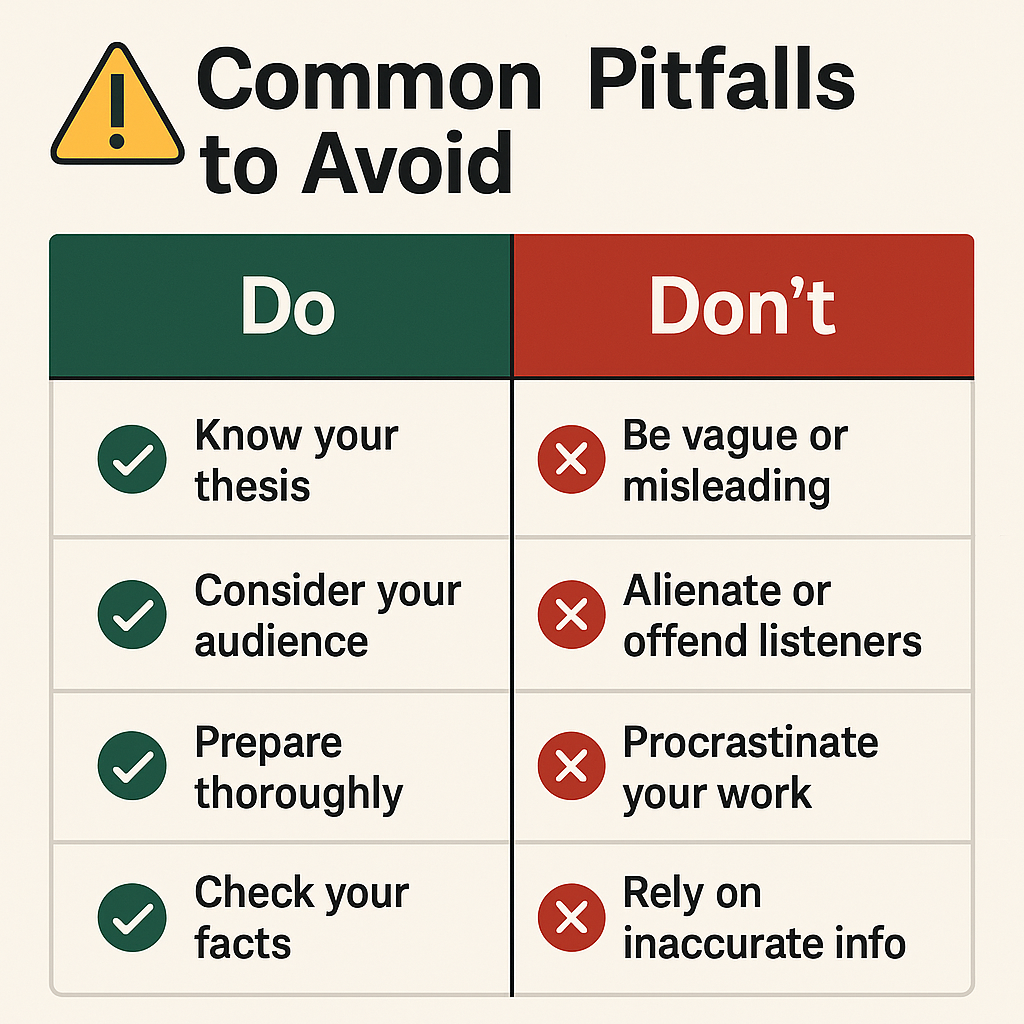
Common Pitfalls Long Description
The image is a comparison chart titled “Common Pitfalls to Avoid”, marked with a yellow triangle warning icon. The chart is divided into two columns under bold headings:
Left Column: “Do” (green header with checkmark icons):
- Know your thesis
- Consider your audience
- Prepare thoroughly
- Check your facts
Right Column: “Don’t” (red header with X icons):
- Be vague or misleading
- Alienate or offend listeners
- Procrastinate your work
- Rely on inaccurate info
The visual structure emphasizes clear positive actions to take and common mistakes to avoid when preparing or delivering a speech. Each point is matched across the row, helping compare good and bad practices directly.
Common Pitfalls Text Transcription
Heading:
Common Pitfalls to Avoid
Table:
Do
- Know your thesis
- Consider your audience
- Prepare thoroughly
- Check your facts
Don’t
- Be vague or misleading
- Alienate or offend listeners
- Procrastinate your work
- Rely on inaccurate info
Try It: Name That Attention-Getter
Activity Instructions: Watch short video clips (or read short excerpts) of different speech openings. Identify what type of attention-getting strategy is used.
Wrap-Up: Every attention-getter works best when it fits both your message and your audience’s expectations. Use this exercise to build a mental toolbox of strategies you can adapt for any speaking situation.
 AI Insight
Yes—AI tools like ChatGPT can help you brainstorm attention-getters, especially for unfamiliar or technical topics. However:
- Always check facts from trusted sources.
- Revise for tone and audience.
- Don’t use AI-generated humor or stories unless they’re edited for clarity, relevance, and authenticity.