
9 Creativity, Technology, and the New History of Marketing
Chapter Overview
Learning Objectives
-
Analyze the evolving role of technology in marketing, from being a functional tool to becoming a strategic partner, and evaluate its implications for marketers, consumers, and society.
-
Examine the intersectionality of creativity and technology in the context of marketing innovation, transformation, and the development of future marketing strategies.
-
Critically assess emerging challenges in marketing—such as consumer intolerance, ethical concerns around ease and data privacy, and the emotional limitations of current technologies—and explore potential creative and technological solutions
Marketing struggles to remain relevant and meaningful in its current avatar. Marketing will have to adorn its new avatar soon. While technology is assumed to be an integral constituent of this new avatar, creativity, which in the author’s opinion will have a rather more central role, is not explicitly accounted for in the overall equation. Technology along with creativity are integrally ingrained in every aspect of marketing. This chapter begins by arguing for the constitutional shift among the marketing fraternity from the perception of technology as a mere tool to being perceived as a partner and a major stakeholder. Reframing technology as a partner is the first powerful step in explaining technology’s future impact on marketing and subsequently on consumers, management and society. This chapter further discusses key areas and challenges where technology will have a major impact in determining marketing’s future. This chapter engages the reader by explaining the intersectionality between creativity and technology and their combined impact on in crafting implications for the field of marketing and along with it consumers and society at large.
Keywords: Marketing, Technology, Creativity, Future, Vision
Introduction
This chapter provides insights into the future of the field of marketing by including creative intelligence and creativity in the equation and by accounting for the intersectionality of creativity and new-technologies and their combined impact on the future of the field of marketing.
There happens to be somewhat of a consensus among the scholarly elite regarding the usage of the mid-life crisis analogy to explain what marketing is experiencing. I too agree with the notion that marketing is undergoing changes, but I believe that mid-life crisis is not the apt way to either understand or explain what marketing is experiencing. Mid-life crisis is a crisis of meaning and purpose that occurs to humans when they are in the middle of their lives. I am not convinced if that can be said with conviction about the field of marketing. To further clarify I don’t think marketing has reached its middle ages. From where I am looking, marketing is merely hitting puberty. There is a sudden influx of hormones (new technologies, new expectations, intangible products), which were absent before, and the discipline is forced to rediscover its identity and relevance. To further clarify, my objection is towards the use of the phrase mid-life and not the crisis part. Hence, below I present to you my analogy, which is also a revised perspective, of what marketing is experiencing.
Creative Re-visioning: Mid-life crisis or Puberty?
I saw something unusual sometime back while hiking through the woods. I was shocked, for a second, because it looked like a snake was eating another snake. I observed what was going on with more focus and attention and realized that that was not the case because if one snake were eating another one, the second snake should be gradually disappearing. That is not what was happening here. Instead, the exact opposite was happening here. Suddenly, it struck me that this snake was shedding its skin because its current skin did not fit well enough and therefore has become irrelevant. I left it alone because according to Sir David Attenborough’s narration, a snake is at an elevated state of vulnerability when it is shedding its skin. Despite moving on physically from the scene, I held on to the phenomenon mentally as it seemed to resonate with what marketing is experiencing. As I pondered over it, it made even further sense and I am now convinced that it is an apt analogy (better than mid-life crisis) to explain the transitionary phase of marketing. I also believe that this is better than the puberty analogy because puberty occurs once but in the case of marketing, I am convinced that such transitions and related vulnerability will occur more than once.
Marketing has grown exponentially and so have customers and their needs. Technological advances have played a key role in this growth of all the three. Different functions of marketing have enhanced in abilities with the entry and utilization of technology. Customers have increased due to advances in medical science related technologies. Needs also have been fueled by technology. Twenty years ago, a picture frame on top of the fireplace or other prominent place in the household would invariably have a picture of the members of the family. The frame still exists but the picture of the family or a family member is replaced with the words “WIFI Password”. This is an observation but at the same time it is also a social commentary that highlights change.
New technological products are being created and promoted at an alarming rate. The current household designs are not in sync with the surge of technological home products. A fundamental redesigning and repurposing of space needs to happen to fit and support all the technological products in the house. The combination of the current household design and new technological products and offerings is not intelligent. It creates friction between the resident and his or her living space. This is but one aspect of marketing in one domain that is creating friction. There are many other aspects where the push from marketing towards excessive and mindless consumption is experiencing what I refer to as the ‘regurgitative pushback’. Both, due to the growth and due to the pushback, marketing is forced to shed its current skin and transform into its new avatar. And due to this, marketing is currently in an elevated stage of vulnerability. Vulnerability that is stemming from doubts, insecurities, and some real concerns regarding relevance and meaningfulness. This vulnerability is the rationale for examining marketing critically and presenting a revised perspective of marketing.
The precise explication of tomorrow’s avatar of marketing is unknown because it constantly changes based on what marketers and consumers independently do or don’t do as well as combinedly do or not do. Marketing is currently riding a technological wave that is fueled mainly by data-based technologies such as machine learning, AI, block chain, and more. The growth of marketing as we have seen in the last two decades is mainly due to the technological revolution and superiority. Countless changes are occurring as you read this chapter and countless more are on their way. Nonetheless, the bottom-line is that the field of marketing is as vulnerable as a snake shedding its skin. Due to the growth of new technologies that impact marketing tremendously, the field, as it is, cannot continue to exist in its current form. If it does, its relevance to the consumers, companies, and society will be deemed inadequate. But at the moment, the snake is undergoing an uncomfortable transition phase. And it has got to engage in some atypical behavior to come out with its new avatar that it does not otherwise engage in during regular times. Also, the hard truth about this technological wave is that like every other wave this one too is headed for the shore. And as the shore closes-in, the wave is bound to lose its influence. But behind the current wave there is another wave building up, which will be composed of creative re-imagination and a revision of the vision of marketing. Creative re-purposing of the existing technologies, while accounting for the unimagined technologies lurking in the dark, will be critical for revised perspective.
A Broad View of Technology’s Future Impact on The Field of Marketing
This section provides a glimpse of the impact of new technologies and its role in the future of marketing. It highlights seven key areas where technology is likely to have a substantial role in the evolution of marketing.
Reframing the role of Technology
My first argument concerns the perception and framing of technology. The concept of technology so far has been perceived as a tool in marketing. It is common to hear people say things like this new technology will help in achieving a given marketing goal or enhancing a marketing function. However, with the evolution of new technologies like AI, and Machine Learning this view, I argue, needs to be seriously challenged. What we have seen so far is, mostly, the rise of functional technologies. These technologies were conceptualized for the role of filling up gaps that creativity could not fill. Creative thought movements were leading the charge and different technologies were put to use to fill a gap and accomplish a function. Technology as a tool enabled marketers to do things quickly, efficiently and effortlessly. As more and more functional gaps got filled, there remained lesser and lesser areas of functional improvement available. This is causing plateauing. If charted on a marginal utility curve, functional technologies have hit their apex and have started showing a diminishing trend following the diminishing marginal utility curve.
Moreover, there is stark difference between old technologies and new technologies. Old technology bluntly and figuratively put, is mindless, whereas new technology is not. New technologies are enterprising and therefore demand respect. This difference warrants a paradigm shift in the minds of marketers and researchers to treat new technology not as a tool but as a partner or a stake holder in the marketing process.
This fundamental symbolic deviation is vital for the field of marketing to transition into its next avatar. When technology is viewed as a tool, it is equivalent to a worker that you put to use after you have made decisions. Whereas when technology is viewed as a partner, you consult with the partner before making important decisions. New technology, I want to reiterate, demands respect. Consulting new technology to make marketing decisions is how scholars should evaluate technology’s future impact on the field of marketing. The perception of the role of technology needs to change and the time when new technologies will start playing an active role in determining the future of marketing is nearer than expected.
Pain Points Are Decreasing but So is the Tolerance of Customers
This is by far the best time to be a consumer. Marketing has done a tremendous job of reducing pain points in the overall customer journey. Major advances in the reduction of pain points have been observed in the last two decades. The advances were mainly aided by technology. Thanks to both old and new technological advances. Making a purchase is incredibly hassle-free. Product quality is the highest that it has ever been. Thanks to superior technological manufacturing, storage and distribution abilities. The only conceivable reason for products to be inferior in this age and day can be human greed or corrupt intent as seen in the case of automobile manufacturer Volkswagen’s emission scandal.
On the other end of the spectrum, customer service has shown monumental improvements to the extent that customer service agents are now eager to assist you with any problem. Years of marketing efforts and stiff competition has taught companies that it is relatively easier to retain existing customers than attract new ones. Due to this, marketing spends millions of dollars in training of the customer service associates and providing round the clock service to their beloved customer.
Digital technology has mitigated greatly or in many cases eliminated any pain points that customers had in regard to going to the mall and making the purchase. In an effort to provide customers value, marketers have almost erased the need to go to a store. You order whatever you want on your computer in the comfort of your home or wherever else you choose. You can do so with your choice of music in the background while petting your favorite furry pet while it is resting in your lap and the product will be delivered to you. No hoping to find a parking spot nearer to the store entrance. No wishing for a cart with all four wheels functioning and not pulling on one side. No wandering in aisles looking for the brand of your choice, which is often not where it used to be due to constant changes in the product placement within a store. No standing in lines for check-out. No braving the words, I do have a coupon to the already overworked underpaid and disgruntled cashier. No worries of running into judging acquaintances or work colleagues who may disapprove of the choice of your toilet paper thickness. All the above and many more pain points are gone, and life just gave you everything you wanted. But wait a minute because this begs the question that what does marketing get in return for all the great work. The answer is less tolerant or incredibly intolerant customers.
Customer intolerance is off the charts. This does not get discussed much because it is not easy to take a dig at customers as the customer is always right, and the customer is the king. Customers misuse their social media presence and abilities to threaten brands to provide them more at the same or less price. Customers have impossible demands that make it impossible to service them. I bring this up not as a complaint against customers but instead as a yet to be discussed and addressed area where new technologies will play a pivotal role in shaping aspects of marketing. This is also a good segue into my next forward-looking aspect of marketing, which is Saturation with Ease.
Saturation with Ease
As explained earlier, technological advances in marketing have done a fabulous job of removing pain points in the consumer experience. With every passing moment, algorithms that are hidden in the clouds are running hard to make everything ‘easy’ for a consumer and for the marketer. Right now, easy is the new toy that is in the process of being unwrapped on the eve of the Christmas morning, or the Diwali day or the Chinese New Year day. We are making the same mistake that every wise, yet emotionally swept parent makes in the moment. We are putting our trust in the permanence of that toy in our child’s life. But as we all know from our first-hand experiences, a child’s interest wanes sooner than the moons waning. As I said earlier, technology enabled ease is a toy that is being unwrapped. Deep learning, big data, machine learning, and artificial intelligence have entered the marketing discipline. They are actively facilitating the figurative unwrapping. However, it is worth noting that consumers, although they may not know it, have a threshold for the want and the need to make shopping experiences easy. Beyond the threshold ease is counterproductive as well as problematic on several grounds.
Ease comes at a price and this is not just referring to the financial cost. With the disposable income increasing and availability of predatory credit lending, I am not worried as much about the financial cost although the later of the two is pernicious and we have already experienced one major economic meltdown in 2008 because of it. Nonetheless, the price of ease in multi-fold. To continue offering unceasing ease, data, lots of data is central. The collection of intimate data raises privacy concerns. The capitalistic US market is not stringent with data and related privacy intrusion, but the rest of the world does not share the same sentiment. Europe has stood up to large tech companies’ practice of collecting data by breaching privacy. Other nations with different cultural and political setup take privacy intrusions seriously and have resisted tech companies through legal recourse. Legal issues cost a lot of money and all this has an impact on the bottom-line and more importantly the brand image of a company making it a double whammy. And to repair the image damage, companies have to spend millions of dollars on rebuilding their brand image which is another hit on the profitability.
A different problematic aspect related to ease is purely a moral and ethical. If we think about the consumer as a person and then examine the effects of too much ease, I can most certainly argue that too much ease will jeopardize the health and well-being of the person, if not the consumer. As a marketer and on ethical and moral grounds, you should self-regulate or be regulated by a body to ensure that the level of ease you are ensuring for the consumer is not harmful for the person. These conversations will become focal as excessive ease becomes more and more prevalent. Balancing this threshold is going to be an important challenge for marketing firms and opportunities for new technology development, which can play a central role in ascertaining the danger levels and mitigating if necessary. This brings me to the next point of adding an emotional element to technology.
Missing Emotional Touch
Technology, without a doubt, has overtaken humans in its ability to conduct ultra-complicated calculations in micro-seconds. However, context and consistency necessary for the emotional connection is missing. From a marketing standpoint, the next critical milestone for technology is emotions. Marketing needs for the new technological advances to develop and add an emotional touch to it. Currently, marketing is the friend that is near you in good times and in bad times. But the real challenge is in being that friend which a person desires during good times and bad times as opposed to be the one that’s just there. Sometimes people need different friends during different times. Humans cannot be two different people, but technology can. And that is what technology should accomplish for marketing to remain relevant.
To further emphasize my argument, I will use two very popular characters (Sheldon and Penny) from the popular pop culture show The Big Bang Theory. What Sheldon is in the show is what technology is now. Accurate, efficient, and intelligent with zero emotional quotient. Penny, on the other hand, is dumb, inept and disorganized but with over the top emotional quotient. AI, Machine learning, and other advanced technologies will have to evolve to add emotional quotient of Penny to Sheldon to create a balanced entity. Giving marketing technology an emotional touch, should be a high priority. Where there are emotions, feelings follow and that is my next argument.
Feelings Are Overpowering Logic and Reason
The rise of the prominence of feelings has just begun. Beginning in the early 12th century, the tsunami of science, logic, and reason started sweeping the societal foundations. This created new perceivably stable structures that enabled and allowed for scientific enquiry to progress and inform decisions at societal and individual level. Lately, the relevance and resonance of academia has not only been questioned but also been ridiculed by an increasing number of politicians and members of the society. Michiko Kakutani (Kakutani, 2018) beautifully asserts that what one feels has become more important that what actually is the truth. Behavior based on logic and reason is largely stable and predictable. Whereas behavior based on feelings is volatile, irresolute, and oscillatory. With such challenges posed to it, the field of marketing will have to reimagine itself by unlearning some of the givens and befriending some of the unreasonables regarding the decision making of consumers, behavior of the market, stability of geopolitical systems.
I am an optimist in the technology’s future impact on marketing, but this is one area that seriously worries me. The power of technology is largely dependent on following a predetermined path and relying on consistent past data. In a feelings-based behavior pattern establishing a pattern is going to be challenging, which will result into weak predictive ability of the technologies. Thus, technology will have to leave lots of room and margin for error but at the same time we also have to be more forgiving towards the follies of the technology. You cannot get mad at a horse for not flying. This presents an exciting opportunity for new technology development that can account for the aberrations and include major deviance for its calculations and still present meaningful marketing insights and decisions.
Lack of Thought Leadership
Scholarly research in marketing has unfortunately been largely unsuccessful in predicting and preventing internal decay. The virus of micro-positivistic research fostering marginal and incremental advances has spread widely and is now keeping the field from growing. According to the article by (Moorman, J. van Heerde, Page Moreau, & Palmatier, 2019), the authors reported that publication of conceptual articles dropped from approximately 40% to below 10% in Journal of Marketing since 2000. Realizing the extent of the decay, the authors asserted that “The need to think outside the box is especially important now because the practice of marketing is changing faster than the research published in marketing journals.” (Moorman, J. van Heerde, Page Moreau, & Palmatier, 2019).
Shifting focus away from micro-positivist incremental advances to broader paradigmatic and conceptual possibilities is an absolute necessity. This criticism is not a criticism of the positivist research or the tradition. This is a criticism of the cumulative creation of a confined horizon of the scope of research possibilities. I would like to quote my advisor on the two advises that he gave me 1) research must be conducted to solve important problems and 2) don’t put the cart in front of the horse. I would say it is important to adhere to these advises because otherwise what we see is waste of resources. Dr. Sheth, when speaking about his work with Bell Laboratories, said that 80% of funded research is conducted primarily for the sake of curiosity. This is a terrible waste of intellectual as well as many other resources but at the same time a major indication of the decay in the field, which needs to be addressed immediately. My last criticism is that marketing has become a very exclusive field. Marketing was marketing because it borrowed concepts and theories and methodologies from every available resource, but such open interdisciplinary attitude is missing now. The undergraduate and graduate programs, the scholarship, and the conferences are highly regimented. From an outside perspective, it may even seem like a doctrinal religious sub-sect where you see people, organizations, and departments paying respects to the accreditation gods. Structures and systems are good, but they can also be stifling and problematic especially when the discipline is in a vulnerable stage.
Voice and Intent Identifiers
I am going to combine these two up and coming technologies that I believe are going to be at the forefront of marketing in the future. Siri and Alexa are just the beginning. Voice enabled interaction with technology would be easily among the top three areas of technological advancement that has improved substantially in the last couple of years. This area is growing and along with it is Intent based marketing. Intent identifiers and intent based marketing has picked up steam with generation of large amounts of digital data. The intent marketing model is based on the premise that it is better to offer customers products that they intend to purchase rather than push them products that they may only be marginally interested. There are models and theories that can capture intent. But they don’t do a fine job yet. When digital data gets combined with voice data, Intent identification will gather more steam and it will hopefully move away from a sound marketing practice in theory to actual practice. What I want to see is coming up with technology that can predict the degree and intensity of intent based on a triangulated set of data generated by an individual through his or her online activities, conversational (voice data) analysis, and benefit evaluation. This combination will make for a powerful predictor that could be the potential game-changer.
Intersectionality of Creativity and Technology
The field of Marketing has oscillated between creativity and technology. A core distinction between the two is that creativity is what we have, and technology is what we build. Creative ideas have revolutionized or brought about paradigmatic changes which open new avenues of opportunity and optimization. As soon as this happens, technology follows. Technological changes bring to fruition or enhance creative ideas and provide functional support for optimization. Marketing although has reaped the initial benefits that it can from the technological advances be it in the area of promotion, production, purchase, consumer loyalty, firm management, and more. Which one is the ultimate game changer in the long run? Based on my assessment, I predict that the impact of technology on the field of marketing will decrease in the upcoming future.
New technologies like AI and machine learning still have a lot more to offer but the problem is that our ability to take from them is also limited. I will use an analogy here to explain this. Imagine you have one basket and you go apple picking. The first time you go with your basket it’s the most fun and cheering experience. You come back with a basketful of apples. The reason being you had access to all the low hanging fruits that the tree had to offer. The second time around, you still might be able to come back with a basketful of apples but this time you will have had to work harder for it. The third time, I am not so sure if the basket will be full because now all the fruits are hard to get at and even the tree has less apples to give. Marketing, I feel, has significantly benefited from technology and it has come back home with two full baskets of apple. But now it’s the third time and apples will not be easy to come by unless a new tree with low-hanging fruit emerges.
This is why I emphasize that Creativity will now impact the field of marketing again. In general, I do believe that there is wisdom in relying more on what we have in comparison to what we can build. However, what we should not forget is that what we build can also have an impact on what we have.
Creativity has played a critical role in the development and repurposing of technology to meet our needs. Human creativity has and continues to influence the expansion and growth of technology. In the context of marketing as seen in Figure 1, we started marketing with creativity. As we progressed, technology was built or put to use to fill up the gaps and cracks that were left by creativity. Most technology used then was functional technology. Smart technology is now entering the domain and it has rapidly revolutionized and changed marketing tremendously. We are at that stage where we are reaping the benefits from its mere existence as opposed to it not existing. In other words, we are not fully deriving benefits from these technologies. However, just like everything once the initial growth spurt is achieved, things change. Take Big data for example, earlier neither was big data available nor were the sophisticated softwares to analyze such big data but now we are being cautious of big data. Big data is experiencing pushback and there is a move towards smart data. We simply don’t want data for the sake of having it, we want data that can be interpreted and transformed into marketable or market friendly insight. Data analytics is also big right now. Every business school now has or is in the process of opening a data analytics major. Data scientist has become the most desired job profile in the last five years. One major conversation brewing about the direction of data analytics is Datavity. A fusion of data analytics and creativity. Creativity is required to come up with creative ways to analyze data and creating insights. Creative ways are constantly sought to generate visualizations of data that can have a meaningful impact on business.
Figure 1 charts the role of creativity and technology in marketing over time. On Y-axis we have the degree of creativity or technology used in different areas of marketing. On X-axis we have time. As seen in the figure 1, the field of marketing started with using high degree of creativity and very little technology. Marketing relied on creativity for promotion of products but at the same time it also relied heavily on creativity to come up with new product ideas to bring them to market. Once products were in place the need to mass produce and mass distribute both the knowledge of the product and the product itself became a priority. This is when technology starts gaining dominance. Manufacturing massive quantities required mechanization and technological advances made it possible. Logistics, supply chain, and distribution of products was made possible by superior infrastructure and constant technological innovation in the automotive industry. Promotion of products and services to distribute the knowledge and information about the existence and relevance of the product was the next frontier where creativity started losing ground to placement and presence on newly emerging technological platforms such as television. The World Wide Web and handheld technological devices elevated the role of technology in marketing to the next level. With the appearances of sellers like Amazon, data collection platform like Facebook, handheld device designers and manufacturers like Apple technology became central in an individual’s life. This was a moment of what I refer to as The Great Migration. The great migration gathered humans and took them to the clouds. Unbelievably and increasingly, vital aspects of our lives are now to be found in the clouds. With so much data already up there in the clouds and even more produced every minute, mining through it and exploring for insights was the next logical step forward. And that is what we are trying to achieve with machine learning and deep learning, and we have seen baskets full of apple coming home. This is good. What is not good is that we are seeing more bad apples in these baskets than good apples and this realization post-consumption is why we are seeing a regurgitative pushback. Marketing has relied heavily on technology in the last thirty years and there has also been a steady flow of new technologies that enabled it. But now the introduction of new technologies has slowed. We do see extensions of the current ones, but entirely new technologies are a distance away.
Figure 1: Intersectionality of Creativity and Technology in Marketing
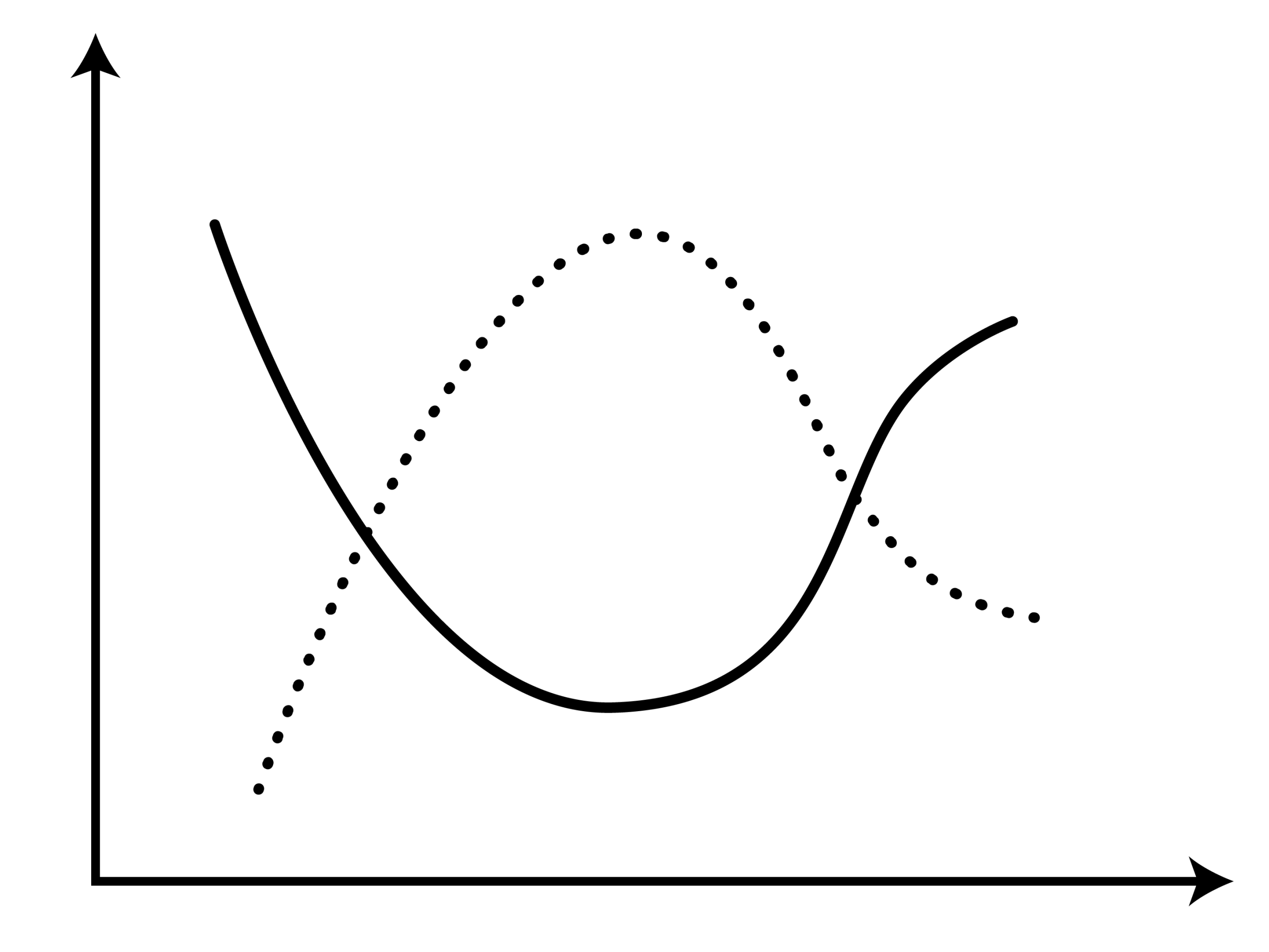
This is why stakeholders in marketing will have to turn to creativity or even resort to a creative breather. Because, creativity is what we have, and technology is what we build. We will have to resort back to what we have to rethink and reimagine what we are going to build next. Moreover, new technology comes in only to be replaced by newer one. Creativity, on the other hand, does not get replaced by newer creativity but it surely does take a back seat for a while when newer technology knocks at the door. Technology does, at times, play a role in enhancing creative expression but that is not at the same level as the vice versa. Figure 1 explains the trend and interplay of technology and creativity and their waxing and waning importance in the field of marketing. Going forward, creativity will see a rise and creative input will be relevant for technology to either bounce back or leap higher and influencing the future of marketing.
Figure 2 demonstrates the journey of marketing through creativity and technology. On the Y-axis we have use of creativity and on the X-axis we have the use of technology. The field of marketing is charted on the U-shaped graph. Marketing starts with high use of creativity and low use of technology. After the initial decade when marketing mainly relied on creativity and hardly any technology, technology stepped in with a bang. And since then technology has consistently seen an increase in its role and influence on marketing. This has gone on for a while. However, this trend will change after the immediate benefits of new technologies such as AI and machine learning are reaped. There will occur a slowdown in the use and influence of technology. This will also be the time when scholars and practitioners will revert back to what they have i.e. creativity.
Figure 2: Usage of Creativity and Technology in Marketing
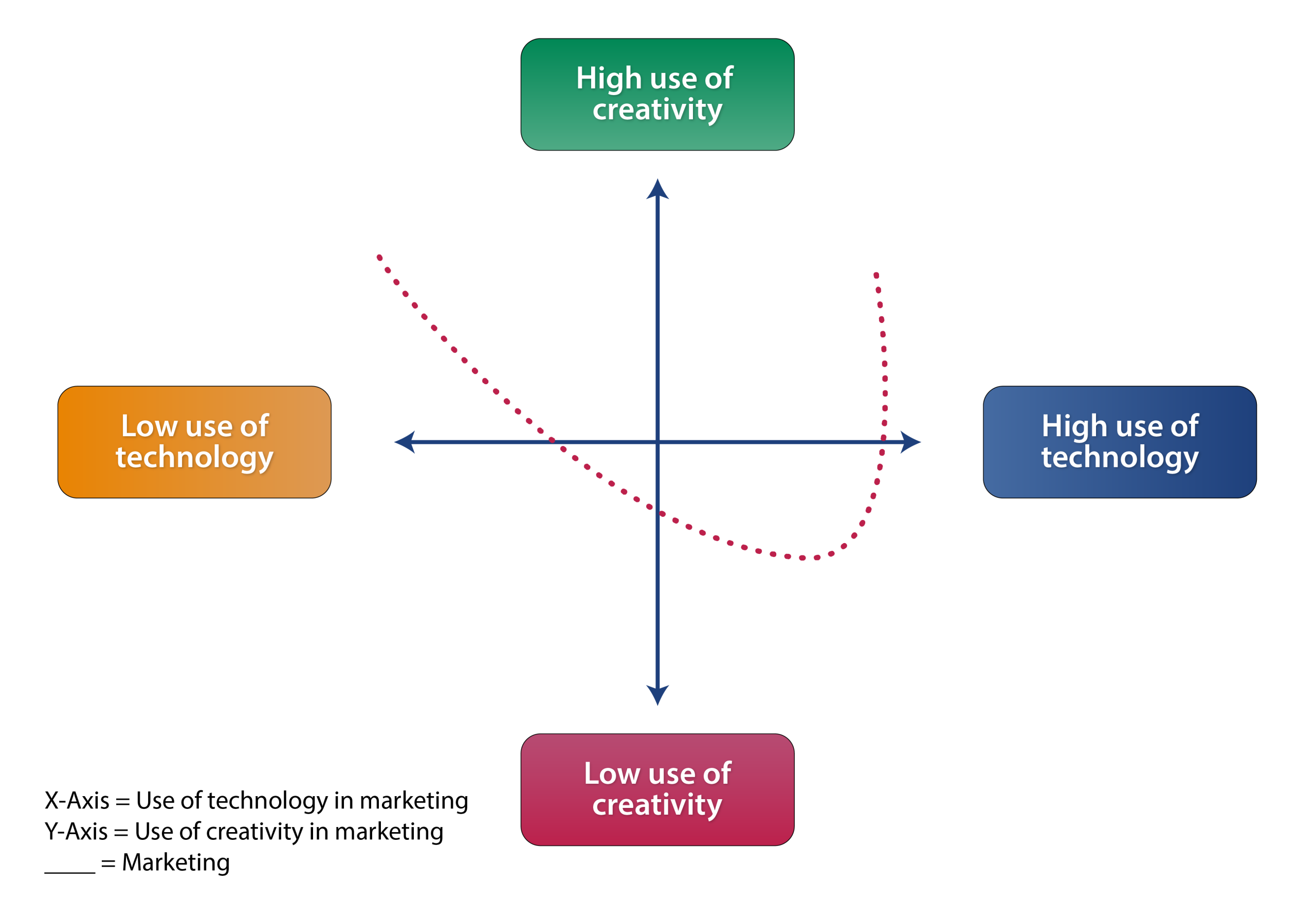
Creativity will influence the further direction of technology or will push for the advent of newer technologies. We are inching closer to what I refer to as the technological slowdown. This slowdown is important because marketing has been progressing without a break and now it is facing a crisis where it has to shed its old skin and adorn its new avatar. Technology alone cannot make it happen because technology is what we build. Creative input and creative inspiration will serve as the ambers that light a fire that will influence marketing in taking its new avatar.
Implications
This section will discuss the major implications of the inclusion of creativity in the equation of future or the new history.
Hiring
The first implication of this revised perspective is on managers, especially hiring managers. For a while skill sets were segregated and hiring targeted a specific skill set. Mangers were willing to hire individuals with degree, skills and experience in computer science and data analytics. Creativity as a skill set was never typically required or sought after. Hiring managers, to prepare their workforce for a future as discussed in this paper, will have to look for individuals that excel in creative problem-solving, design thinking, divergent thinking and more in addition to technological skills. A major challenge that they will have to overcome will be to develop tests and formats to measure and evaluate the presence of these skills. And this will not be easy. Universities and Schools will have to play a dual role here. They will have to 1) create sufficient learning opportunities and experiences for students to learn these skills by revising their curriculum and pedagogical strategies, and 2) conduct research into ways for a hiring manager to accurately measure and evaluate creativity in a potential employee.
Who gets selected for Promotion?
Another implication will be sensed by the workforce in the field of marketing. They will start seeing shifts in who rises to the top and who gets promoted. Individuals with technological background have lately risen to the top and called the shots. The technological wave demanded that leaders and people calling shots be enabled with technological acumen. This will change.
The intersectionality of creativity and technology and its interplay will demand individuals that are skilled in thinking outside the box and those who are interested in moving beyond as well as investing in new paradigms at the helm. Individuals who may have not faced difficulties in securing a job may experience difficulties in securing one.
Academic Restructuring
Educational institutions will have to restructure their departments, hire new faculty or develop existing ones to be able to provide students opportunities of learning and experience while working towards a bachelors or a masters. Numerous universities in the US and Europe have now started offering a master’s degree in Creativity. The learning of creativity, which is also the ability to connect different dots, will also flourish when students are exposed more to a variety of different disciplines suggesting a shift in higher credit requirements for general education courses than the ones specific to a student’s major. Such collaboration with other disciplines and student exchanges with specialized schools will need to be established to provide students with the competitive edge. These demands will most certainly require institutional level policy reform initiatives to shed the existing structure of education in marketing and gain a new form.
Research
The lack of conceptual research work in the field of marketing (Moorman, et. al., 2019) is no secret. With technology as a partner rather than a tool, research trends will shift. Research trends will shift towards areas such as examining the moral and ethical considerations of new technology in regulating itself in providing ease and measuring the effects of ease on a customer. Furthermore, research in conjunction with technology will also shift towards various models of triangulated set of data generated by an individual through his or her online activities, conversational (voice data) analysis, and benefit evaluation to predict consumer demand and intention to purchase with greater accuracy. Another major implication for researchers that I feel will be pertinent is the collaboration between senior scholars and freshly minted researchers. The reason for this is that identifying new areas of research will require what MacInnis refers to as a beginner’s mind. “A beginner’s mind can look at something as if seeing it for the first time and without inference or judgment.” (MacInnis, 2011). However, beginner’s mind only will not be able to fill the research gap. It has to be coupled with an experienced mind that possesses the historical and prevailing perspective of the field. Such alliances have to be established and promoted at the policy and systemic level for identifying new research opportunities.
Since conceptual research has dropped drastically more research can also look further to develop frameworks for conceptual research. Currently, the availability of well-established frameworks for structuring conceptual work is limited. However, this is also an area where researchers need to proceed with caution. Establishment of frameworks and research protocols should not themselves become hurdles to more conceptual research.
Another major concern, which already exists, will be privacy. With advances in voice and intent identifiers, a consumer will further compromising privacy. An individual will always be a specimen in a laboratory. S/he is constantly studied, examined, enticed, lured, and at times even deceived. There are two thresholds that policy makers within institutions and at the national level will have to seriously consider and think about when collecting data. How much should a private organization which exists to make profit know about an individual? Going further guidelines will need to be developed along these lines to ensure preservation of privacy. Secondly, what is or is there a threshold to learning about an individual? In other words, is there a point we can convincingly say that we have learnt everything we can from this individual and there remains no more learning value to be obtained. What happens then? Society and all stakeholders involved will have to determine and formulate guidelines around these issues.
Conclusion: The New History
The impact of technology on the future of marketing is multi-pronged. As marketing undergoes transition and rebuilds its meaning and purpose for the consumer and society and more importantly for the sake of its own survival, technologies will play central role in several aspects such as saturation with ease, domination of feelings, lack of appropriate thought leadership, and more. But before all that happens two major things that need to happen are the change in the perception of technology as a partner rather than a mere tool and inclusion of another major actor, creativity, into the equation. The perceptual shift of technology from a tool to a partner is constitutional. Without this happening, we will always end up with a myopic and an unfairly biased view of technology’s future impact on the field of marketing. If we are to take a forward-looking approach then this shift towards participatory and dialogical model is warranted. We have a lot more to gain from technology as a partner than as a tool. If technology continues to get created in the shadow of mankind, it is going to remain a lesser version of what it can actually be. For the future field of marketing, technology will need to be created in the combined shadow of mankind and intelligent technology. This out of the box thinking will enable scholars and practitioners to access ideas that were previously available but not reachable.
Creativity is the source of the out of box thinking. Creativity is “the drive and ability to make something new or to connect the seemingly unconnected in significant ways so as to enrich our understanding of ourselves, our communities, the world, and the universe that we inhabit” (MacArthur Foundation, 2019). It is through creativity and technology together that marketing will be able to rediscover its relevance and meaning. One without the second will only be a band-aid solution. The intersectionality of creativity and technology is elaborated in the chapter. Based on the explanations provided for the Figures 1 and 2, their co-existence in varying proportions and their subsequent influence on the field of marketing is important in understanding technology’s future impact on marketing, consumers, and society. Technology despite playing a major role in advancing the field of marketing but is going to see a reduction in its influence due to plateauing of functional technologies and lack of creative gaps. Creativity on the other hand will see a rise in its influence within the new development of technologies area as well as repurposing of the existing technologies. These two will co-create a new avatar of marketing that is meaningful and relevant to the new breed of consumers and to the new age managements and societies. Thus, to conclude, ‘Technology Inspired by Creativity’ will shape the future of marketing.
References
Kakutani, M. (2018). The Death of Truth. Penguin Random House.
MacArthur Foundation. (2019) MacArthur Fellows Frequently Asked Questions. Retrieved from https://www.macfound.org/fellows-faq/ on November 12, 2019.
MacInnis, D. J. (2011). A framework for conceptual contributions in marketing. Journal of Marketing, 75(4), 136-154.]
Yadav, M. (2010). The Decline of Conceptual Articles and Implications for Knowledge Development. Journal of Marketing, 1–19.
Moorman, C., J. Van Heerde, H., Page Moreau, C., & Palmatier, R. W. (2019). Challenging the Boundaries of Marketing. Journal of Marketing.