4 Confines of Conformity
Learning Objectives
After reading this chapter, you will be will be able to:
- explain the ways in which societal and organizational conformity can limit creative thinking
- explore historical and contemporary examples of individuals or groups who have successfully defied conformity to innovate
“Is there a template for this? The slow death of creativity begins with this question.”
Conformity. It’s a concept we all understand, even if we don’t actively realize it’s presence. Silent adherence to conformity is rampant. From the way we dress, to how we speak, to the choices we make in our everyday lives, there are invisible rules—unwritten codes that shape how we think and behave. These Confines of Conformity are often so ingrained in us that we don’t even notice them. They are like the air we breathe, ever-present but unnoticed. A fish lives and swims in water all the time but is never really aware of its presence. Conformity comes from society, culture, and even our own habits, and they have a powerful impact on the way we approach creativity, problem-solving, and self-expression.
At their core, the confines of conformity are templates. Templates about the expectations that society has set for an individual. They dictate what is considered normal and acceptable in terms of behavior, appearance, and thinking. This also extends to what is moral and what is not. It is this thinking that we are concerned here with the most. Templates of how one should think are forced down our necks in the two standardizing mechanisms. From the moment we are born, we are taught to fit in, to follow rules, and to align ourselves with the expectations of the world around us. Unquestioned conformity to these maintains structure in society, but they also have a downside: they discourage our inclination to think freely, to challenge the status quo, and to innovate.
You may not even realize how deeply these confines have embedded themselves into our lives. How often do we find ourselves making decisions based on what others expect of us, rather than what we truly desire or believe? How many times have we caught ourselves stuck in convention, simply because it’s easier, more predictable, or less risky? These choices can stifle our creativity, keeping us locked in a box of limitations that we’ve constructed—or inherited—from others. Once you have a template, you just have to follow it. Within a broader societal template, there could be many trends, which you can choose to subscribe to. Between the trends and the templates, your originality and creative expression have no space to flourish.
We have discussed previously about trends and especially about social media trends. Well, now I want you to consider social media templates. Templates for how to create a post or a reel and what filter to use and how many seconds will an image appear before it gives way to another. There are templates for everything on social media and internet. Templates for cover letters, for accounting sheet, travel itinerary, birthday cards, wedding invites, and more. I am sure you all have heard and used the Mecca of templates aka Canva. Canva is all about templates. It has single handedly reduced creativity and ingenuity to ashes.
In a world that celebrates creativity and innovation, the confines of conformity are one of the biggest barriers to true original thinking. Whether in art, business, or personal growth, it’s easy to fall into patterns that are comfortable and familiar, but this can make it difficult to break free from the mold. The truth is, the most groundbreaking ideas and creations often come from those who dare to defy the norm of asking for a template or a sample, which in turn encourages them to think differently, and to embrace the unconventional. And then you have Canva. Where are you going to stand the chance to be creative anymore.
So, what exactly are the “Confines of Conformity”? Think of them as the invisible forces that quietly influence our actions and decisions. They shape what we consider “acceptable” or “expected,” but they also limit our potential for creativity. These confines can be societal—like the pressure to fit in with a particular group or follow a specific trend. They can also be personal—like the habits and routines we develop over time that feel safe but ultimately restrict us from exploring new possibilities. Well, here I want to talk about Rio. Rio was my adviser’s dog. He was older when I met him. He would do this one very peculiar thing. He would suddenly brake while chasing a bird or a squirrel. I did not understand why he did that. After noticing this multiple times, I asked my adviser, why does this fellow stop just when he is about the catch a squirrel. Why does he abandon his chase? My adviser said that that is because of his collar. I didn’t understand what that meant. But then he said that the collar he is wearing has a machine in it. There is a boundary if Rio crosses it then Rio will get a sharp electric shock. It gets a mild one as he starts approaching it. As he goes closer the zap becomes sharper. There is an underground hidden perimeter which gets activated when he crosses it. He then laughed and said well now the device on the collar does not work but he has gotten so strongly conditioned that now out of his own accord he won’t cross that invisible perimeter.
Confines of conformity are very similar to Rio’s invisible perimeter. And often times, those invisible fences are non-existent or irrelevant but then still we conform to them. The real challenge is learning to recognize these confines and then finding ways to break free from them. To do so requires intentional effort, a willingness to step outside of our comfort zones, and a commitment to not seek the templates that would make our life easy. In short, it’s about giving ourselves permission to be unconventional, to take risks, and to explore new ways of thinking and creating.
Activity: Breaking Free from a Zoo
Alright, enough barking or growling or roaring. Let’s break free. Grab a pen, paper, or your device of choice (no templates allowed). Your mission, should you choose to accept it: Break free from the confines of conformity. This one’s a bit wacky but stick with me. Imagine you’re that wild animal, and you’re in a zoo made of templates and rules. What would you do to escape? Maybe you’d climb the fence, dig a tunnel, or disguise yourself as a cute house pet. Draw or write your escape plan. It’ll make you realize how absurd it is to stay locked in when the world is full of possibilities.
Once you have done the above, then try this. In this escape plan you are a bird. Wondering which one. The answer should be clear to you. In case if it is not, then here you go. You are a dodo. And you have to escape from the zoo. Tell me how.
The above two were just warm-up. Now that some creative juices have begun to flow well. Set a timer for 5 minutes. Now, write, draw, or create something without following a single guideline. No “rules,” no template, just pure, unfiltered you. Maybe you write a random poem about your favorite pizza topping or draw a picture of an alien in a sombrero. It doesn’t matter. Just create whatever comes to mind without thinking about what “should” be done.
One more thing you can do here as a sustained longer activity is to pick something you do regularly (like a work report, a social media post, or even choosing your outfit). Now, do the complete opposite of what you’d normally do. If you always go for a safe, black-and-white outfit, wear something totally ridiculous. If you always write formal emails, write one with only emojis. It’s like creativity doing the moonwalk—it’s bizarre, but fun!
How Templates Are the Real Villains
Let’s be real for a second: we all love a good template. Whether it’s for a work presentation, a resume, or that DIY Pinterest project you swear you’re going to do (but never do), templates give us the illusion of control. They’re the ‘comfort food’ of the creative world—easy, predictable, and, let’s face it, a little boring. Templates are like that one friend who refuses to leave their comfort zone and suggests the same restaurant every Friday night because “we know it’s good.” Sure, it’s safe, but is it ever exciting? No. Not even a little.
So, here we are—trapped in the confines of conformity. It’s like someone locked creativity in a cage and gave it a “please don’t escape” sign, because God forbid something original happens. Templates are the cages, and we’re all the poor animals stuck inside, staring at the same walls day in and day out.
At first, templates seem like the answer to everything. They’re like a GPS for your brain. “Don’t worry, just follow the map and everything will be fine!” But templates do have a dark side. They’re not just guidelines; they’re silent dictators, telling you how to think, how to act, and how to create. You end up sticking to what’s comfortable, and suddenly, creativity is like that wild raccoon you never knew you had—stuffed in a cage, shaking its little paws and begging for freedom.
So, here’s the deal: Templates are like furniture instructions. They look nice, they seem useful, but at the end of the day, you’ll be surrounded by random screws and a half-built bookshelf wondering why you didn’t just do it your own way in the first place. Templates limit your imagination because they force you to follow someone else’s idea of how things should be done, which is great if you’re building a desk, but not if you’re trying to, say, invent the next coolest thing.
Think of creativity as a wild animal—like a bear, but cuter—roaming free through the forest, doing its own thing. Then, along comes Conformity, in the form of a zookeeper who says, “Let’s put this bear in a cage so it can’t get out of control.” Suddenly, the bear’s running in circles, trying to make the best of the situation, but it’s just…not the same.
That’s how templates feel. They don’t leave room for creative bursts of energy or spontaneous genius. Instead, you end up with something that’s safe, sure, but boring. It’s like the creative equivalent of a beige wall. Nobody’s ever looked at a beige wall and thought, “Wow, that really speaks to me.”
Let’s talk about the modern-day zoo we have created for ourselves. We are the animals, and the cages a.k.a templates are those neat little boxes we place around ourselves to avoid making waves. Whether it’s conforming to societal expectations or sticking to the “rules” of a template, we’ve basically turned our lives into an uncreative safari.
Here’s the thing, though: We don’t need a zookeeper. We don’t need a template. We need freedom. We need to let that wild animal out of the cage, to roll in the mud, knock things over, and do whatever it wants, whenever it wants. (Metaphorically, of course. No actual animals were harmed in the making of this article.) So be wild and be feral.
Let me blow your mind. I want to introduce something that blew my mind when I learned it. The QWERTY keyboard which is used everywhere was first invented and introduced to reduce the speed of human typing. Typewriters were not able to function as fast as a human’s finger typing speed. The letters of the alphabet were not distributed in the way they are now today. So, they scattered the letters and made it more challenging so that the speed would naturally reduce. Can you believe that? The QWERTY keyboard is an invention to reduce human efficiency. It became a template, and it is still limiting our typing abilities after all these years. Why does no one care to change the keyboard anymore. There are some software that will reprogram the letters to be something else. That’s how far as we have gone. But I don’t see innovation in keyboard hardware anytime soon. We created an inefficient template and then forgot it exists and now keep living in it.
Challenging Your Creative Limits
In pushing against the confines of conformity, we also have the opportunity to challenge the boundaries we place on ourselves. Remember this is all about defying the self. At this level we don’t want to chase the crowd or the zeitgeist. For many of us, creativity feels like something that comes naturally to a select few, but the truth is, creativity is a skill that can be developed and nurtured. The more we challenge ourselves to think unconventionally, the more we unlock new ways to approach problems, create art, or find solutions in our personal lives.
By embracing the unexpected, you begin to break the chains of conformity that may have been holding you back for years. The goal isn’t to reject all societal norms—after all, some rules are in place for a reason—but rather to recognize where the boundaries are and when it’s time to push beyond them. The more we embrace nonconformity, the more we find that there’s no limit to the ways we can express ourselves, solve problems, and contribute to the world. Challenge yourself to think differently, act boldly, and break free from the mental and cultural limitations that may have been holding you back.
When you move beyond the confines of conformity, you’ll not only discover new ways of thinking and creating, but you’ll also uncover new aspects of yourself. The more you embrace this process, the more you’ll realize just how much potential lies within your ability to think unconventionally. It’s time to break the mold—and in doing so, find new ways to express your creativity and shape the world around you.
Breaking free from the confines of conformity is no small task. Society, family, friends, and even our own inner critic often push us to follow specific paths, adhere to routines, and fit in. The challenge comes when we realize that these rules—these confines—may be stifling our creativity. The most groundbreaking ideas and innovations often come from those who step outside the conventional, who dare to do things differently and take risks. In fact, the act of breaking away from conformity is one of the most powerful tools for creative growth.
The first step in breaking the mold is recognizing that the confines of conformity are there. They can take many forms—cultural expectations, personal habits, the need to fit in, the pressure to be “normal.” They can also show up in the form of routine or tradition: the familiar ways of doing things that we’ve always relied on because they feel safe. These confines are like invisible walls that limit the way we think, act, and create. Once we acknowledge them, we can begin to challenge and push against them.
It’s important to remember that not all conventions are inherently bad. Some societal rules are necessary for maintaining order and peace. However, too much reliance on convention can lead to stagnation. And that’s where creativity comes in. Creativity thrives in spaces where the rules are challenged, where the unexpected is embraced, and where thinking beyond the norm becomes the goal.
Fun Activities to Uncover New Ways of Thinking
Now that we understand the concept of the confines of conformity, let’s explore some activities to help you break free from them. These activities will push you to think differently, to step outside your comfort zone, and to embrace the unconventional.
1. The Unusual Object Challenge
Choose an everyday object that you see around you, something simple like a spoon, a chair, or a paperclip. The challenge is to think of at least 10 completely unconventional uses for that object. For example, a spoon could be used as a bookmark, a mini rake for your garden, a hair accessory, or even a piece of art. The more outlandish and imaginative, the better! This exercise forces you to break free from the conventional purpose of an object and approach it with a fresh perspective.
Tip: You can also challenge your friends or coworkers to come up with their own unconventional uses for the same object, then compare your ideas and see who can think of the most unique one!
2. Reverse Brainstorming
In most brainstorming sessions, we’re taught to think about ways to solve a problem. Reverse brainstorming turns this idea on its head. Instead of thinking of solutions, think of ways to make the problem worse. If you’re trying to design a more sustainable product, brainstorm ways to make it more wasteful, less eco-friendly, or more harmful to the environment. This might sound counterintuitive, but the point is that by thinking of what not to do, you can open up new, innovative ways to solve the problem when you flip it back around.
This exercise breaks the conventional problem-solving mindset and encourages creative, lateral thinking.
3. The Random Word Challenge
This activity is all about connecting seemingly unrelated ideas. Pick a random word from a dictionary or use an online random word generator. Then, take that word and think of ways it can connect to something you’re currently working on, whether it’s a project, a story, a piece of art, or a problem you’re trying to solve. How can this word inspire something new?
For example, let’s say the word is “cloud.” How could a cloud relate to a product design, an artistic concept, or a business idea? Could it be a metaphor for lightness or freedom in a new ad campaign? The possibilities are endless! The goal is to force your mind to make creative associations with something completely random.
4. The 30-Minute Rule
Set a timer for 30 minutes, and during this time, you are only allowed to engage in completely random, creative activities. No matter how bizarre or seemingly irrelevant, everything is fair game. Draw on napkins, write poems about your shoes, rearrange your desk in a completely ridiculous way. The catch? You cannot judge your creativity during this time. Simply let go of any expectations and allow your mind to wander freely.
This activity is designed to break you out of any mental blocks, to force you into a creative flow where conventional thinking takes a backseat. When you’re finished, take a moment to reflect on how freeing it felt to just create without any constraints.
5. The Mind Map of Unconventional Solutions
Pick a problem or challenge that you are facing—big or small—and create a mind map. Now, here’s the twist: for every possible solution, think of the most unconventional and out-of-the-box way to solve it. If your problem is “How to get more customers,” think of solutions that you’d never consider if you were bound by traditional business thinking. Could you solve the problem by giving away something entirely unexpected (like a free “disruption” event)? Could you create an unconventional marketing campaign, like hiding clues for your product in unusual places?
The goal of this activity is to stretch your imagination and explore solutions that might seem completely crazy but could lead to innovative breakthroughs.
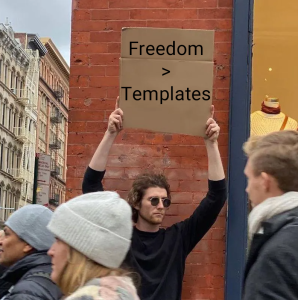
Conclusion — Freedom > Templates (Always)
Breaking free from the confines of conformity requires us to challenge the status quo—both externally and internally. We often put pressure on ourselves to act, think, and create in ways that are accepted by society. However, by embracing the unconventional, we open up a whole new world of possibilities. The more we step outside the expected and embrace new, creative ways of thinking, the more we expand our horizons.
It’s not always easy. There will be moments of self-doubt, judgment, and hesitation. We have an entire chapter about this very thing. It’s called the Crisis in Confidence. So, hold onto your wild horse to learn about these moments of fragility and vulnerability. But you must also know that those are the moments that matter most—because they are the ones that push us to grow. The more we challenge ourselves to think differently, the more we uncover new ways to solve problems, create art, and experience the world.
Remember, creativity is a muscle. The more you exercise it, the stronger it becomes. By breaking free from the confines of conformity, you’re not only allowing yourself to think differently—you’re opening up new pathways for innovation, self-expression, and possibility. And who knows? In the process, you may just discover something truly groundbreaking.
The world needs more unconventional thinkers. And that starts with you. So, go ahead. Break the mold. Step outside the confines of conformity and see where your creativity can take you.
So, there you have it. Templates and conformity are the cages we put ourselves in, convinced that they’re “safe” and “productive.” But creativity is the wild animal that just can’t be contained. It’s time to break out of that zoo, toss the templates aside, and run wild through the fields of possibility. You never know what you’ll create when you stop following the rules—just make sure you bring your wild animal spirit with you.
Media Attributions
- Freedom Over Templates