
1 Chapter 1: Why Mason Bees?
Mason bees are bee species in the family Megachilidae and specific to the Osmia genus. They are solitary, spring-flying species that forage on pollen, nectar, and mud/wetted soil to construct and provision eggs that will hatch and develop into adult bees slowly over the course of the following year. They are a proven pollinator of tree fruit blossoms and are known for their ability to improve both seed and fruit set in managed orchard settings.
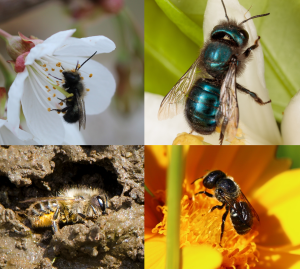
Mason bees are effective alternative (or ‘insurance’) pollinators for early blooming tree fruit orchards for many reasons, including:
- They are more likely to fly and forage in cold or rainy weather conditions than honey bees (Vicens and Bosch, 2000)
- They preferentially forage on tree fruit blossoms over other available resources in the landscape (Crone et al., 2024)
- Their typical foraging range is limited to about 60m (200 ft), providing localized and targeted pollination services (Rust 1990)
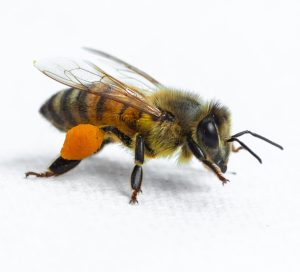
- They collect pollen dry and store the grains in between specialized hairs under their abdomen, called ‘scopae’. In contrast, honey bees wet their pollen with nectar before tucking it neatly away on their hind legs. This means that more pollen is available on the body of a mason bee to enable cross-pollination across varieties within orchards (Parker et al., 2015)
- Mason bees naturally emerge from cocoons in the spring around the same time that fruit trees bloom (in Pennsylvania, this is between March and May, depending on climate and species). Even better, managed populations can be manipulated to emerge when most needed through established practices (Bosch and Kemp, 2001)
- In addition, they are resilient against many of the stressors honey bees face in their daily lives because of their solitary lifestyle. They are less susceptible to many of the pathogens and viruses common in honey bee colonies and developing larvae are sheltered from post-bloom chemical sprays.
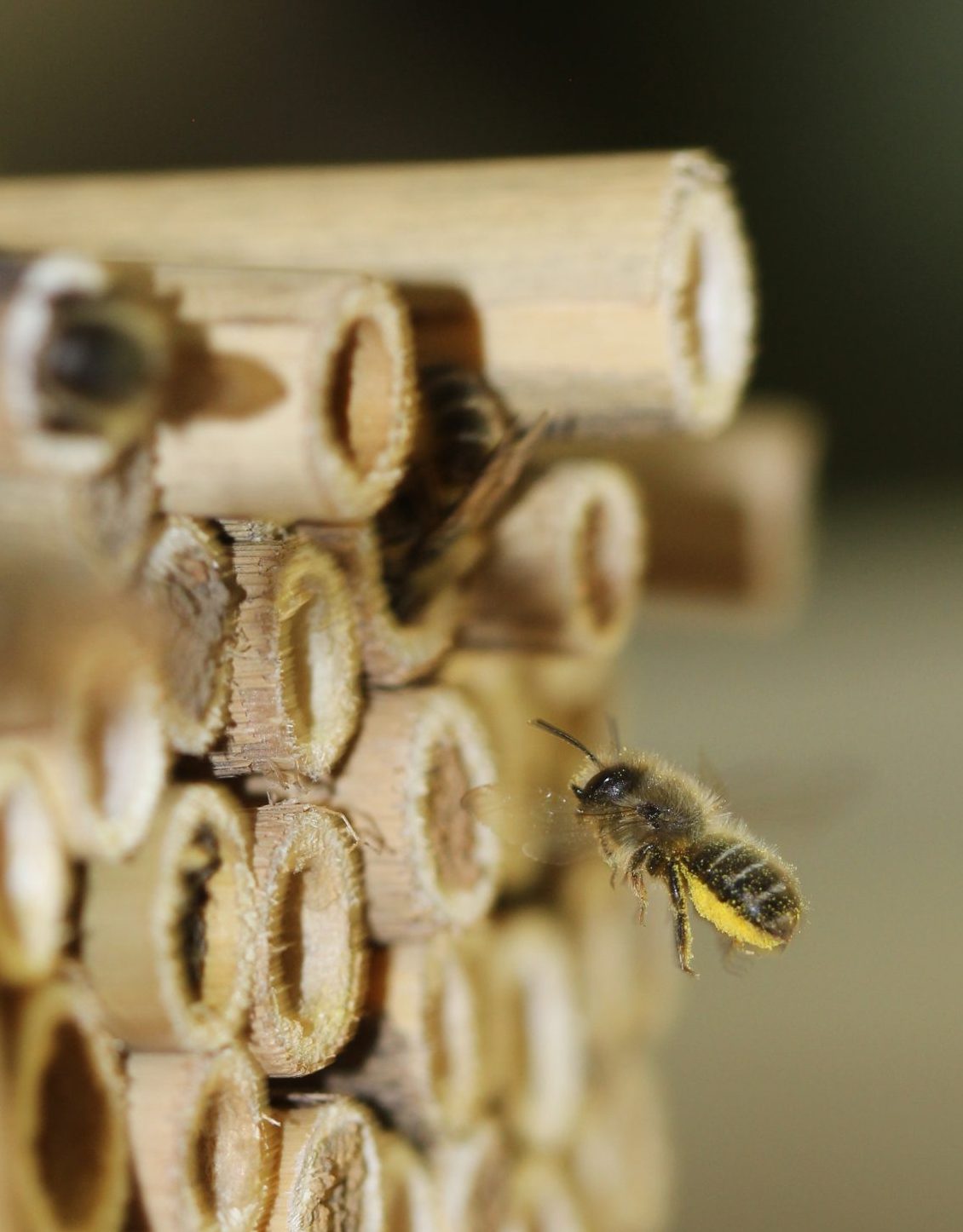
Many orchardists probably benefit from wild populations of mason bees due to their wide distribution and abundance, without even knowing it. Wild pollination services are especially valuable for smaller and diversified farms, which characterize most Northeastern agricultural landscapes. This is because small and diverse farms typically support many pockets of natural, unmanaged land surrounding their crops where mason bees (and other bee species) can nest in naturally occurring hollow stems, reeds, or small abandoned burrows in wood, and are relatively sheltered from chemical sprays.
Mason bees are frequently purchased from local suppliers to improve the pollination services in orchards alone or in combination with rented honey bee colonies. They are typically managed directly by the orchardists, and often in consultation with the mason bee supplier. In the Northeast, Osmia cornifrons, the horn-faced mason bee, is the most well-studied and popular mason bee species to use, although other mason bee species may be available depending on your location and supplier. For example, Osmia lignaria, the blue orchard bee, is most frequently employed in California almond orchards and other orchards managed in Western states. Some mason bee suppliers have begun maintaining and building additional populations mason bee species for sale, including Osmia ribofloris and Osmia californica, although these species are typically not available in quantities to perform commercial-scale pollination services. Further, many of these alternative species are captured from wild populations in the Western United States and thus may perform poorly in humid Northeastern climates.
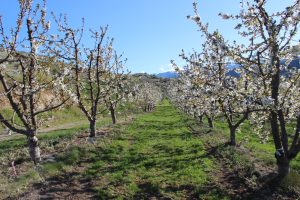
In this handbook, we will focus our management recommendations around mason bee management and husbandry for Osmia cornifrons, the horn-faced mason bee. However, please note that there is a lot of overlap in management practices across species, so many of the practices outlined here can be applied towards other mason bees and corresponding cropping systems. Indeed, many of the practices and recommendations you will read about here were inspired from pioneering mason bee research conducted by the USDA ARS Logan Bee Lab in Logan Utah during the 1970s and 1980s, and primarily on Osmia lignaria, the blue orchard bee.