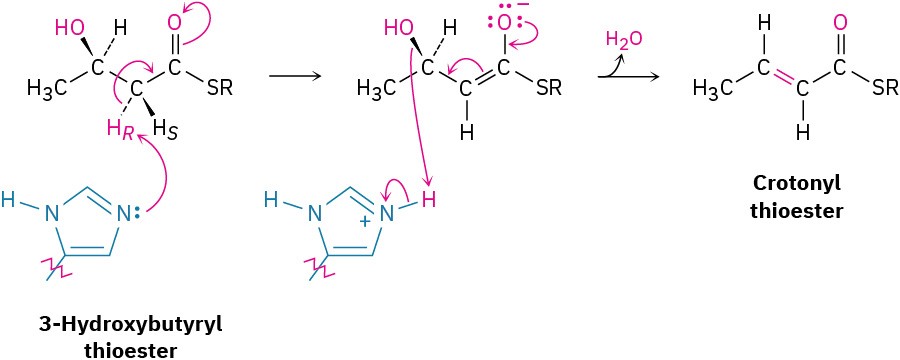
All three elimination reactions—E2, E1, and E1cB—occur in biological pathways, but the E1cB mechanism is particularly common. The substrate is usually an alcohol rather than an alkyl halide, and the H atom removed is usually adjacent to a carbonyl group, just as in laboratory reactions. Thus, 3-hydroxy carbonyl compounds are frequently converted to unsaturated carbonyl compounds by elimination reactions. A typical example occurs during the biosynthesis of fats and oils when a 3-hydroxybutyryl thioester is dehydrated to the corresponding unsaturated (crotonyl) thioester. The base in this reaction is a histidine amino acid in the enzyme, and the loss of the –OH group is assisted by simultaneous protonation.