
10.1 Relevance to Society

As we wrap up the information presented in this open educational resource (OER), it is time to revisit the goal we set at the beginning:
Overarching Goal: After reading through and engaging with the material presented in this OER, students will understand the process of scientific ocean drilling and its context in oceanographic discovery and exploration, past and present.
We started the OER with a look to the past of scientific drilling, from its beginnings as just an idea to reach Earth’s crust/mantle boundary. The first attempt with CUSS 1 for Project Mohole led to institutions organizing and guiding us through some of the most important discoveries about the deep sea. Future vessels and their drilling technologies yielded cores that showed us the presence of salt domes to proving the theory of plate tectonics to so much more.
But as we look to the past of scientific ocean drilling, it is important to also look to the future and the application of what the deep-sea material has shown us, not just in terms of the science but the relevance to society.
Science-based knowledge of Planet Earth is of fundamental importance to support a modern resilient society facing the global challenges posed by climate change, natural hazards, the energy transition, and the needs of a safe and sustainable blue economy. — IODP3 What is scientific ocean drilling?
In a look at some of the final International Ocean Discovery Program (IODP) expeditions, one can see the contributions each expedition is making in the areas of climate and ocean change, biosphere frontiers, Earth connections, and Earth in motion. (These examples were highlighted in Physics Today)
- IODP Expeditions 304, 357, and 399 – Atlantis Massif: probing hydrothermal activity, life, and geological structures at the seafloor along the Mid-Atlantic Ridge.
- IODP Expeditions 316, 343, and 358 – Nankai Trough/Japan Trench: understanding the physics and triggers of tsunami-generating earthquakes at subduction zones to improve geohazard monitoring techniques and responses.
- IODP Expeditions 349, 353-356, and 359 – Indian Ocean and South China Sea: tracking the evolution of monsoons, past and present climate, and relationships between tectonics and climate.
- IODP Expeditions 318, 374, 379, 382, and 383 – Southern Ocean: understanding the interplay between climate change, ocean circulation, sea level, ice-sheet evolution, and the biosphere.
2050 Science Framework
The international scientific ocean drilling community operates under a long-term vision and plan that guides scientists on the important research frontiers that scientific ocean drilling should pursue. This document, the 2050 Science Framework: Exploring Earth by Scientific Ocean Drilling, not only defines how scientific ocean drilling will increase our understanding of Earth systems, it reminds us of the range of natural and human-caused environmental challenges facing society that can be addressed through scientific ocean drilling.
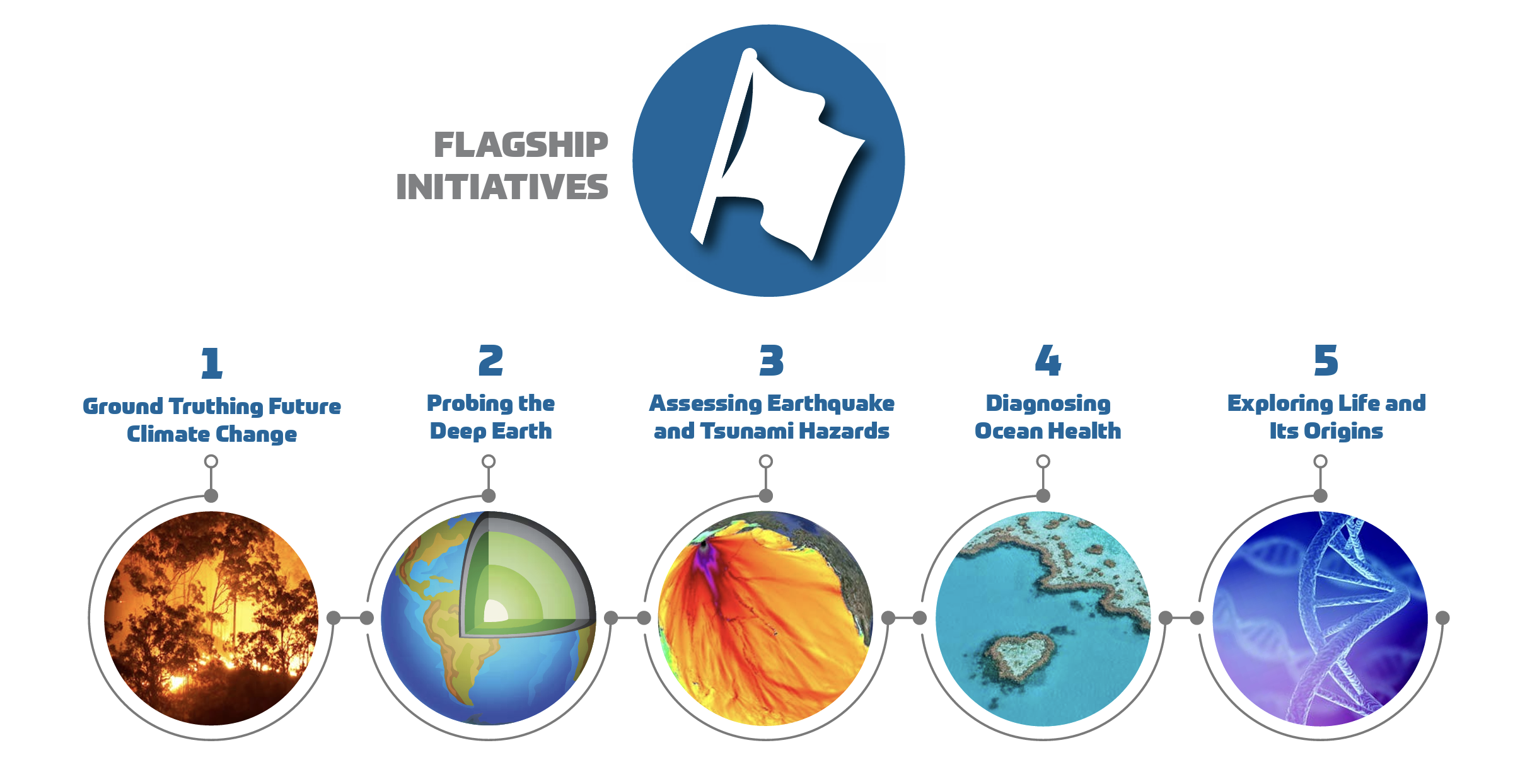
The Flagship Initiatives in the 2050 Framework are the long-term research efforts that require samples, analyses and results from multiple scientific ocean drilling expeditions over 10- to 20-year time intervals . Combined, these multidisciplinary studies will inform issues of particular relevance or interest to society.
So keep looking forward along with the scientists, technicians and crew members involved with scientific ocean drilling expeditions. Whether drilling for new core material or exploring the information contained in core archives, the answers to some of our societal challenges can be found in material from the deep sea.