
Chapter 5: Time to Apply
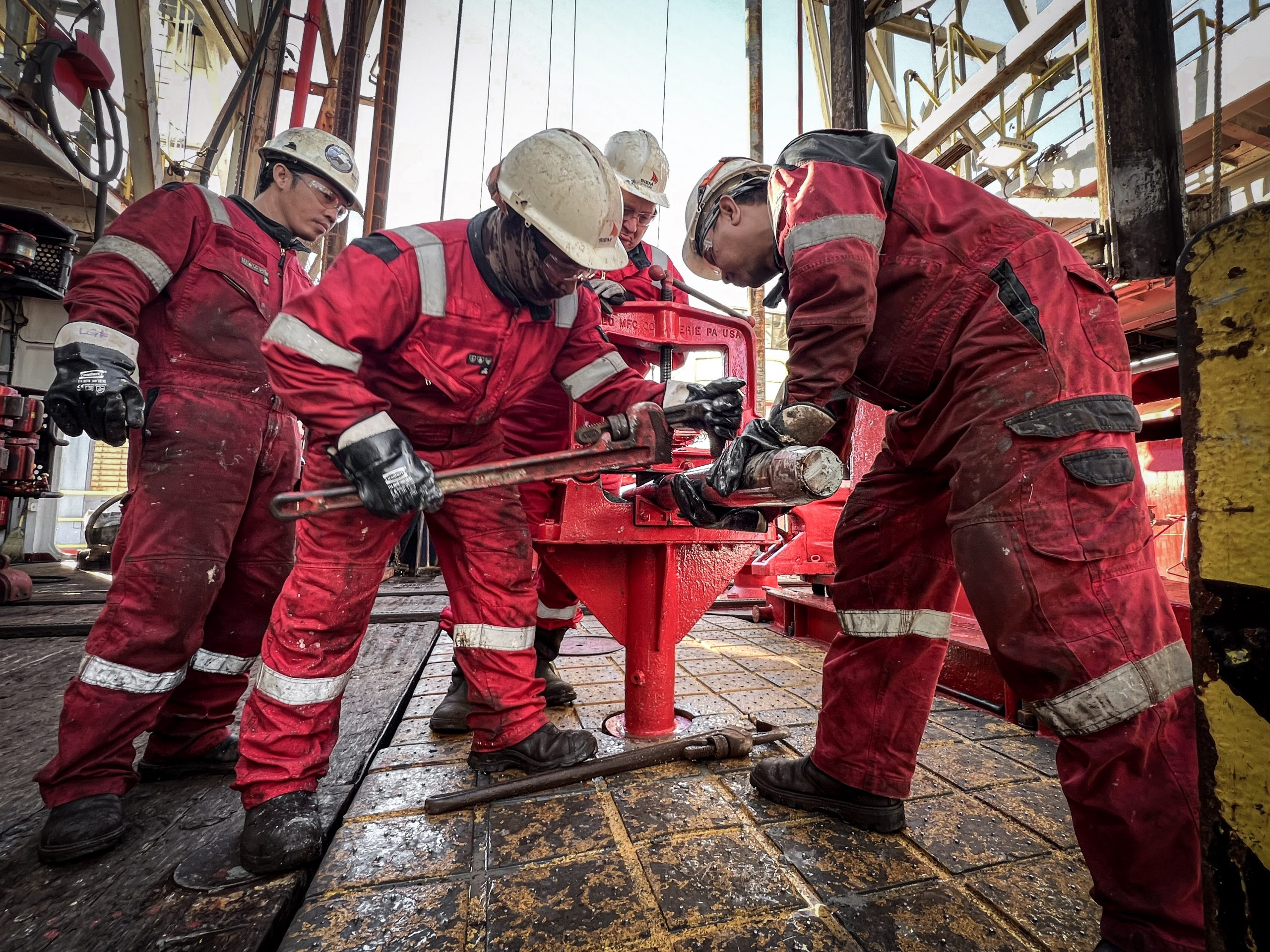
Below are materials to support teaching and learning about scientific ocean drilling that connect to the content in this chapter. We also encourage you to explore the Resources for Educators page in this OER for links to additional exercises and assessments.
Time to Apply: Part A
Exercise 1
View this video about the roles and responsibilities of one the JOIDES Resolution’s operations superintendents and respond to the questions:
a) What were the unique challenges faced by the operations superintendent and crew during deep-sea drilling expeditions?
b) How did these challenges vary depending on the location and type of material being drilled?
c) How did working on the JOIDES Resolution foster cultural exchange and collaboration among an international team, and what could this teach us about global scientific endeavors?
Exercise 2
Based on what you learned about Coring in this chapter, there are differences in the drilling process when coring in soft, hard, and the hardest formations. The data table below was taken from a Daily Operations Report sent out to expedition crew members and scientists during their time at sea. Examine the different columns and rows and answer the questions below:
Expedition 393 Core Data
| Site | Holes | Cored (m) | Recovered (m) | Recovery | Drilled (m) |
| U1559 | U1559 B | 12 | 49 | 26.2% | 0 |
| U1558 | U1558 E | 1 | 9.5 | 104.9% | 0 |
| U1558 F | 23 | 174.2 | 94.3% | 3 | |
| U1558 D | 38 | 220.2 | 45.8% | 0 | |
| U1583 | U1583 A | 1 | 9.1 | 100.4% | 0 |
| U1583 B | 1 | 9.4 | 99.8% | 0 | |
| U1583 C | 13 | 107.5 | 102.5% | 0 | |
| U1583 D | 1 | 9.5 | 105.7% | 0 | |
| U1583 E | 12 | 105.2 | 100.0% | 0 | |
| U1583 F | 28 | 138.5 | 33.1% | 101 | |
| U1560 | U1560 B | 32 | 153.4 | 39.7% | 0 |
| Expedition 393 Totals | 162 | 985.5 | 64.8% | 104 |
a) What kind of formations do you think the expedition crew was drilling into at sites: U1559B, U1558D, and U1583C?
b) For the boreholes where recovery was less than 100% (which means that there are parts of the core that are missing), what kind of information do you think is lost as the scientists try to understand the seafloor formation?
Exercise 3
150,000 Pounds of Stuck
In this chapter, you learned how the drilling substrate determines the type of corer used. Sometimes, certain sediment types, like soft-yet-sticky material, complicated the coring choice —just as IODP Expedition 392 experienced on the volcanic Agulhas Plateau.
Read the following excerpt from the JOIDES Resolution Onboard Outreach Officer about this situation, then answer the questions below:
Imagine shoving a straw through a peanut butter layer cake. When the substrate is sticky or hard, piston coring can become impossible. That’s when we resort to extended core barrel (XCB) rotary coring, which is not unlike corkscrewing into a fine cabernet—if you can envision the corkscrew with a hole in the middle, and the prize being not a sip of wine, but a long, lovely bit of cork. At any rate, I was watching while an enviously agile rig floor crew switched the system from piston coring to XCB rotary coring. Coming out of the drill string was a shiny stainless steel half-length advanced piston corer(HLAPC). Going into the hole, a black XCB rotary coring system.
Why make this switch, which eats up valuable hours of the 11 days we plan to be at this particular site? Not because of any trouble shooting the piston into the formation, but rather because of stickiness, according to Bill Rhinehart, who directs the drilling operation. The deeper we drilled, the more challenging it was to pull the core barrel back out. The marshmallowy substrate at shallower depths below the sea floor was now glue-like at 142 meters down.
We hadn’t yet hit rock, so we kept piston coring as long as possible, because the quality of core is so much better versus the more disturbed material recovered during rotary coring, Bill explained. It’s a delicate weighing of risks and benefits. The upside of piston coring is you get a relatively pristine sample. It has an orientation. Scientists can tell how it was situated in the ground, which is key for magnetic analyses, among other things.
“We may be stuck,” Bill remarked, not seeming alarmed. “It happens.” What happened next was unusual, however. And unfortunate.
When an assembly gets stuck, the rig floor crew tries to fish it out, essentially drilling over it to wiggle it free. If that fails, the only option is to pull. And then pull harder.
Most often, it pops free. But not always.
“We were 150,000 pounds of stuck,” Bill said, referring to having pulled to the tune of 68 tons—until something broke. The short, sad story is that the core and core barrel are still down in Hole U1579A, 76 meters below the sea floor. Since then, having moved just 20 meters to the north, with the JR’s dynamic positioning system holding us steady, we tripped all of the pipe back down to the seafloor to begin Hole U1579B—a 20-plus hour process. Not only expensive and labor intensive, it makes for bleak downtime when scientists are hungry for core.
But soon enough, the welcome words, “Core on deck!”
-Maryalice Yakutchik, Expedition 392, February 17, 2022
a) Why do scientists prefer piston coring over rotary coring when possible, and what trade-offs must they consider when switching to XCB rotary coring?
b) How does the changing consistency of the seafloor sediment impact the coring process, and what challenges does this pose for obtaining high-quality samples?
Exercise 4
Expedition 336 visited North Pond on the western side of the Mid-Atlantic Ridge. OKI Productions created a documentary following the expedition, featuring stories from both the science and operations crews. Watch the documentary from minute 17 to minute 47 and answer the questions below:
a) During this time range, who are the people introduced, and what are their goals for this expedition?
b) What is the thermistor string, and what problems did they encounter when trying to collect it before removing the entire CORK body?
c) What is the purpose of the colonization experiment (also called Flux)?
d) Where were all the CORK parts fabricated for this expedition?
e) Why are fiberglass collars being used instead of steel?
f) How much does the drill string weigh?
Time To Apply: Part B
These lessons are based on are based on activities developed by educators and scientists who worked aboard JOIDES Resolution. They have been revised by the American Geosciences Institute (AGI) to connect to Next Generation Science Standards (NGSS) and to include additional support for student learning. All lessons can be found under Educational Resources Using Ocean Coring Data.
1. Understanding Oceanic Crust Using Density — Students will be able to calculate the density of samples taken off the west coast of Central America to determine the relationship between density and depth in a given core, and measure, calculate, and compare to continental rock samples.
2. Downhole Logging Data Patterns–After coring is complete at a site, the borehole itself becomes a laboratory. Instruments are sent down and data on the formation is collected continuously as the instruments are retrieved. This process is called downhole logging. Students will examine data collected along the Cascadia Margin and the Peru Margin to explain why it is done and what it allows scientists to learn about the ocean floor.
3.Inquiry into Sediment Cores — Sediment cores hold a lot of information, and sedimentologists take toothpick amounts of sediment to learn more. Check out this activity that serves as an inquiry-based introduction to description of sediment cores and to primary types of marine sediments, their distribution on the sea floor, and the controls that determine their distribution.
These lessons are based on are based on activities developed by educators and scientists who worked aboard JOIDES Resolution. They have been revised by the American Geosciences Institute (AGI) to connect to Next Generation Science Standards (NGSS) and to include additional support for student learning. All lessons can be found under Educational Resources Using Ocean Coring Data.
3. Put a CORK in It: Monitoring Conditions under the Ocean Floor–Several sites on the Juan de Fuca Ridge axis and flanks have now been drilled and sealed by CORKS equipped with long-term pressure and other data collecting instruments. Students use CORK data of fluid pressure within seafloor sediment and rock to explain tectonic activity of the Juan de Fuca Plate.
The JOIDES Resolution website has an entire collection of Classroom Activities that include lesson plans, data exercises, digital interactives, posters, and career information. Here in Part B, we call attention to materials that relate to the content of this chapter.
4. Drilling rates through oceanic crust — Students will be able to calculate drilling rates over a three-day period during Expedition 309 off the coast of Central America by using the data provided.