
Chapter 7: Time to Apply
Below are materials to support teaching and learning about scientific ocean drilling that connect to the content in this chapter. We also encourage you to explore the Resources for Educators page in this OER for links to additional exercises and assessments.
Time to Apply: Part A
Exercise 1
Check out this blog written by a geologist from the British Geological Society about the sample party for Expedition 368 – it had to be held on the ship because of covid protocols! Here is an excerpt:
“The reason we were all in Japan was to complete the sampling from 831 m of cores that had already been retrieved from 8 km below the sea surface at the bottom of the Japan Trench. These cores contain valuable records of ancient mega-tsunamis, triggered by the rare but devastating, huge earthquakes that shake this part of the world. ” — Dr Jeremy Everest
a) How many cores were sampled?
b) The expedition was conducted off the coast of Japan. What core repository would the cores be stored?
c) What institutes/ organizations were involved in this sampling party?
Exercise 2
Watch this video and then answers the following questions:
a) What expedition or leg number does the collection start with?
b) Why would the working halves of cores be put on the bottom half of the core shelves?
c) What is the Paleocene – Eocene Thermal maximum? What key organism were they able to use to study this event in the sediment?
Exercise 3
a) Why were scientists surprised about the Tōhoku mega-earthquake?
b) What are homogenite-turbidite sequences?
c) What is the decollement zone and how is it related to chert?
d) The article mentions that the Japan Trench is not an isolated case. Why is that?
Exercise 4
Listen to this interview with Chad Broyles of the Gulf Core Repository (GCR), and answer the questions below:
a) Which institutions originally held the core collections before the National Science Foundation (NSF) consolidated them into three main repositories?
b) What do the day-to-day operations at the repository involve?
c) How does the GCR preserve its core samples?
Exercise 5
The BCR has written about what it takes for the science party to sample their expedition cores at the repository. Read through this article about the process and answer the following questions:
a) What is the SAC and what is their goal as they set up for the sampling party?
b) The article mentions that “Good planning at this stage is critical …” when discussing creating the sampling plan. How would you handle create a sampling plan if you were able to open up a core only once? What organizational tools could you implement?
c) In what case of sampling would the plastic receptacles have to be swapped out for metal ones?
Exercise 6
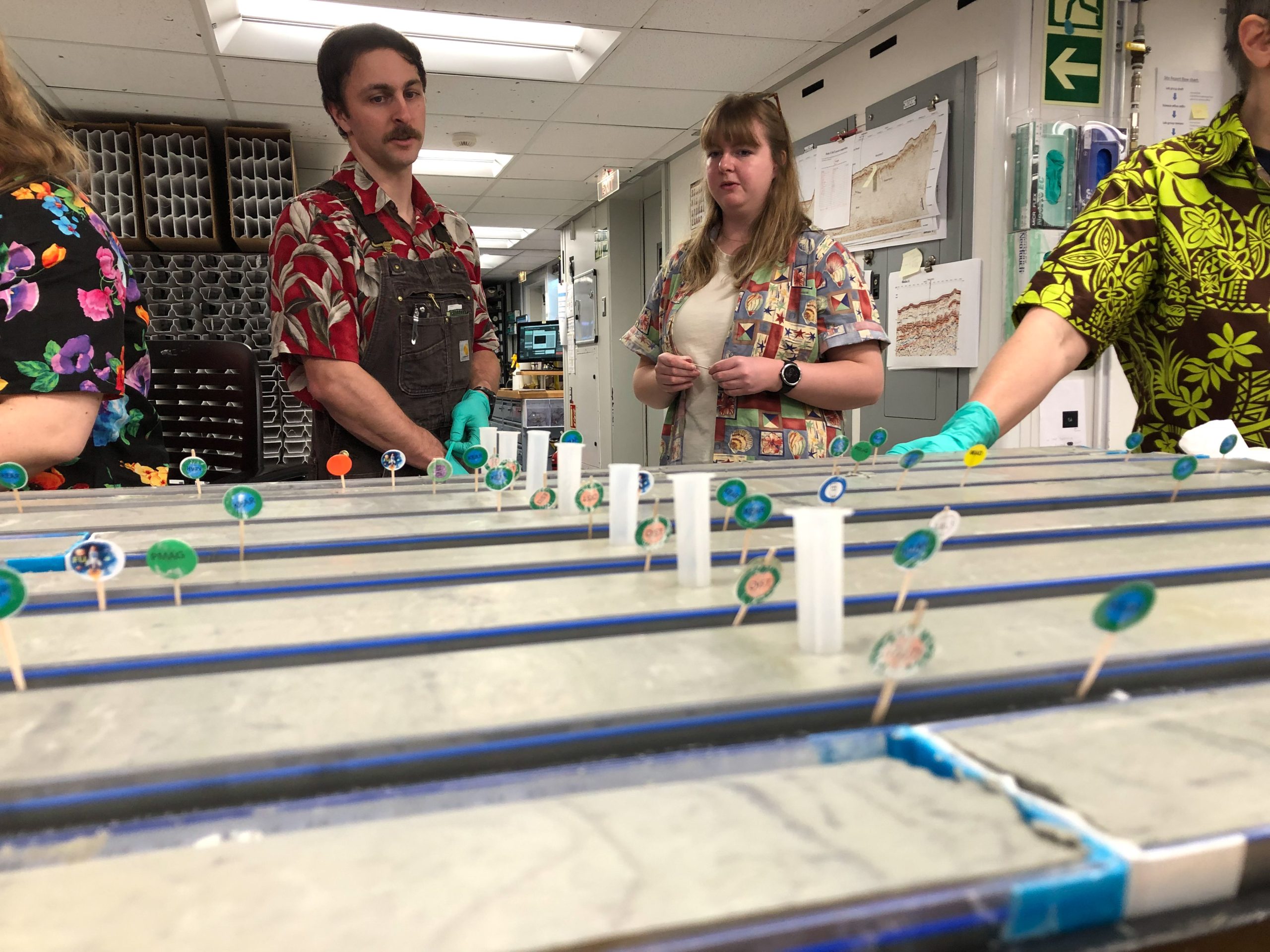
In the video above, you see Erin being guided through the process of taking samples from the cores laid out on the table during a sample party. The cores are aligned along a table ruler to show exactly where samples should be taken. After watching the video, consider the following questions:
a) If you were in Erin’s position, what skills would you need to follow along with the scientist’s instructions for taking samples?
b) Why are the scientists wearing gloves during the sampling process?
c) Why do they place foam cubes or wedges in the spots where samples have been removed?
Time to Apply: Part B
The JOIDES Resolution website has an entire collection of Classroom Activities that include lesson plans, data exercises, digital interactives, posters, and career information. Here in Part B, we call attention to materials that relate to the content of this chapter.
- Try out curation yourself with this lesson plan, Core Section Curation, developed by the outreach team for IODP. You will be able to use your prior knowledge, plus the guides and materials provided, to catalogue and label one or more core samples.
- ECORD has seven replica cores based off of ODP and IODP drilled cores. These replicas are available for classroom activities and can serve as displays in temporary exhibitions or conferences in Europe and Canada. Learn more here.