9.5 Patches, Logos, and a Sea Turtle Rescue
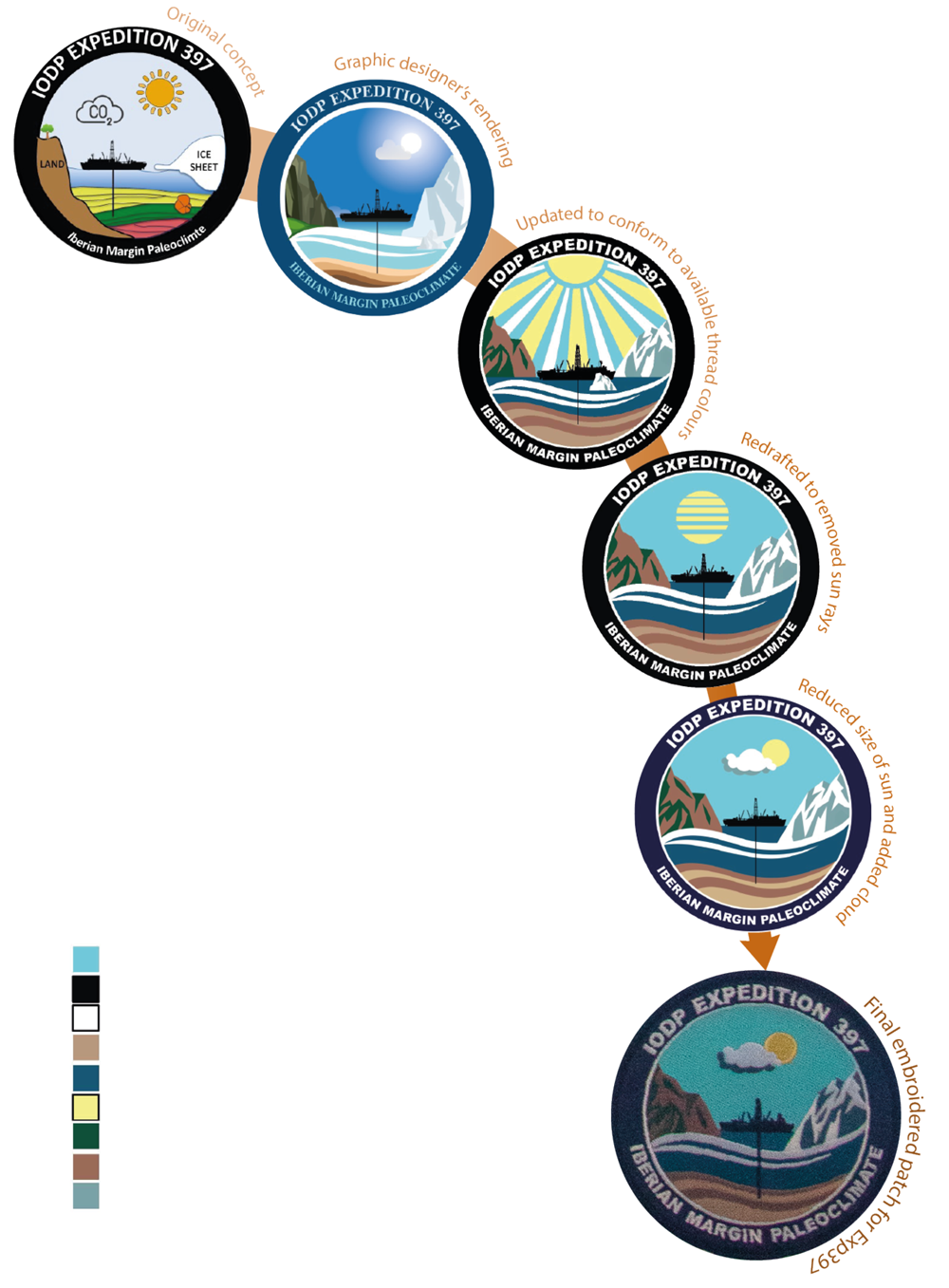
Patches have been generated for scientific ocean drilling expeditions going at least as far back as IODP Expedition 317 (November 2009 – January 2010). These embroidered emblems each feature a unique design corresponding to the expedition’s scientific goals, the vessel used (JOIDES Resolution, a mission-specific platform, etc.), and the specific location of the drill site(s). The artwork on a patch is a piece of visual storytelling, often conveying complex scientific concepts, such as a link between what is being cored and the surrounding environment, or the geological processes occurring at a particular drilling location.
The caption in the above figure describes the process that was undertaken to develop the image for the center of the patch for IODP Expedition 397. The main objective of this expedition was to recover the sedimentary archive preserved beneath the seafloor on the Iberian margin to study past climate change with great precision at high resolution over short periods of time. The patch design reflects these sedimentary layers in the subsurface of the ocean, with the drilling vessel JOIDES Resolution floating above a drill site.
Expedition patches are distributed during an expedition to those on board the drilling vessel, acting as a commemorative symbol of the research undertaken by the scientists and crew.
The Story Behind the Sea Turtle Logo

As stated previously, each patch design was generated before the official start of a drilling expedition. This is the patch for IODP Expedition 395E (April-June 2021), a different type of expedition. This expedition did not sail with scientists on board at the time (see Navigating COVID-19), only with technicians and the crew to complete reentry installations along the South Atlantic Transect for the upcoming IODP Expedition 390/393 sailings in 2022.
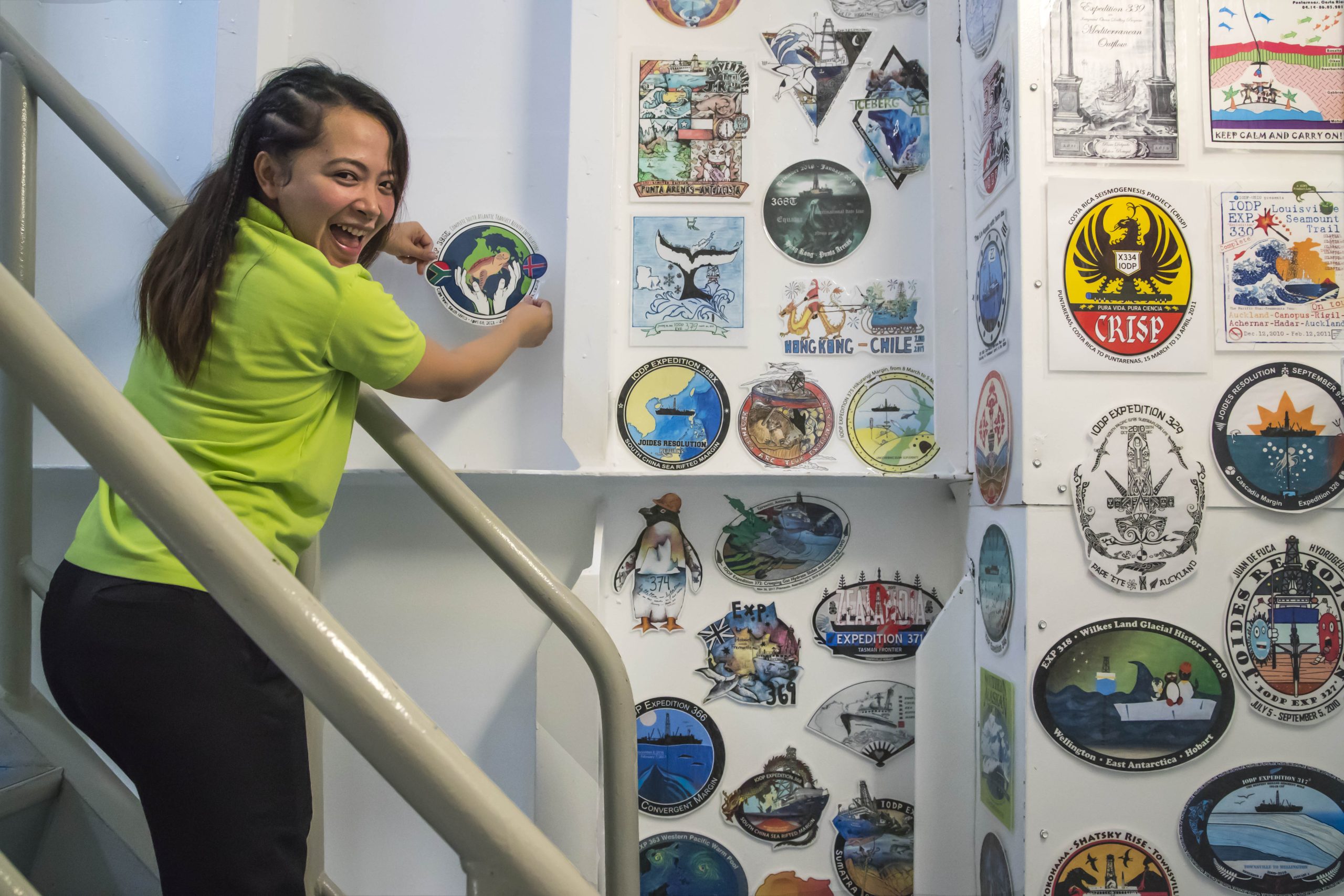
But in addition to the expedition patches, each expedition held a contest to design an expedition logo. The contest was held on board while the drilling vessel or platform was at sea and open to all scientists, staff and crew. The logo was different than the patch, as it typically reflected activity or an event that took place during the expedition. The contest submissions were requested towards the end of an expedition and would be displayed for a secret vote by paper ballot. The winning logo would be printed on t-shirts that scientists and technicians brought on board JOIDES Resolution, and a printout of the logo would be hung in the stairwell among the “hall of fame” of other design-winning logos from prior expeditions.
One logo that hung in the stairwell with a unique story was the one for IODP Expedition 395E.

IODP Expedition 395E started with JOIDES Resolution departing Cape Town, South Africa, and after 20 days of on-site operations, then completed a three-week transit to end the expedition in Reykjavík, Iceland. The limited on-board contingent successfully cored to basement at two new sites and completed reentry systems at three sites on the South American plate perpendicular to the Mid-Atlantic Ridge. During these operations, the JR is always keep in eye on not just what is happening below the ship, but also what might appear on the surface around the ship. A Texas A&M University article reported how, after the JR was seven days away from shore, one of the crew members spotted an unidentified floating object. As that object came closer to the ship, it turns out that the object was a sea turtle entangled in fishing nets.
Once the turtle floated close enough to the JR, the crew used a rod to pull the netting closer, then hooked the object and used a winch to lift it up the side of the ship. The netting was cut and the freed sea turtle splashed back into the ocean and swam away.

The observations and actions of the crew in saving this sea turtle led to this expedition’s contest-winning logo design and its incredible story of a rescue and release at sea.