
8.4 Southern Ocean Exploration
Two photos taken on JOIDES Resolution during IODP Expedition 319. Top photo: Saiko Sugisaki (Paleomagnetist, Graduate University of Advanced Study, Japan) watches icebergs go by. (Credit John Beck, IODP/TAMU); Bottom photo: A Transocean crew member removes snow from the main deck. (Credit Zenon Mateo, IODP/TAMU). (MerlinOne photo archive, CC BY 4.0)
The Southern Ocean is the region that extends from the coast of Antarctica to 60 degrees South latitude and is also defined by the Antarctic Circumpolar Current (ACC), the largest wind-driven current on the planet. The Southern Ocean is a region where the scientific ocean drilling community had an early interest, as Glomar Challenger sailed into these high-latitude waters for four Deep Sea Drilling Project (DSDP) expeditions: Leg 28, Leg 29, Leg 35, and Leg 36.
View this video to learn more about scientific ocean drilling, and ice-based drilling on Antarctica, from the early years until 2018 (note the final JOIDES Resolution expeditions in the Southern Ocean occurred after this video was produced).
This paper, published in 2025, is a summary of the significant findings from scientific ocean drilling in the Southern Ocean, as well as potential topics and exploration for the future.
“Shipboard excitement” from DSDP Leg 28
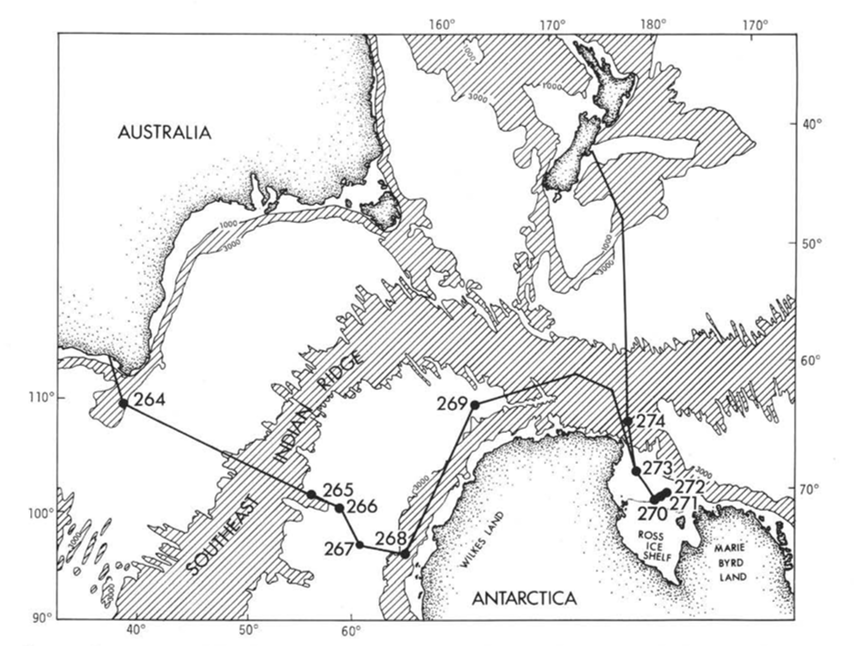
DSDP Leg 28 was designed to explore the long-term glacial, climatic, biostratigraphic, and geologic history of the Antarctic continent and the region. This figure shows the route of Glomar Challenger for Leg 28, starting in Freemantle, Australia, and concluding in Christchurch, New Zealand, sailing a total of 7,400 nautical miles. During the expedition, 16 holes were drilled at 11 sites, with 4,606 feet (1,404 meters) of sediment recovered. There were significant scientific findings from Leg 28, notably pushing back the age of Antarctic glaciation from 3 million years to 25 million years. But there was more than the science that was collected on this expedition, thanks to the personal notes of the sedimentologist on board, Dr. Elizabeth Kemp Truswell.
SciOD Spotlight – Elizabeth Truswell (A Memory of Ice – DSDP Leg 28)
Dr. Elizabeth Kemp Truswell was a postdoctoral researcher at Florida State University when she joined Glomar Challenger in the Southern Ocean for Leg 28, December 1972—February 1973. When she wasn’t focused on her science duties as an onboard sedimentologist, Elizabeth decided to keep a diary, as was customary of Antarctic explorers from the past. She turned her diary into a published book, titled A Memory of Ice: The Antarctic Voyage of the Glomar Challenger (PDF of chapters available online).
Elizabeth was motivated to publish her diary, as “the achievements of this voyage have been documented in the scientific literature, but there is no account of the shipboard excitement that accompanied these” (p. xxiii). And although “diary keeping was possible for most of the voyage, but when the vessel entered the Ross Sea, where shallow water meant that cores were landing rapidly on the deck, the pressure of dealing with more and more drill core in a tight time frame meant that I abandoned the diary” (p. xxii)
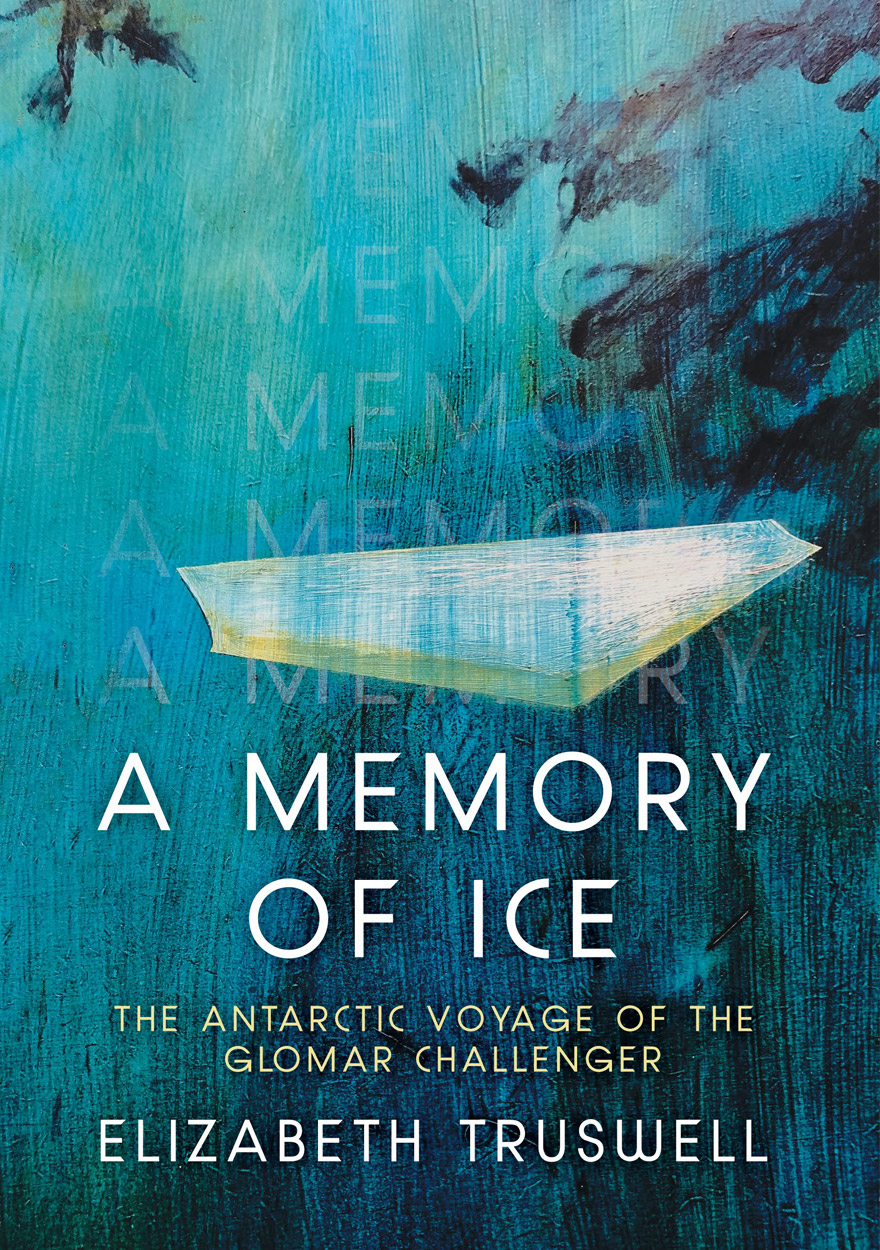
On Monday, January 8, Elizabeth wrote about the time demands on writing up her initial findings: “No chance much since scribbling the above notes to fill out details. Site 266 took up about 3 days of time solidly, with only time for quick meals and a few hours sleep – managed to get my site summary in by the first day of our fourth site (267) and feeling quite pleased with it – it will probably get shredded editorially” (p. 106).
Her entry from Thursday, January 18, shares some of the physical environment around her while working on the interpretation of her results: “Strangely, there has been no birdlife in these past few days – we have come a little bit north again, and lost the icebergs a day or two after the last site, so it is strange that the seas seem so barren” (p. 129).
Elizabeth’s diary entry from January 29 presents the range of emotions felt around the science as it unfolds at sea: “There is too much to record! I have given two talks this past week – one on the preliminary stratigraphy of the sites so far, and one on Antarctic vegetation history. The discussions have been strenuous. The co-chief scientists are rather aggressive and highly competitive during these sessions. Our other sedimentologist is quick tempered and goes red to the roots of his hair when he fails to win his point. Others, fortunately, are steady. These are strange sessions. They are difficult because the problems we are trying to grasp are difficult, and no one alone can get there, but the men make it harder because of their competitiveness… or have we just been at sea too long at this stage?” (p. 151).
To read more about Elizabeth, DSDP Leg 28, and some of the historical mapping expeditions in the Southern Ocean, be sure to check out d A Memory of Ice: The Antarctic Voyage of the Glomar Challenger.