7.3 The Legacy of Cores

The purpose of repositories are to store cores and other samples taken from the seafloor through time, and to make them accessible to the larger science community. They have served the scientific ocean drilling community thus far by providing samples for scientists internationally, for Masters and PhD candidates to build out their theses, and by providing material that can be used in community education.
The role of scientific ocean drilling core repositories remains unchanged, even as the research community transitions to new drilling vessels and platforms. The Bremen Core Repository (BCR) is working with multiple expeditions that have been run on mission-specific platforms funded through ECORD and IODP3. The Gulf Coast Repository (GCR) transferred all instrumentation from the drilling vessel JOIDES Resolution to its facilities at Texas A&M University (TX, USA), allowing scientists sampling GCR cores—or working with their own cores—to use the laboratory facilities for their analyses.
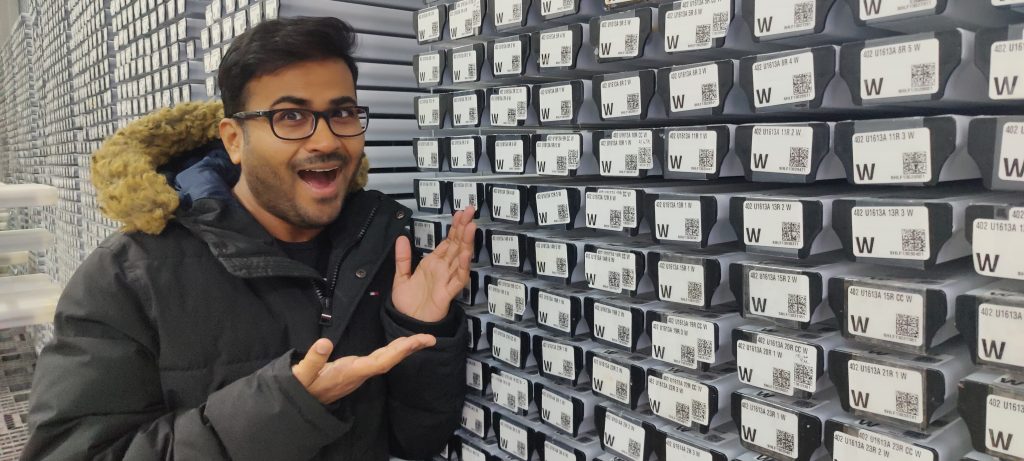
SciOD Spotlight: A PhD Student using cores for their academic research
OUtreach at Repositories
All three repositories provide outreach, education, and professional development opportunities for the public. For example, the BCR at MARUM offers both an online virtual tour and information for visitors interested in in-person tours of the facility. The repositories are not only home to seafloor samples that hold Earth’s history, but are also staffed by experts who share their knowledge through workshops. At the GCR, a five-day workshop called CORE School (COres for Research and Education) introduces participants to scientific ocean drilling methods and subseafloor analysis techniques. This program is open to ocean science geologists at any career stage. The BCR also hosts the ECORD Summer School, a two-week program that immerses participants in ocean drilling science and core analysis. Meanwhile, the KCC organizes multiple seminars each year to showcase the diverse research being conducted on cores.
Bringing people together to learn
This Instagram post with description is from the @ecord_iodp and @marum_uni_bremen accounts celebrating the 21st Century Drilling Workshop, posted on November 11, 2024.
This week, the Bremen Core Repository at MARUM has hosted the second of two 21st Century Drilling Workshops funded through the ECORD MagellanPlus scheme. As part of these linked workshops, we are bringing together a group of international scientists to explore best practices for combining digital- and repository-based activities to enhance capacity of scientific ocean drilling in the digital domain. We are focussing on South Atlantic cores so we can use the data we collect to trace changes in ice rafted debris (IRD) and biological responses to shifting Antarctic fronts in the Southern Ocean in response to Miocene ice volume variability.
During the MagellanPlus 21st Century Drilling Workshop series, we were joined in Bremen by a wide range of international researchers to form teams for Biostratigraphy, Core description and Geochemistry-Physical Properties, with a digital team spanning all three groups. The teams were made up of experienced scientists and early career researchers (ECRs, including PhD students) alike and included both those with prior (shipboard) experience or those who have not had the opportunity to participate in an IODP expedition or activity before.
The Work Still Carries On
The frequency of new cores arriving at the three repositories will now depend largely on the pace of expeditions led by ECORD, individually supported MSPs, and IODP3. However, the repositories already house an immense number of working halves that are just waiting to be sampled. As Michelle Penkrot from the GCR noted, while some cores—such as those from the K–T boundary—are heavily sampled, many others remain underutilized. Advances in technology also open new avenues for discovery. For example, cores collected during the ODP and DSDP eras were not originally studied using X-ray fluorescence, as the technique was not yet available. Now, with this instrumentation housed at the repositories, these cores can be reanalyzed, though it is important to recognize that core properties can change over time once removed from the seafloor.
Continued sampling of working halves builds essential baseline datasets, which can, in turn, help justify new expeditions to revisit existing drill sites or explore comparable locations elsewhere. This approach is supported by Scientific Projects using Ocean Drilling Archives (SPARCs), an initiative financially backed by IODP3. SPARCs promotes research that leverages archived and working-half cores, broadening opportunities for onshore investigations. By lowering barriers to participation, this model expands access to ocean drilling science, particularly for researchers outside member nations or those seeking to build international collaborations.
SciOD Spotlight: No Ship, No Problem
Yige Zhang and colleagues have a great example of utilizing the historical record held in cores to push science forward. In this publication:
Li, Z., Zhang, Y.G., Torres, M. et al. Neogene burial of organic carbon in the global ocean. Nature 613, 90–95 (2023). https://doi.org/10.1038/s41586-022-05413-6 )
Li et al. established the rate of global organic carbon burial over the Neogene Period by by using measurements of total organic carbon (TOC%) and dry bulk density (DBD), alongside well-constrained age models, from 81 sites of the International Ocean Discovery Program. The selection process involved going through all the Initial Report volumes for scientific ocean drilling from the beginning up to 363, and by screening 1508 sites from the Deep Sea Drilling Project (DSDP Legs 1–96), Ocean Drilling Program (ODP Legs 100–210), the Integrated Ocean Drilling Program (IODP Expeditions 301–312) and the International Ocean Discovery Program (IODP Expeditions 317–363).
Why did they have the 81 sites for their study?
They needed sites that had available total organic carbon percentage (TOC%), dry bulk density, and age models that covered most of the past 23 million years. Once identified, they had data set that spanned all main ocean basins and depositional environments (regions with large terrestrial sediment input, areas with strong upwelling activity and associated high rates of primary productivity and pelagic, carbonate-rich, open ocean areas and so on).
The article below appeared in the May 2023 issue of digital newsletter for the U.S. Science Support Program, The Drilling Dispatch. Read on to learn about how scientist Yige Zhang and his co-authors changed how ocean science viewed organic carbon burial in global ocean by utilizing the already existing cores in repositories.