"

5.5 Returning to Boreholes Through Reentry Systems
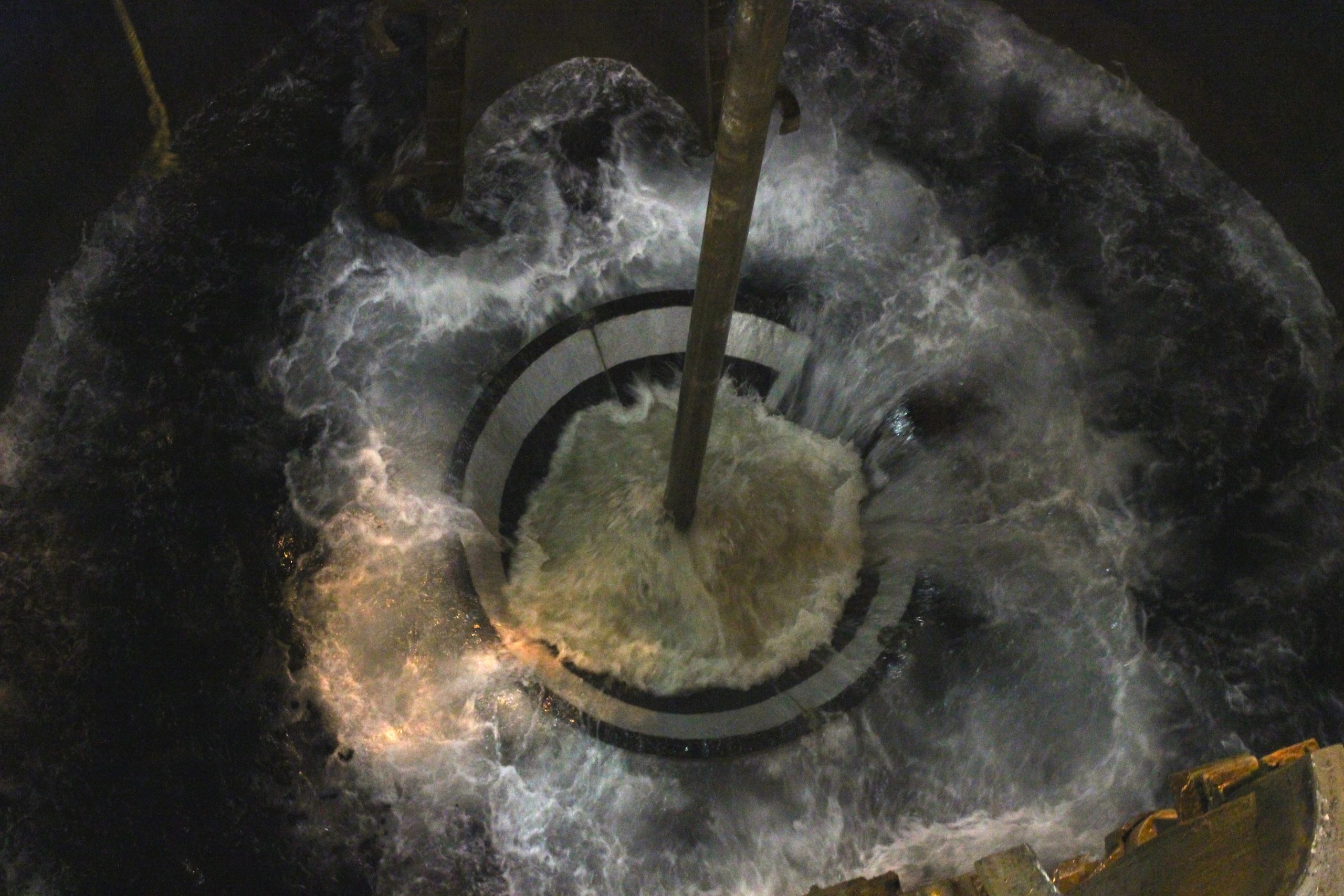
circular gray disk with black circles painted on the inside splashes into the ocean
Deployment of the free-fall funnel. (Credit: Petra Dekens & IODP, MerlinOne photo archive, CC BY 4.0)

Scientific ocean drilling has been ongoing since the 1960s, with some expeditions returning to previous sites to drill deeper, explore new seafloor features, and conduct further research. This raises an important question: How can a ship reliably return to the same borehole?

To address this, reentry cones and free-fall funnels allow ships like JOIDES Resolution to accurately relocate and re-enter boreholes for continued study. However, not every borehole during an expedition receives a reentry cone or a free-fall funnel due to various logistical and operational constraints.

While a two-month research expedition may seem like a long time at sea, it is actually quite short given the extensive work required. Unpredictable factors such as weather can further limit the available time, making tools like reentry cones essential for maximizing efficiency in scientific ocean drilling.

Examples of when reentry funnels or cones were used

  • During Expedition 379, reentry cones were used while the ship was sailing in waters with icebergs. The cone was deployed in case the ship had to make an emergency exit out of the borehole and out of the way of an oncoming iceberg. The cone would allow the ship to return to the same borehole when it was safe to do so.
  • Read this blog post to see what Expedition 391 did when using a free-falling funnel and coming back to find they could not see it.
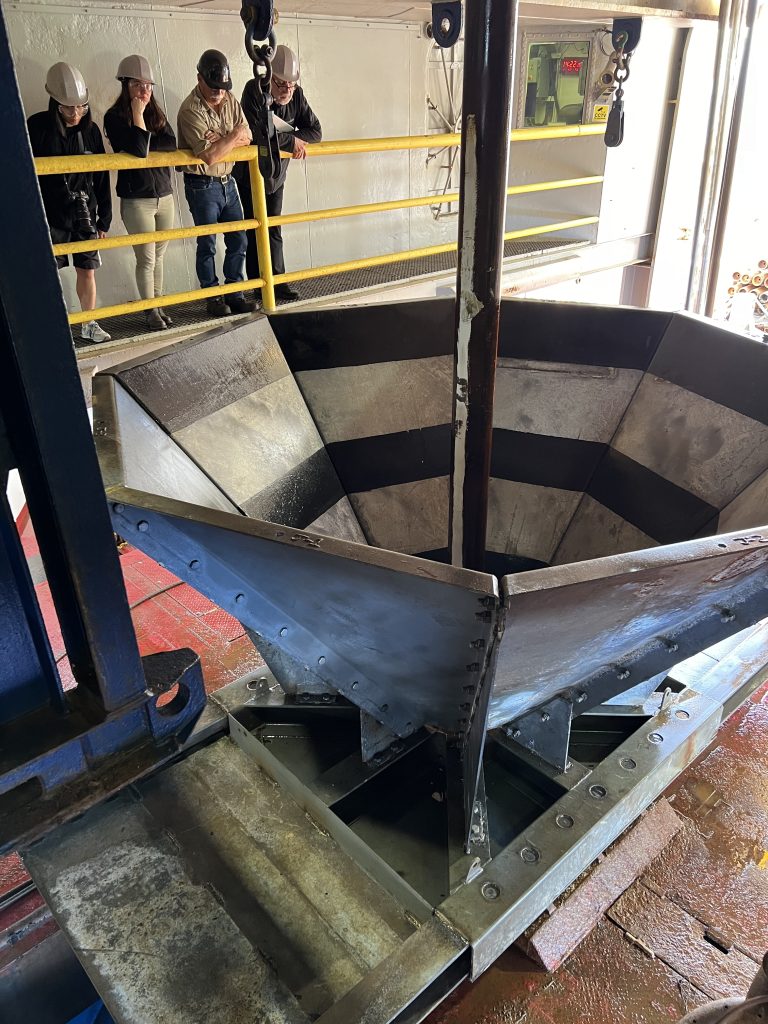
Four people looking over a railing to a large metal funnel sitting on a deck below them
The finalized reentry cone, built and painted, sits above the moonpool with the drill string going through it. (Credit: Tessa Peixoto)

Exercise: Reentry Cone Markings

Refer to the image above and consider the following question:

a) Why do you think this stand of the drill string has a white streak painted on one side of the pipe?

Reentry Cone vs a Free-Fall Funnel
A reentry cone is a multi-panel funnel shape piece of metal that sits on the seafloor at the estimated entry point of a borehole. It has a rectangular base called a mud skirt to ensure it does not sink into the hole or seafloor. It comes disassembled and was put together by the SIEM (now called Sea -1) crew as needed. It was generally used where the borehole was designated as one that would be returned to within the same expedition or in future expeditions. The site was first drilled to determine what kind of formation exists, and these cores were taken up for analysis by the scientists.  This preliminary drilling provided both the scientists and the drilling team with valuable insight into what to expect from the formation. For example, it helped the drilling crew determine the appropriate type of casing and its required length, especially if the cores indicated softer formations than expected. Casings were used to wall off the top of the borehole for a certain amount of distance.

A reentry cone and a set of casings were built before drilling the new borehole. The cone was lowered to the seafloor as the drill string was being built via a casing hanger.   Once the cone hit seafloor, there was an additional step the rig floor crew had to take into account before coring the new borehole could begin. The casing hanger had to be released from the drill string. This release allowed the drill string to be brought back up to the rig floor of the ship to attach a drill bit. Only then are they able to redeploy the drill string to move through the reentry cone and core below the casing.
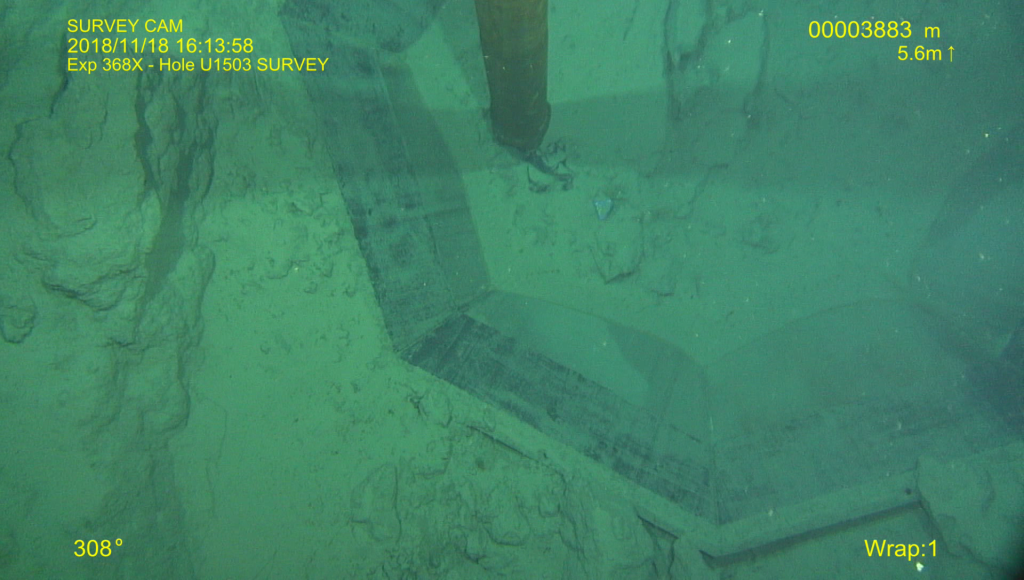
A free-fall funnel was similar to the reentry cone, with multiple panels welded together into a funnel shape. The main difference was that the free-fall funnel would sit on the seafloor at the entry point of the existing borehole. Other differences were that: 1) it did not have the mud skirt, 2) it did not have a extensive casing to hold the borehole wall, and 3) it was used in emergency situations. Additionally, the free-fall funnel was sent down to the seafloor by riding down the already deployed drill string to ensure that the current borehole was marked, hence the name “free-fall”. Unfortunately, because of the lack of a mud skirt, there was a chance that it would sink into the soft sediment. So finding it again could pose a challenge if that happened.
Underwater image of the seafloor with a partially sunken funnel covered in seafloor sediment. Written on the image on top left: Survey Cam, 2018/11/18 16:13:58, Exp 368X- Hole U1503 Survey
A partially sunken funnel from Expedition 368 ( Credit IODP JRSO, CC BY 4.0)
Also, without the casing, the borehole would likely be less stable and at risk of collapsing. Therefore, before coring could begin again, some drilling was necessary to clear the borehole and ensure its stability. This step helped maintain the integrity of the borehole as the drilling process continued.
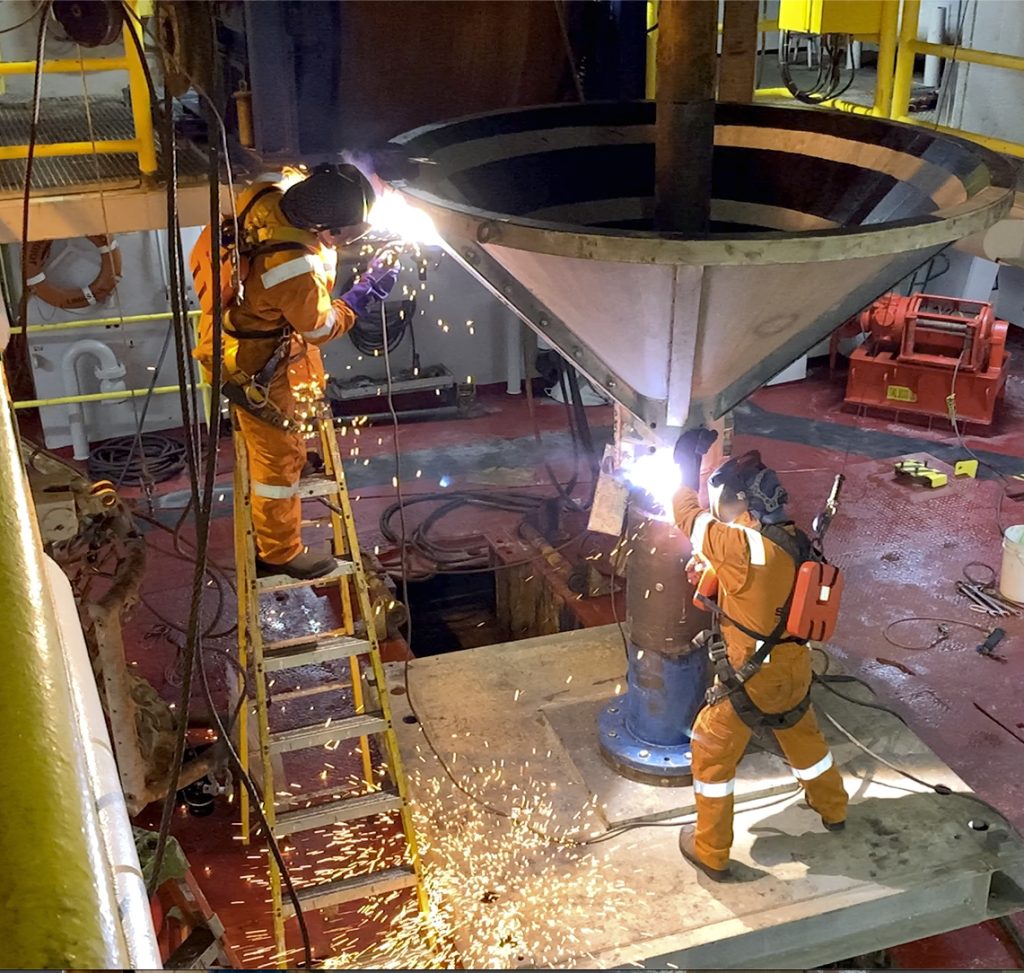
two men in orange jumpsuits working on a large metal funnel, one man welding the top part of the funnel while the other is welding the bottom part
The welders are securing the funnel to the HRT (hydraulic release tool) base. (Credit: Phil Christi, IODP JRSO, MerlinOne photo archive, CC BY 4.0)
Where do they build it? Both the reentry cone and free-fall funnel were built near and around the moon pool area because once it was constructed it was very bulky to move. Plus, it needed to be built around the drill string before deployment, which was easily accessed above the moon pool. By using multiple winches, the reentry cone or funnel was moved over the moon pool doors and the interior was painted with black stripes and the site number. The reason being that the painted stripes of the funnel or cone make it much easier to see the reentry cone or free fall funnel when the ship returns to the site. With out the stripes you risk the grey metal blending in with the grey-colored sand.

Midpoint Review

Watch the video below to see the process of building the casing and the cone on JOIDES Resolution.

Read the summary below of how two crew members explain the differences between a free-fall funnel and reentry cone.

Reentry system summary from JOIDES Resolution Crew Members

Information related to reentry systems, provided by Kevin Grigar (Operations Superintendent) and Glenn Barret, OIM (information provided via email from the JR on July 8, 2024)
JOIDES Resolution had two types of reentry systems: one is planned, and the other is for emergency or contingency purposes.
The first system is the full reentry cone and was installed before the coring began. The reentry system consisted of a funnel placed above the seafloor, supported by a “mud skirt” that prevented  it from subsiding or sinking into the soft sediment. Below the funnel, a length of casing was installed into the ground, blocking unwanted soft or sloughing formations from falling into the hole. We would have to drill and take cores of a borehole at the desired site until we reached the depth that the casing would reach prior to the installation. Once, we cored to that depth, we would pull out of that first borehole, and start installation of the reentry cone in a new borehole. This approach allowed us to target the specific zones that scientists wanted to study, while bypassing those that they may not need or want.
The second system is the free-fall funnel, a contingency reentry system deployed after some coring had been completed. It was dropped from the surface, following the drill pipe down to the seafloor. This system was used when coring or drilling was interrupted, perhaps by weather or ice, and we needed to temporarily pull out before completion. The free-fall funnel allowed us to re-enter the hole at a later time and continue from where we left off. Unlike the full reentry cone, it does not have a mud skirt.


How Do We Find The Funnel or Cone Upon Our Return?
The next step of any reentry cone or free fall funnel was finding it again after deployment. Even though the sailing crew had GPS coordinates of where the cone or funnel was sent down, it was still a hard task to position the boat where they could find the funnel, and place the drill string into the funnel.
The way the rig floor crew and sailing crew were able to see the cone or funnel at the seafloor and watch the drill string enter it was by using a Vibration Isolated Television (VIT) camera ( the below video shows you the VIT being used). The VIT is sent down through the moonpool and brought back up through the moonpool. However, the viewfinder has a limited diameter, so there were times when the ship had to maneuver slightly to align and locate the funnel or cone after it was deployed to the specified GPS coordinates.
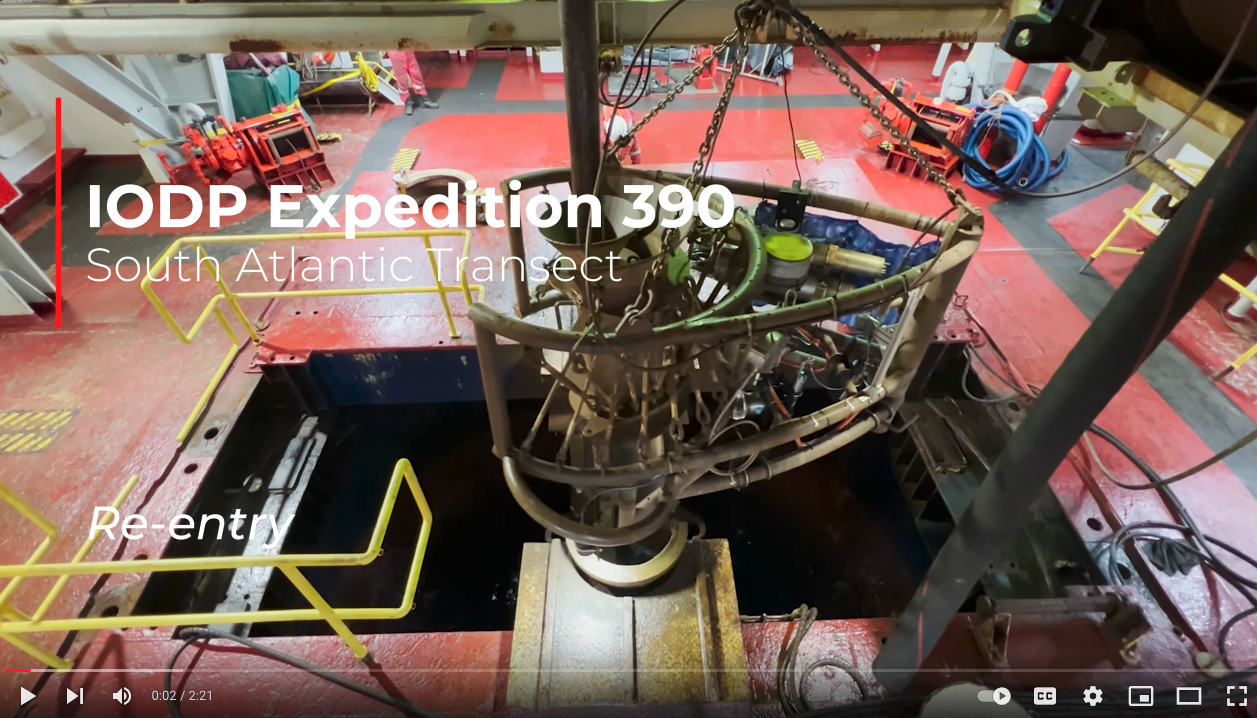
Screenshot of a youtube video with the words IODP Expedition 390, South Atlantic Transect
Watch how Expedition 390 preformed a reentry process with the VIT. Click the image above or click here to watch the video.

Exercise: Reentry on Expedition 390

Refer to the video above and answer the following questions:

a) How long does it take for movements at the sea surface to be transmitted to the drill bit on the seafloor?

b) What are the three working groups, each located in different areas of the vessel, that coordinate to make the drill bit’s reentry possible?

Learn more about the VIT

The VIT was a very exciting operation to watch when on a JR expedition, especially since not every expedition utilizes the VIT, free-fall funnel, or reentry cone. Read the JOIDES Resolution blog post published in 2018 by Aliki Weststrate (Expedition 375) reproduced below and linked here to learn more.

“The JR’s Underwater Camera – an essential part of the drilling/science operation

Without an underwater camera, a driller’s job would be almost impossible – trying to do anything with a drill pipe in deep water – while blind – is incredibly tricky.

So, the JOIDES Resolution’s camera is in high demand, and its capabilities are constantly being improved and added to.

In this blog, IODP Engineer John Van Hyfte takes us on a tour of “the best underwater camera in the world”!

In the dark old days (literally) science drilling ships relied on sonar to help them locate the borehole in relation to the drill, and it could take days to enter and re-enter funnels. Back then, the funnels had sonar reflectors on them that bounced a message up to the ship’s sonar, guiding the ship into position. It was time-consuming, and therefore costly.

The camera changed everything

The crew of JOIDES Resolution has used an underwater camera to help re-enter the borehole for several decades. However, John and his team of engineers and technicians are constantly improving its imaging capabilities, using fibre optics and electrical hardware for it to capture high-definition live footage.

Watch our short video on the underwater camera’s evolution from 2010 to 2018:

Most other drill ships have an ROV, but these are extremely expensive to operate and maintain, so JOIDES Resolution has focused on investing in a VIT camera, which stands for ‘Vibration Isolated Television’. Our footage can be recorded and replayed in standard and high definition too if we need to revisit it.

The VIT is lowered and raised using a very strong cable, called an ‘umbilical’ that has 4 optical fibres in it, as well as 2 sets of twisted pair copper electrical wires so it can carry electrical power to the cameras and sensors, and carry a lot of data back up to the ship.  The umbilical is about 7,000 meters (4.3 miles) long, although we only use about 5,000 meters (3.1 miles) for safety reasons.

Many years ago, before we had fibre optic we used copper lines to carry the television signal from the seafloor, but the time latency was several seconds. This made it hard to put the ship into the correct position, allowing the driller to put the drill pipe back into the borehole.

Deep in the ocean, things change fast

Down deep, there are strong currents (sometimes in different directions) and the ship heaves up and down in the swell above too.  The drill pipe has to go through these currents to get back to the borehole.  Without a television system, this would be very difficult to accomplish.

To lower the camera down through the sea to the seafloor we attach it to the drill pipe on the moonpool floor and lower it with a winch through the moonpool. The moon pool is a 6-meter (19.6 foot) diameter hole in the middle of the ship through which we lower the drill pipe, reentry funnels and camera. When it is not in use it is covered for safety reasons.

Who operates the camera?

The Toolpusher sits in the ‘subsea shop’ just above the moonpool and controls how much umbilical is let out. The driller operating the drill pipe can watch how the drill pipe is going on a TV in his office (called the Doghouse) on the drill rig floor.

The camera can pan (move left or right), tilt (move up or down) and zoom, and this is controlled by the Captain and Chief Mate in the DP office located on the Bridge. DP stands for Dynamic Positioning. That way the Captain can control the camera angle to get the best view, and quickly adjust the ship’s position to optimize the reentry and drilling.


This is the survey camera, a high definition camera that can pan, tilt and zoom.

This is the telemetry pod, which has electrical power and sensors in it.

The umbilical gyroscope measures the direction of the frame and which way it is pointed to get the best camera angles.

The VIT camera also has a sonar altimeter on it so we know how far off the seabed we are.


ONe More Point About the VIT
The VIT was sent down and brought up on its own winch line, and rode the length of the drill string down to the seafloor. It was when the crew used the VIT that they were able to see the seafloor, identify the cone or funnel, and understand its condition such as remaining in the correct location.
In addition to serving as the eyes for the sailing crew and rig floor crew to entering the cone, the VIT also had a secondary job of collecting data such as temperature, and samples of seawater at depth. This extra information was very useful to the sailing microbiologists who aimed to understand the conditions under which seafloor microbes survive and thrive.
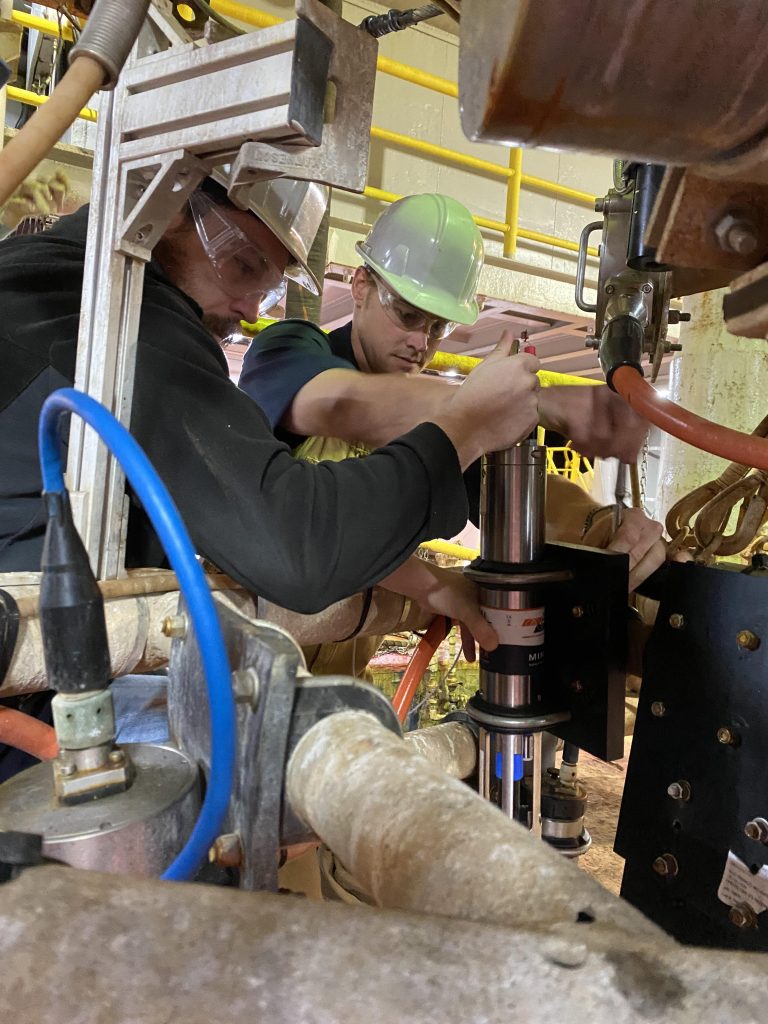
Two people working on a metal cylinder connecting multiple tubes to it and fixing it in place
Fabricio Ferreira and Mark Higley (Marine Laboratory Specialists, IODP JRSO) attach the CTD tool to the VIT frame. (Credit: Jessica Riekenberg, IODP JRSO, MerlinOne photo archive, CC BY 4.0)


Riding down on the VIT: Shrinking Styrofoam cups

One activity that happens whenever the VIT  is being used is for the crew to design Styrofoam cups to send down with the VIT to the seafloor. The immense pressure on the cups causes them to shrink to half their size. When the VIT camera comes back up, everyone gets a souvenir from the depths of the ocean they sailed.

Image 1 – School of Rock Participants Andrea Swensrud (KQED Public Media, USA), Sabreena Kasbati (Aquarium of the Pacific, USA), Emily Powell (Ocean Leadership/USSSP), and Jean-Noel Puig (College Marguerite de Navarre, France) decorate Styrofoam cups to send down the drill string to demonstrate pressure change at the bottom of the ocean. (Credit: Amy Work). Image 2 – Decorated Styrofoam cups mounted on the Vibration Isolated Television (VIT) frame that will be sent to ~740 meters below sea level. (Credit: Erick Bravo). Image 3 – Decorated Styrofoam cups after they were sent to a depth of 1800 meters below sea level on the subsea camera frame during a hole reentry. As the cups descended, they were subject to increasing pressure. This caused air to be squeezed out of the Styrofoam, shrinking the cups. (Credit: Erick Bravo). Image 4 – David Fackler (Marine Computer Specialist) compares his shrunken, decorated cup to the original sized styrofoam cup. (Credit: Sarah Kachovich). All images are from IODP JRSO, MerlinOne photo archive, CC BY 4.0.

 

License

Icon for the Creative Commons Attribution-NonCommercial-ShareAlike 4.0 International License

Scientific Ocean Drilling: Exploration and Discovery through Time Copyright © 2024 by Laura Guertin; Elizabeth Doyle; and Tessa Peixoto is licensed under a Creative Commons Attribution-NonCommercial-ShareAlike 4.0 International License, except where otherwise noted.