
5.7 Circulation Obviation Retrofit Kits (CORKs)

Downhole measurements, as previously discussed, can be done through a process called downhole logging. However, there was another way to collect borehole data, especially if one wanted to continually collect data well beyond the expedition timeline.
Similar to how one would prevent the contents of a glass bottle from being exposed to the environment by using a plug, one can apply a similar concept to collecting data from boreholes. In the field of scientific ocean drilling, that system was called a CORK (Circulation Obviation Retrofit Kit). During a 1987 workshop about wireline reentry of deep sea boreholes, the idea for the CORK system was drafted up. “CO” referred to stopping the fluid exchange between formation and ocean bottom water that was to be expected if holes into hydrologically active formations were left unsealed; “RK” referred to the fact that the experiment could be installed in any reentry hole, whenever it was drilled. Two years later, the instrumented borehole seal was added to the Ocean Drilling Program expedition schedule of December 1989 (Becker and Davis 2005). Between 1989–2003, there were 20 Circulation Obviation Retrofit Kit (CORK) long-term sub-seafloor hydrogeological observatories installed during the Ocean Drilling Program (ODP).
View this video for an overview of CORKs.
Check out this gallery of images to see examples of CORKs installed on the ocean floor.
Image 1 – Expedition 327, Painted CORKs for the “Deepest Art Installation.” (Credit: Katerina Petronotis, IODP/TAMU, MerlinOne photo archive, CC BY 4.0), Image 2 – Expedition 375, CORK deployment. (Credit: Tim Fulton, IODP JRSO, MerlinOne photo archive, CC BY 4.0) , Image 3 – Expedition 327, Deployment of the Hole U1362B CORK. (Credit: Katerina Petronotis & IODP, MerlinOne photo archive, CC BY 4.0) , Image 4 – Expedition 327, The Hole U1262A CORK platform is launched through the moonpool. (Credit: William Crawford, IODP/TAMU, MerlinOne photo archive, CC BY 4.0)
![View of CORK deployment from below the drill floor. (Credit: William Crawford, IODP) [Photo ID: exp336_136]](https://psu.pb.unizin.org/app/uploads/sites/427/2025/07/Cork-Deployment_-Exp-336_-Credit-william-Crawford-IOPD.jpg)
The Anatomy of a CORK
Circulation Obviation Retrofit Kits (CORKs) were designed with the goal that scientists could gain in situ data post drilling by leaving a diverse collection of logging sensors to monitor temperature and pressure, as well as sample collectors in and above a borehole. While cores of the seafloor are crucial to understanding seafloor processes, they are fixed to the time of retrieval. Having the additional data of sub seafloor hydrology through time widens the research findings. Before deploying the CORK tool, the borehole is made and casing is sent down to the seafloor to reinforce the borehole walls. Then a platform with a re-entry cone is deployed (if you want to see the different parts deployed, watch this animation). The CORK acts as the last step to creating the observatory because once it does enter the re-entry cone it is hydraulically latched in place with the casing. This creates the seal necessary to prevent flow into or out of the borehole. A scientific ocean drilling ship, such as JOIDES Resolution, is required to drill the borehole and install the CORK system. Later, a ship equipped with Remotely Operated Vehicles (ROVs) can return to the site to retrieve logging data and recover collected samples.
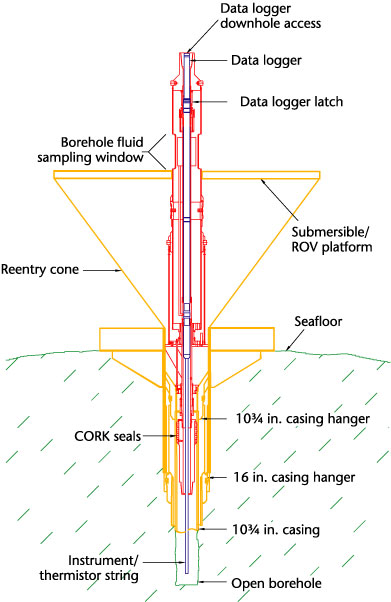
Additional sensors can be attached to the CORK. These may include osmotic samplers, which store downhole fluids for extended periods, or sensor strings equipped with multiple sensors at different depths within the borehole. However, sensor size is restricted by the instrumentation string, which must fit within the diameter of the drill pipe and the CORK body. As a result, the string’s diameter cannot exceed 3.75 inches or 9.5 centimeters.
Different CORK technology
Although the original CORK design was groundbreaking, subsequent versions have incorporated improvements.
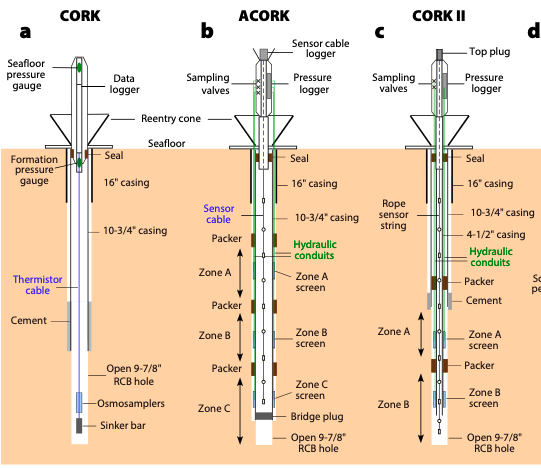
- The standard CORK monitors the open hole below the casing, providing only average conditions within the borehole.
- The Advanced CORK (ACORK) was developed to isolate and measure multiple zones within a single borehole. It achieves this by using casing packers at targeted depths, which transmit fluid pressure or samples through hydraulic cables positioned along the outside of the casings.
- CORK II enables multi-zone measurements but utilizes a system akin to the Borehole Instrument Hanger. This design allows instrument-containing casings to pass through the re-entry cone and be cemented in place at specified depths. Like ACORK, it also features hydraulic cables along the casings for sample collection.
Continuing with CORKs
CORKs After Installation
Did you know that Earth Scientists aren’t the only ones interested in using CORKs. Between 2000 and 2019, OsmoSamplers were included with the deployed CORKs, which allow for microbial colonization experiments, microbial sampling, and fluid flow rate monitoring, aiding in subseafloor microbiological research.
Though it was not found in the OsmoSampler, this microbe was found on one of the CORKs that was deployed. Archaeoglobus sulfaticallidus, was isolated off a CORK back in 2001 which has a known presence around hydrothermal vents. They are a type of Archaea, meaning they live in extreme habitats, and they produce iron sulphide, which is known to cause the corrosion of iron and steel in oil and gas processing systems.
A Microbe Monday info graphic shared on the JR website from Expedition 376. (Credit: Peregrin (Perry) A. Hyde, Outreach Officer Expedition 376 )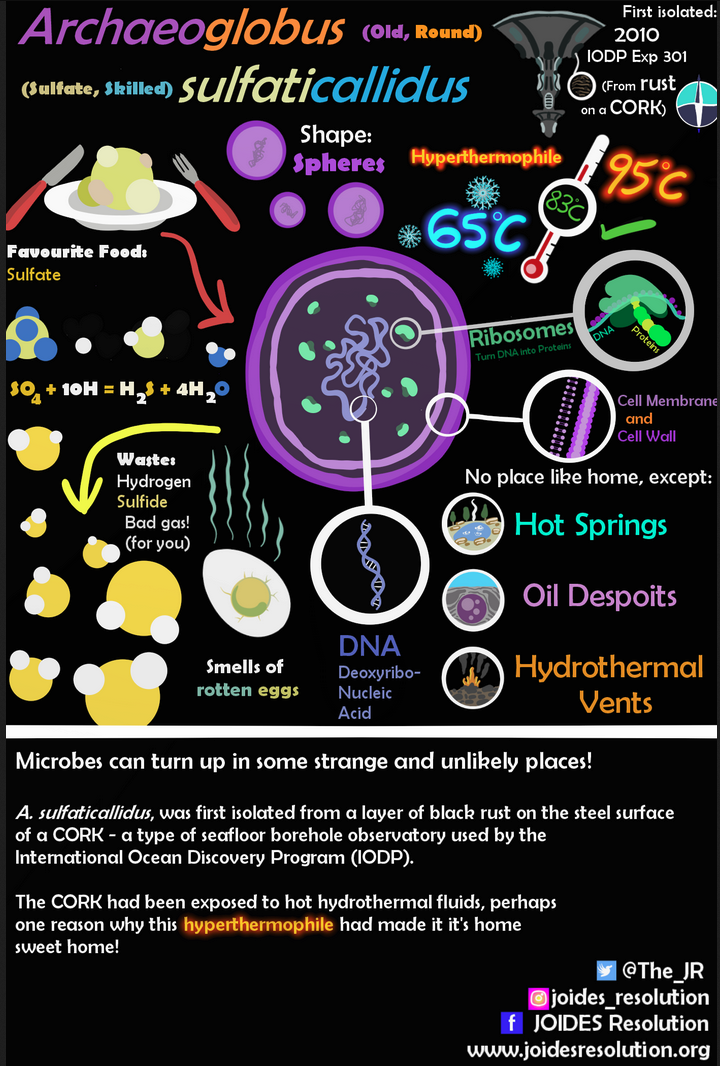 A Microbe Monday info graphic shared on the JR website from Expedition 376. (Credit: Peregrin (Perry) A. Hyde, Outreach Officer Expedition 376)
Once deployed, the CORK can be continuously used and updated. The Exploration Vessel Nautilus has ROVs that allow for scientists to return to the CORK sites to collect data, and/or to insert new loggers or samplers.
The above video shows the E/V Nautilus visiting a CORK. The description of the trip is as follows: “First Dives of 2024: Science and Maintenance of CORK Site OET and Ocean Networks Canada (ONC) have launched the first few dives (H2029 and H2030) of our 2024 season at the NEPTUNE observatory. Using ROV Hercules, we successfully deployed a new autonomous data logging device at the Circulation Obviation Retrofit Kit (CORK) 1024C site, reviving this infrastructure that has been studying the seafloor for over twenty years. This CORK was first installed on leg 168 of the Ocean Drilling Program in 1996. CORKs enable geoscientists to observe changes in subsurface pressures and temperatures caused by earthquakes, storms, hydrothermal convection, and regional plate strain. In the video, you’ll see some familiar tools, such as the TBOS “toilet brush of science” and a push core for sediment sampling.” (Credit: Gallery, Nautilus Live Ocean Exploration Trust, 2024)
Exercise: “Plugging the Seafloor with CORKS”
Read this article published by OCEANUS Magazine about the use of CORKs and answer the following questions:
a) The article states that “CORKs require investments not only in equipment and infrastructure, but also in time.” What are three or more specific resources or steps needed for a CORK program to succeed?
b) The article provides three examples of important findings. Rewrite each one in plain language so that a general audience can easily understand, keeping your explanations brief.
c) What examples does the article give to illustrate the “dynamic plumbing system” of the seafloor?
Reference
Becker, K., and Davis, E.E. (2005). A review of CORK designs and operations during the Ocean Drilling Program. In Fisher, A.T., Urabe, T., Klaus, A., and the Expedition 301 Scientists, Proc. IODP, 301: College Station TX (Integrated Ocean Drilling Program Management International, Inc.). doi:10.2204/iodp.proc.301.104.2005