
3.6 Meng Xiang
“Scientists have yearned to pierce the Moho since 1961 when the first scientific ocean drilling program was dubbed ‘Project Mohole.'” -Dennis Normille (Science, 2024)
Scientists around the world have increased their chances of reaching and obtaining samples of the Moho because of one of China’s recent endeavor (as of 2024). Though not new to the scientific ocean drilling community, China now is contributing their own ocean drilling vessel named D/V Meng Xiang, Chinese for Dream, and their own accompanying scientific ocean drilling program.

The new program deemed China Multifunctional Platform (CMP) will be run by the Ministry of Science and Technology and the National Natural Science Foundation of China. The main operators of CMP will be two universities, where Tongji University will develop the Science Center and the Guangzhou Marine Geological Survey will develop the Platform Center. Their vision for CMP to address pressing scientific questions was influenced by the 2050 Scientific Framework, which was drafted by members in the international ocean drilling community.
Review of the Moho
It was not always known that there was a layer between the crust and mantle. Thanks to the Croatian seismologist Andrija Mohorovičić, we now know there is the Moho Discontinuity between the two layers. After analyzing earthquake data, Mohorovičić saw an unexpected change in behavior of seismic waves, P waves and S waves, on his seismograph. Instead of moving at a proportional velocity, suggesting the earthquake wave was moving through the same kind of material, it started to speed up. He theorized from his data that there was a very obvious difference in density (and thus composition) between the Earth’s crust and the mantle. You can learn more about the quest to sample the Moho in The Start of Scientific Ocean Drilling section of this OER.
Reaching the Moho is a challenge, as the depth to the crust-mantle boundary varies throughout the Earth. At some locations, the Moho is between 3-6 miles (5-10 km) below the ocean floor, and in other locations the Moho lies 10-60 miles (20-90 km) beneath continental crust.
Specifications of D/V Meng Xiang
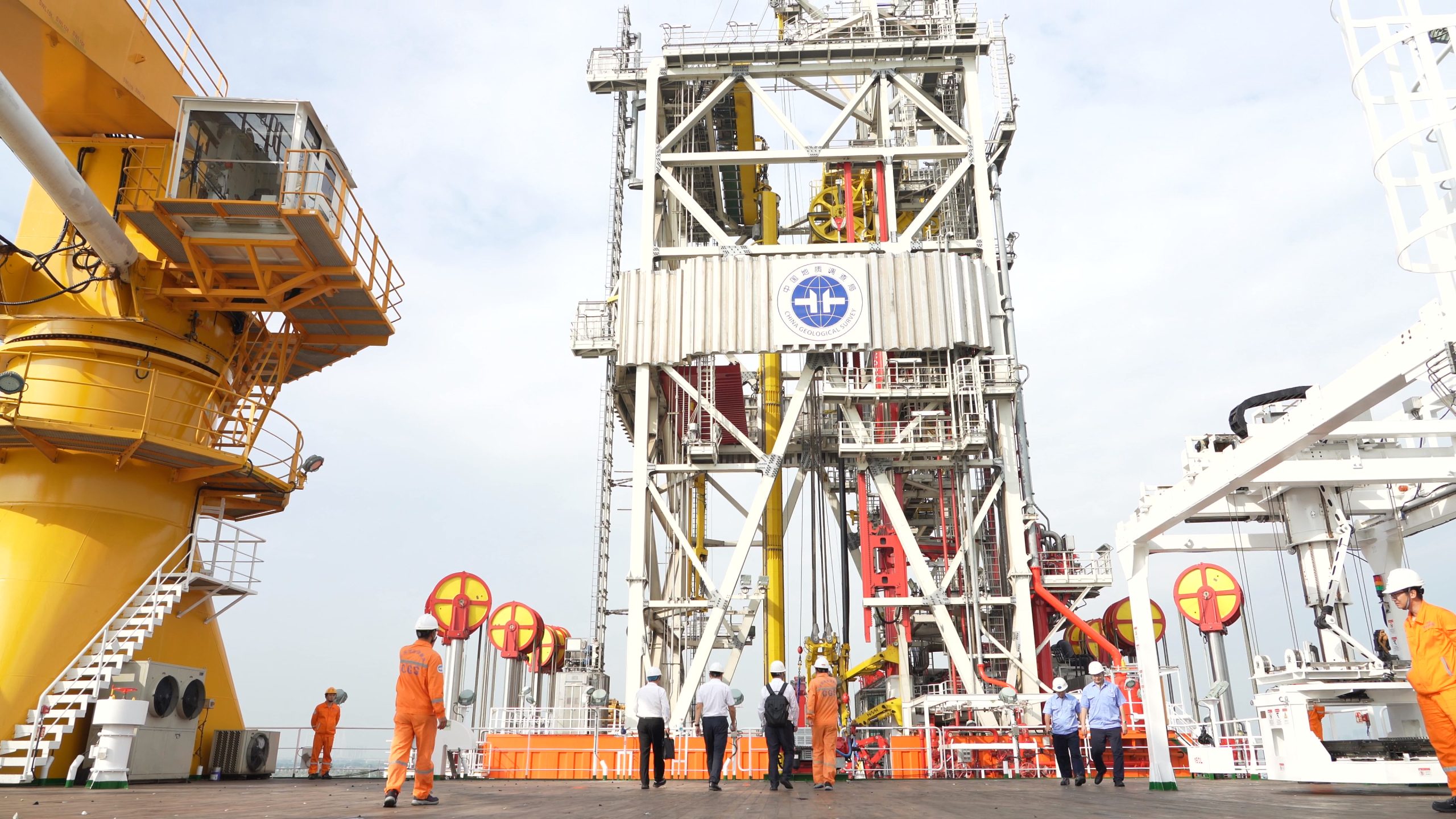
D/V Meng Xiang has the capacity to drill deep into the oceanic crust with a maximum depth of 11,000 meters, deeper than previous and current scientific drilling ships can reach. In October 2024, the Meng Xiang was officially deemed ready to sail after surpassing all performance indicators during trial expeditions.
D/V Meng Xiang is equipped to perform four drilling modes and three coring methods. It has the functionality to conduct oil and gas exploration and development, as well as the functionality to conduct scientific ocean drilling to recover cores of sediment and ocean crust. The chief designer of ship drilling operations, Zhang Haibin and his team, made possible this deep-sea capacity for operations because of the inclusion of a hydraulic lifting rig that has a top drive lifting capacity equivalent to three-to-four Boeing 747 jets, or an entire cargo ship.
Watch an introductory video about the D/V Meng Xiang below:
Exercise: Overview of the D/V Meng Xiang
After viewing the video about the D/V Meng Xiang directly above, respond to the following questions:
a) What ship schematics (structures and major functions) were shown in the video, and what do they reveal about Meng Xiang’s capabilities?
b) How do these schematics differ from those of the other research vessels described in earlier chapters of this OER?
c) On your own, find out what ship displacement means. Then, create a simple diagram that illustrates this concept.
Another new feature of Meng Xiang is that it has a more advanced version of a riser-less mud recycle (RMR) drilling system, which should help it to maintain an open borehole for deep ocean drilling. RMR allows for more efficient drilling through reusing and recycling the mud cuttings as the borehole is created. Plus, it can reduce the environmental impact because the mud, drilling fluid, and cuttings are not getting ejected onto the seafloor. In addition, Meng Xiang is designed to withstand atmospheric weather conditions as strong as super typhoons, where winds alone can get up to 150 mph.
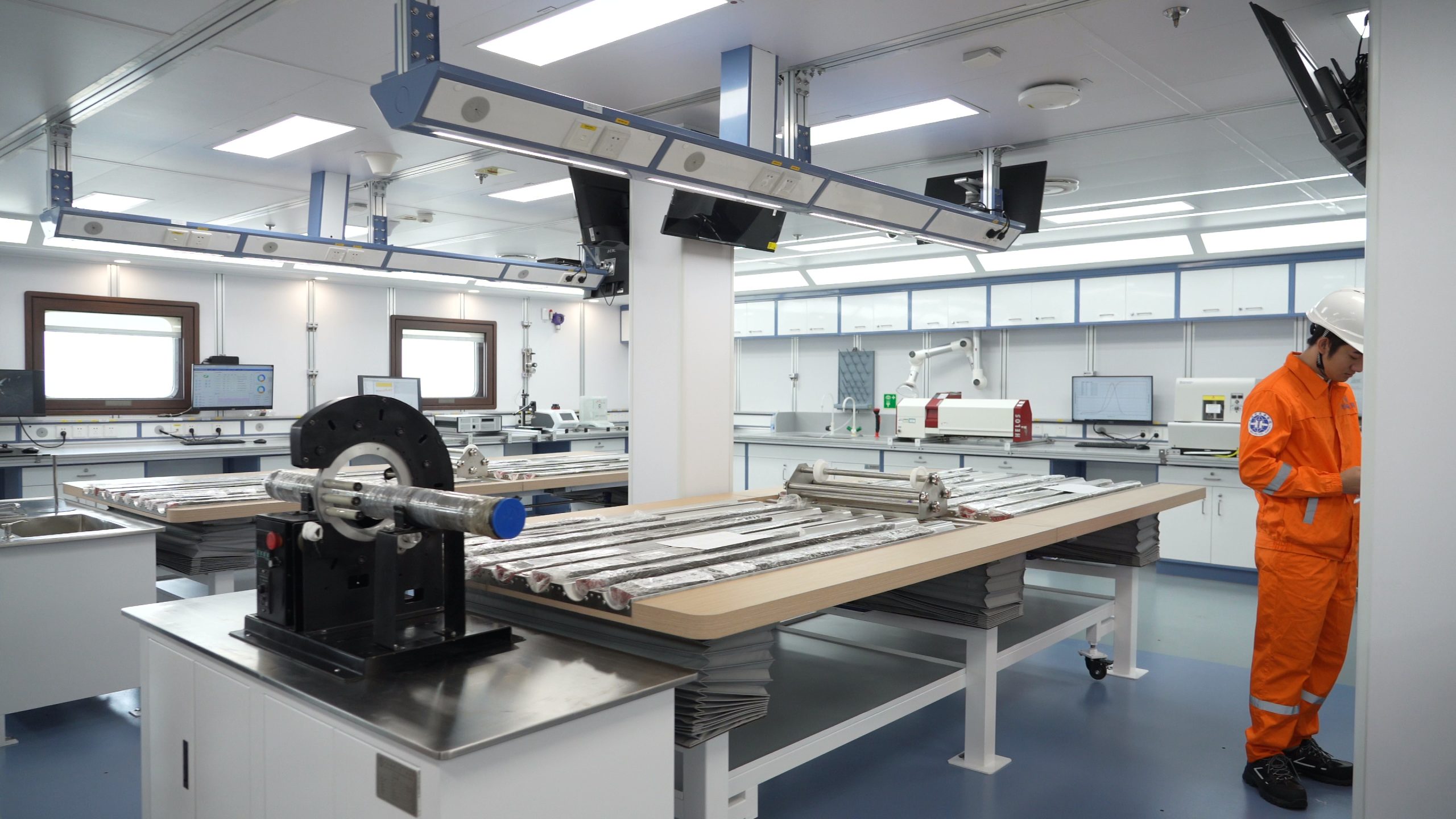
Beyond the drilling and sailing operations, there are 3000 meters of space dedicated to scientific research:
- An onboard automatic core transmission and storage system to handle core samples
- A magnetically shielded room
- An ultra-clean lab
- A comprehensive information system to support many experiments and analyses
- Geology laboratories
- Geochemistry laboratories
- Microbiology laboratories
- Ocean science laboratories
- Drilling technology laboratories
Looking To The Future
D/V Meng Xiang and China’s new drilling program start their journey with two objectives. First, to “[drill] through the Earth’s crust and into the upper mantle, contributing to the exploration of the Earth’s history and dynamics” and secondly, “… to penetrate the Moho discontinuity”.
The ship serves as a key tool in an ambitious plan. China’s deep-sea drilling program aims to complete 30 expeditions by 2035, with input and collaboration from international scientists and their proposed research. CMP hopes to use the D/V Meng Xiang to revive expedition proposals that were left unfinished due to the conclusion of IODP and JOIDES Resolution.
References
China’s first deep-ocean drilling vessel enters service. (2024). Www.gov.cn. https://english.www.gov.cn/news/202411/17/content_WS6739adf7c6d0868f4e8ed157.html
Mengxiang: All you need to know about China’s “dream” deep-Sea mining ship. (2023, December 29). The Times of India; Times Of India. https://timesofindia.indiatimes.com/world/china/mengxiang-all-you-need-to-know-about-chinas-dream-deep-sea-mining-ship/articleshow/106367665.cms
Normille, D. (2024, December 11). China’s “dreamy” new ship aims for Earth’s mantle—and assumes ocean-drilling leadership [Review of China’s “dreamy” new ship aims for Earth’s mantle—and assumes ocean-drilling leadership]. Science; Science. https://www.science.org/content/article/china-s-dreamy-new-ship-aims-earth-s-mantle-and-assumes-ocean-drilling-leadership
Tuo, S., & Wang, W. (2024). Preparing for International Scientific Ocean Drilling beyond 2024: China’s actions and plans [Review of Preparing for International Scientific Ocean Drilling beyond 2024: China’s actions and plans ]. Pages; Past Global Changes Magazine. https://pastglobalchanges.org/publications/pages-magazines/pages-magazine/138079