
7.1 You Got Core, Now What?
The Repositories
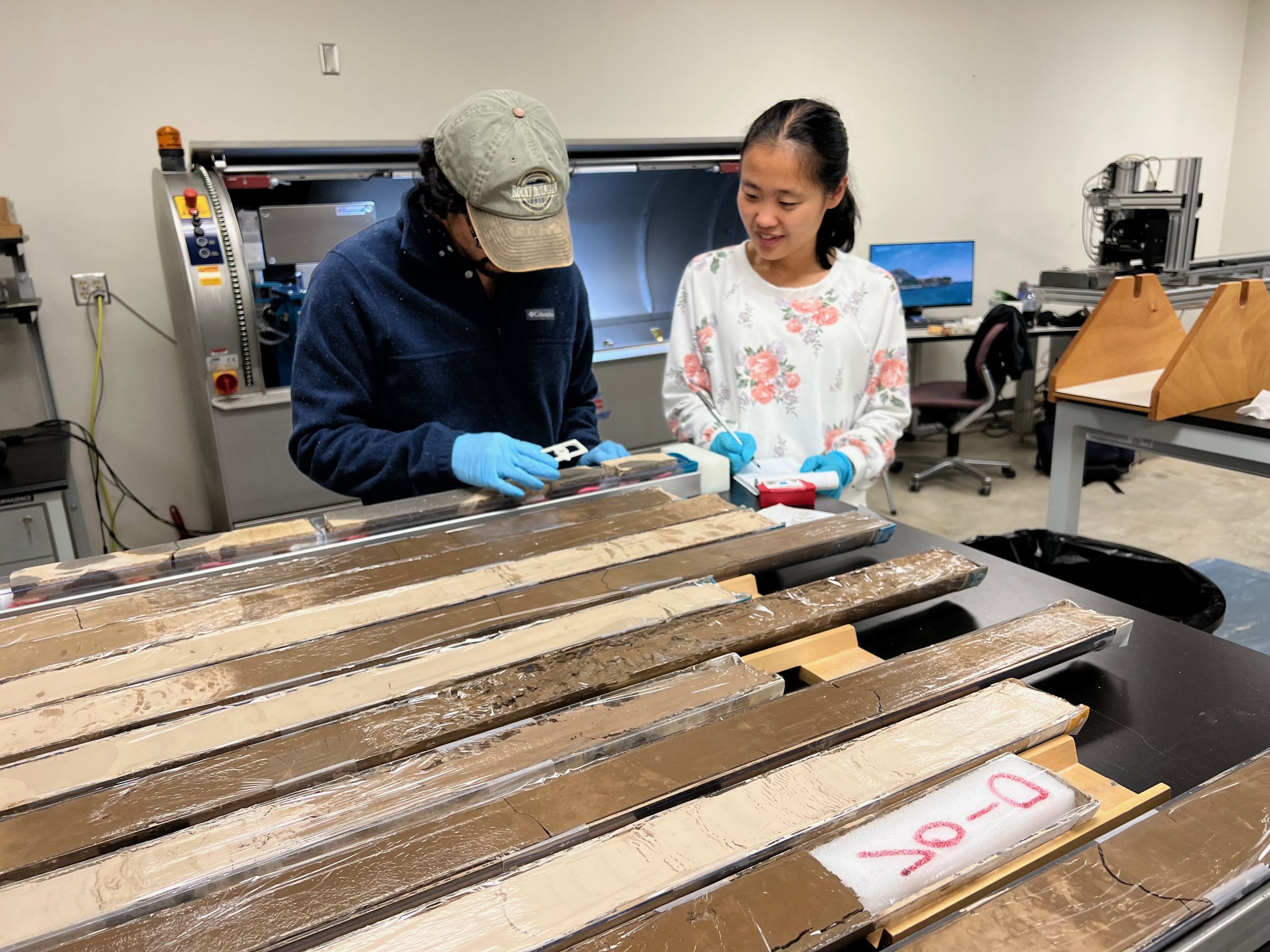
The main objective of the scientific ocean drilling process is to obtain samples of the seafloor through recovering cores. Given that scientific ocean drilling has been happening since the 1960s, there has been a lot of sampled core that needs a place to go so that the scientists back on land can keep working with it. For example, the cores that were collected on Project Mohole are at the Geological Collections at the Scripps Institution of Oceanography at the University of California, San Diego, which also includes some ship logs, and some basalt samples from the cores are stored at the Smithsonian’s National Museum of Natural History.
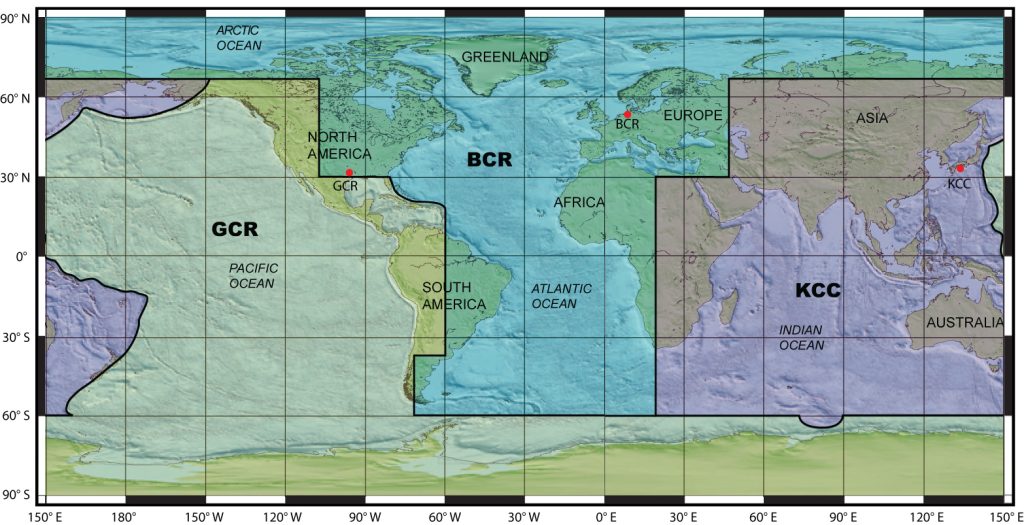
As more expeditions were collecting material through the DSDP, ODP, and IODP programs, an international agreement was reached for three different locations that would be dedicated to housing all the cores collected on scientific ocean drilling expeditions based upon the location of the collected cores . The three repositories are found in Bremen, Germany, Texas, USA, and Kochi, Japan.
The repositories additionally include host educational components, like providing public tours, in-house workshops or classes, and having educational cores that can be loaned out to educators around the world.
Marking The Cores
To begin, every core retrieved from the deep sea and brought on deck of a drilling vessel or platform was given a label and identification number that helps keep everything organized as the core moved through the core flow. The core flow is the journey the core took from ocean floor through all the laboratory analyses on the ship. Once the core reached the rig floor and passed onto the core deck, it was split into 1.5-meter long sections. From there:
- The plastic liner was laser engraved with the core identification number
- The cap at both ends of the core tube had the identification number written on it with permanent marker
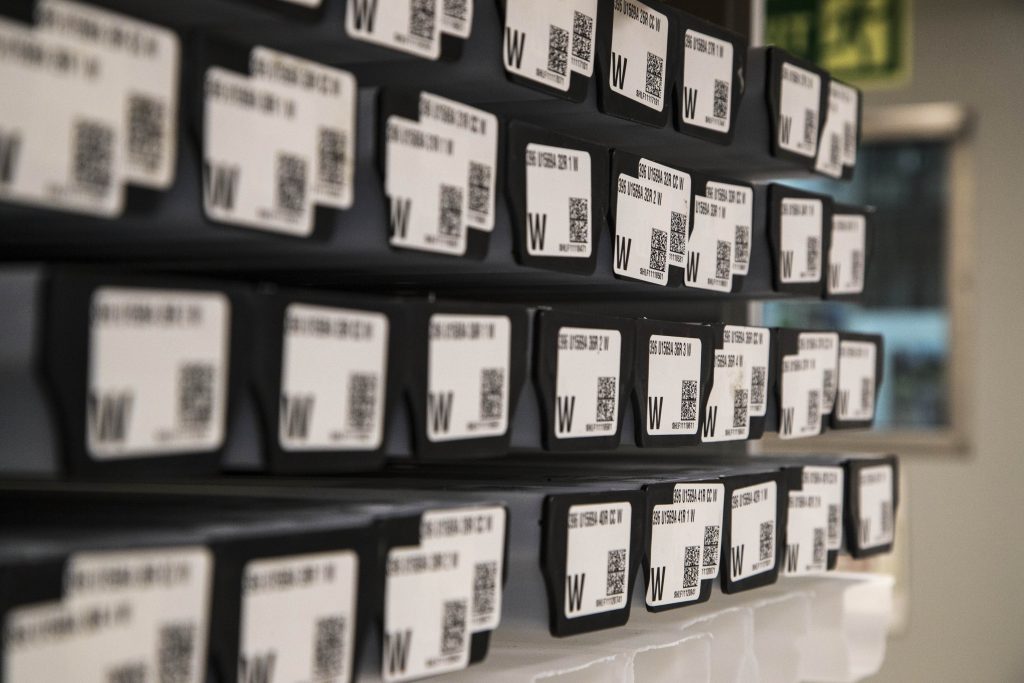
- Once the core was split lengthwise down the shortened section, a sticker with a barcode was printed and taped to the two halves of the core (one half being the archive half and the other being the sampling half)
Once through the core flow and every scientist had a chance to look at the core halves, the core halves were stored in D tubes marked with the identification number and packed in cardboard boxes. D tubes are plastic tubes that would fit the section halves and looking head on at them they have a distinctive cross section shape that looks like a letter D. These boxes were then placed in the shipboard refrigeration unit designated for seafloor samples (on JOIDES Resolution, this was a large room located at the bottom of the ship called the Hold Deck).
Images of split cores in D tubes on JOIDES Resolution for IODP Expedition 390. The empty white tubes are waiting for scientists to complete their sampling and analyses. The red caps mark that core sections are inside and ready to be brought to the Hold Deck for refrigeration. The lower two photos are from inside the Hold Deck, with each cardboard box containing D tubes of core. (Credit: L. Guertin, CC BY-NC 4.0)
Everyone Wants A Piece
When the ship docked, the technical crew began loading containers with core boxes and other samples, such as thin sections, for shipment. Depending on the location of the post-expedition sampling party, the cores were sometimes sent there first before being transferred to their designated long-term repository. The sampling party is a collaborative process between onboard and onshore scientists, where they identify, claim, and mark the sections of cores needed for their research. Once selections are made, the technical crew and scientists cut and group the samples according to each researcher’s requests.

Video of a Sampling Party at the Bremen Core Repository
In July 2024, the sailing party of scientists reunited in Bremen, Germany for the Expedition 401 sampling party. Bremen is the site of one of the core repositories. Over the week long meeting, scientists took nearly 16,000 samples of the rock they collected during the expedition to bring back to their home labs for study. This video gives you a glimpse behind the scenes of this intensive week.
Quick question: What is Emmanuelle Ducasou collecting samples for?
Gulf Coast Repository (GCR)

The Gulf Coast Repository has its space dedicated to the cores that are collected on expeditions in the Pacific Ocean and around Antarctica in the Southern Ocean. Since 1985, its facilities are a part of Texas A&M University in College Station, Texas, USA. It currently houses about 152 kilometers from expeditions under the scientific ocean drilling programs DSDP, ODP, and IODP. In addition to storing cores, the facilities also store thin sections (extremely thin slices of hard rock that has been glued to microscope slides), smear slides (toothpick amounts of sediment that has been dried and glued to a microscope slide), residue collections, and other expedition-related samples.
Bremen Core Repository (BCR)
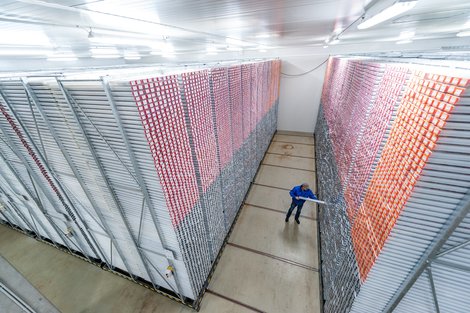
The Bremen Core Repository is housed at MARUM, the Center for Marine Environmental Sciences, at the University of Bremen. It was established in 1994 and holds cores from expeditions completed through International Ocean Drilling Programme (IODP³ – which is the iteration of scientific ocean drilling post-2024), International Ocean Discovery Program (IODP), Integrated Ocean Drilling Program (IODP), Ocean Drilling Program (ODP), and Deep Sea Drilling Project (DSDP). Like the other repositories, the building stores the cores in 100-square meters of refrigerated space. As of 2025, the BCR houses cores from 106 expeditions, which translates to 119 miles (192 kilometers) of deep seafloor material in 290,000 boxes.
Kochi Core Center (KCC)

The Kochi Core Center is located in Monobe campus of the Kochi University in Nankoku City, Kochi, Japan. The facility is managed by two institutions: The Kochi University and Japan Agency for Marine-Earth Science and Technology (JAMSTEC). The partnership ensures they cover all necessary expertise for core research. From Kochi University, one finds the Geochronological Analysis Group and the Global Environmental Change Research Group. While from JAMSTEC, one finds the Physical Property Research Group, Geochemical Research Group, and the Geomicrobiology Group. It was established in 2003 as the Center for Advanced Marine Core Research, and only in 2007 did it join International Ocean Discovery Program as the KCC.
Repositories Are There For Others, Too
You do not have to have been a sailing scientist on an expedition to have access to the cores that are stored in the core repositories. All three repositories have built in accessibility points for international scientists to make requests for physical samples of the cores that are currently stored.
Exercise: From Sea to Storage- Expeditions and Their Repositories
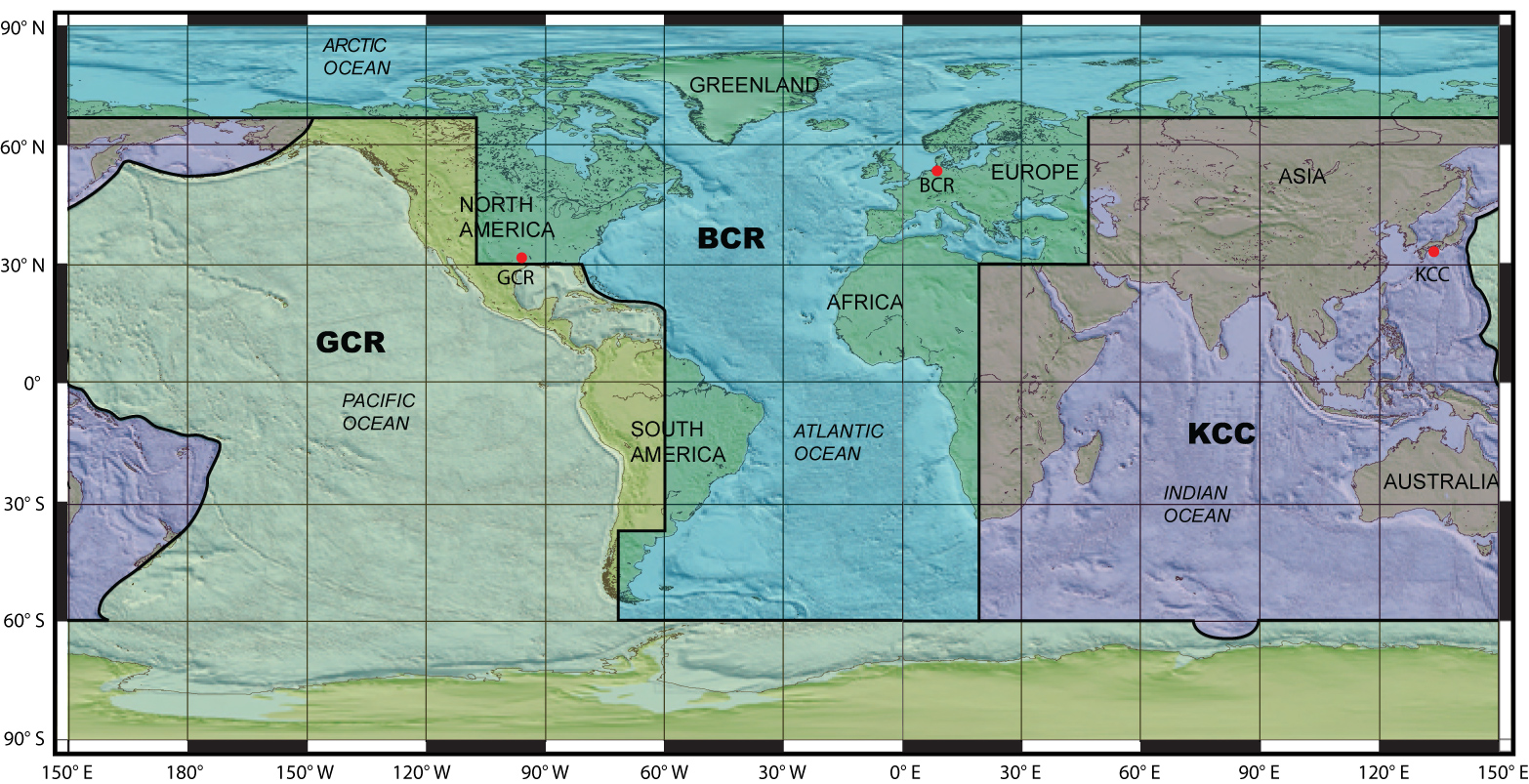
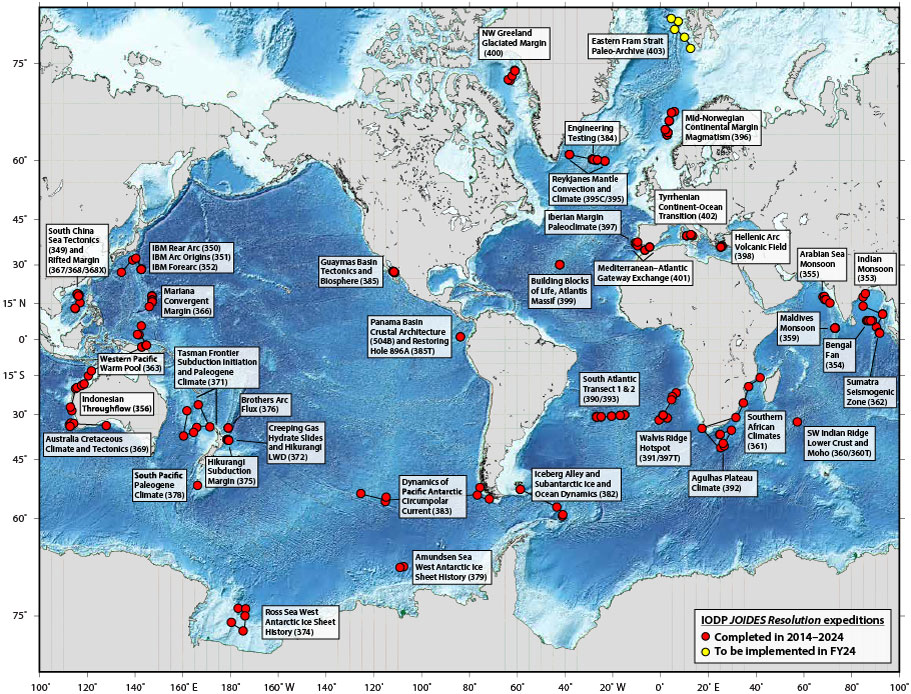
The top map is the core repository map. The map directly above shows completed expeditions. Compare the two maps. The core repository map will help you make sense of the map of expeditions. Your goal is to identify which repository would hold the cores from historical expeditions shown as red dots:
a) For IODP Expedition 379 (Expedition title: Amundsen Sea West Antarctic Ice Sheet History), where would the cores be stored?
b) For IODP Expedition 362, (Expedition title: Sumatra Seismogenic Zone), where would the cores be stored?
c) For IODP Expedition 390/393 (Expedition title: South Atlantic Transect 1 and 2), where would the cores be stored?