
Chapter 5: Dimensional Models
Modern Dimensional Models
The goal of modern dimensional theorists is to understand the relationship between emotions by identifying underlying dimensions of emotions. Typical methodologies include participants ratings of their emotions in the past two weeks or participants rating how similar emotions are to each other. Then, researchers use statistical analyses to arrange participants ratings around a circle based on similarity (or those emotions that are positively correlated). A circumplex model is developed that displays similar emotions in the same space based on scores that are positively correlated.
Before investigating modern dimensional theories, let’s define some terms. Valence is a dimension that measures the extent to which an emotion is pleasant or unpleasant. Activation measures the extent to which an emotion arousing and intense or calm and low in intensity. Mixed emotions occur when people experience more than one emotion at the same time. Mixed emotions could be similar in valence/arousal (e.g., tense and nervous) or different in valence/activation (e.g., happiness and sadness). Each dimensional model varies in the emotions they consider to co-occur. For example, some models believe happiness and sadness can co-occur, while others do not.
In the dimensional models, dimensions may be bipolar or unipolar. On bipolar dimensions, participants are asked to determine the ratio of two opposing concepts. A bipolar pole measuring emotions might place two opposite emotions at each pole (e.g., happiness and sadness). On bipolar dimensions, the two poles are negative correlated. So, if happiness-sadness represents a bipolar dimension, then this means someone high in happiness is low sadness. This further means that an individual cannot be happy and sad at the same time (i.e., high happiness AND high sadness).
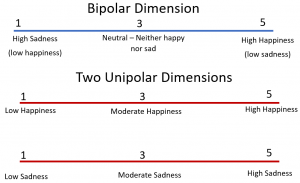
On unipolar dimensions, participants are asked to consider whether a certain emotion is present or absent (high sadness versus low sadness). Typically, unipolar dimensions place the high and low levels of the same adjective at each pole. For instance, Figure 4 shows one bipolar dimension and two unipolar dimensions. So, on the bipolar dimension below, people cannot experience happiness and sadness at the same time (because people can only pick one spot on the line). This bipolar dimension implies that happiness and sadness are negatively correlated – as happiness increases, sadness decreases. But, in the two unipolar dimensions below, people can simultaneously experience high happiness and high sadness. The unipolar dimensions suggest happiness and sadness are not correlated. As we work through modern dimensional theories, pay close attention to which dimensions are unipolar and bipolar.
Figure 4
Example Bipolar and Unipolar Dimensions Using the Emotions Happiness and Sadness
Long Description
The image presents two conceptual models for measuring emotional states, specifically happiness and sadness:
- Bipolar Dimension Model:
- This model uses a single scale ranging from sadness to happiness.
- The scale is labeled as follows:
- 1: High Sadness (implying low happiness)
- 3: Neutral (neither happy nor sad)
- 5: High Happiness (implying low sadness)
- This model assumes that happiness and sadness are inversely related—more of one means less of the other.
- Two Unipolar Dimensions Model:
- This model uses two separate scales:
- Happiness Scale:
- 1: Low Happiness
- 3: Moderate Happiness
- 5: High Happiness
- Sadness Scale:
- 1: Low Sadness
- 3: Moderate Sadness
- 5: High Sadness
- Happiness Scale:
- This model allows for the possibility that a person can experience both happiness and sadness simultaneously, to varying degrees.
- This model uses two separate scales:
The image visually contrasts these two approaches, highlighting the conceptual difference between viewing emotions as opposites on a single continuum versus independent dimensions.