
Chapter 5: Dimensional Models
Cacioppo and Berntson’s (1994) Evaluative Space Model (ESM)
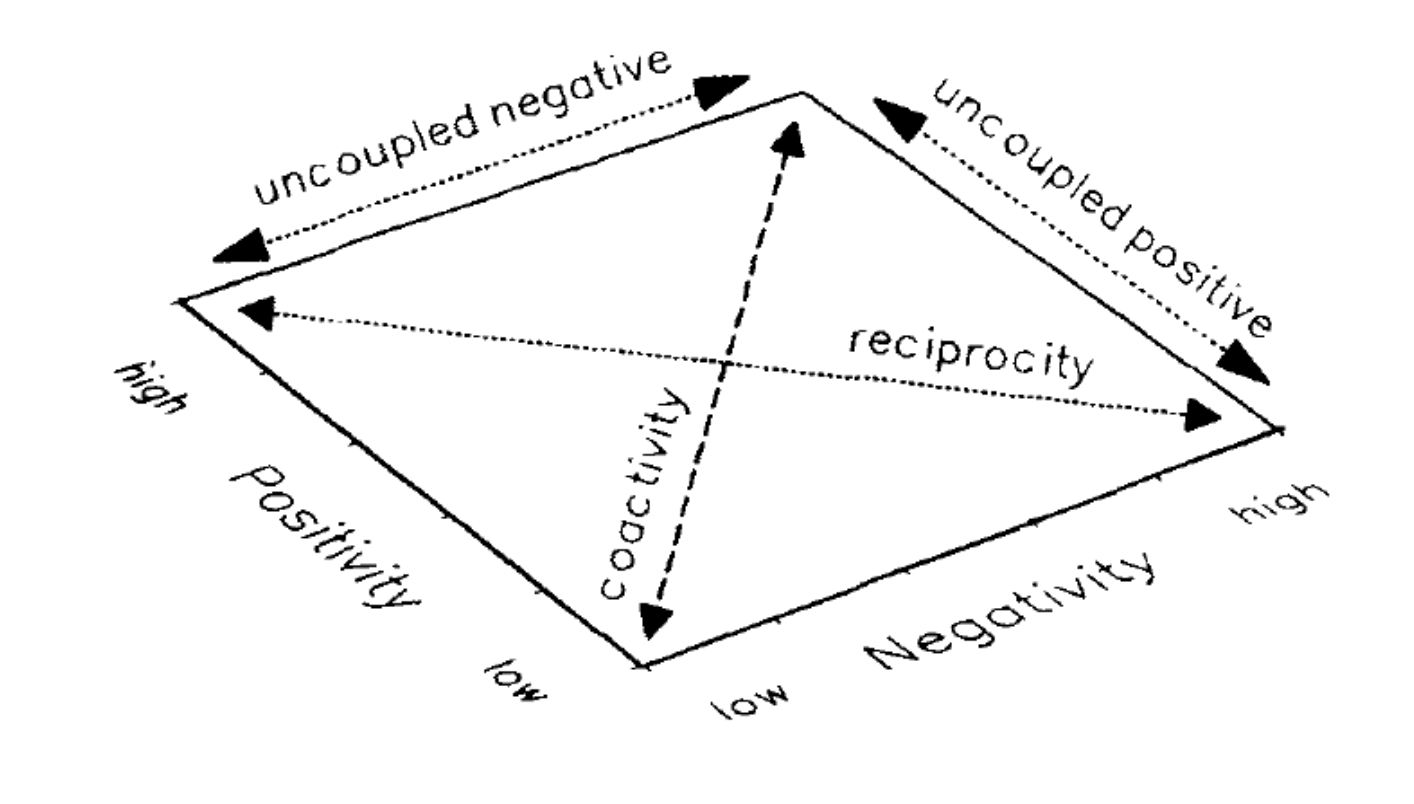
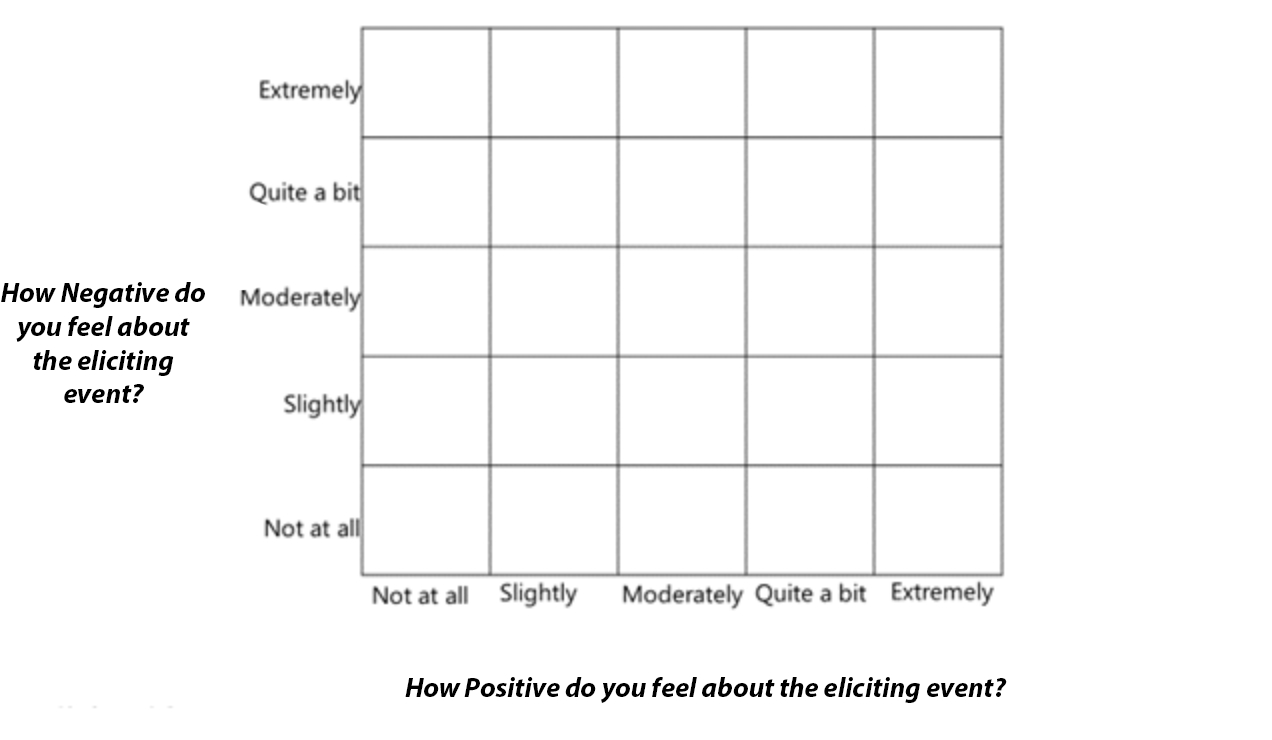
One problem with Russell’s (1980) and Watson and Tellegen’s (1985) circumplex models is that they do not allow for mixed emotions of happiness and sadness. Cacioppo and Berntson (1994; Cacioppo et al., 1999) developed a bivariate model (see Figure 11) to allow for mixed emotions of any level of valence. Bivariate means that the models investigates the relationship between two variables – these two variables are positive valence and negative valence. Thus, Cacioppo and colleagues measure valence with two separate unipolar dimensions. One dimension measures positive valence from not at all to extremely, while a second dimension measures negative valence from not at all to extremely. Typically, in their research participants self-report their negative and positive emotions on the Evaluative Space Grid (see Figure 12). In the ESM, participants select only one box to represent their current emotion.
Figure 11
Bivariate Evaluative Plane
Long Description
The image is a three-dimensional coordinate system diagram, resembling a diamond shape. It is labeled with four axes: Positivity on the vertical axis, ranging from high to low at the bottom left, and Negativity on the horizontal axis, ranging from low to high at the bottom right. Two additional concepts, “reciprocity” and “coactivity,” are depicted with dashed lines intersecting the diagram diagonally. “Reciprocity” runs from the top left to the bottom right, while “coactivity” runs from the bottom left to the top right. The terms “uncoupled negative” and “uncoupled positive” are noted outside of the diamond shape, along the top edges.
Figure 12
Evaluative Space Grid
Long Description
The image is a three-dimensional coordinate system diagram, resembling a diamond shape. It is labeled with four axes: Positivity on the vertical axis, ranging from high to low at the bottom left, and Negativity on the horizontal axis, ranging from low to high at the bottom right. Two additional concepts, “reciprocity” and “coactivity,” are depicted with dashed lines intersecting the diagram diagonally. “Reciprocity” runs from the top left to the bottom right, while “coactivity” runs from the bottom left to the top right. The terms “uncoupled negative” and “uncoupled positive” are noted outside of the diamond shape, along the top edges.
In the ESM, three terms describe the relationship between pleasantness and unpleasantness. Coactivation occurs when someone experiences two unrelated emotions at the same time. For example, happiness and sadness. In coactivation, PA and NA are positively correlated. Coinhibition occurs when people experience low levels of PA and NA, also a positive correlation. Reciprocity occurs when PA and NA are negatively correlated, while uncoupled activation occurs when PA and NA are not correlated. Cacioppo and colleagues (Cacioppo & Berntson, 1994; Cacioppo et al., 1999) state that typically PA and NA are negatively correlated because experiencing a mixed emotion is uncomfortable and confusing, so people will typically move from a mixed emotion state to either a positive only or negative only state. Finally, when mixed emotions do not exist, circumplex models defined by arousal and valence apply.
In the figure below, identify the boxes that represent coactivation, coinhibition, and reciprocity. Drag the type into the corresponding grid box.