
Chapter 9: Anger
Subjective Feelings
Figure 1
Dimensional Models of Anger
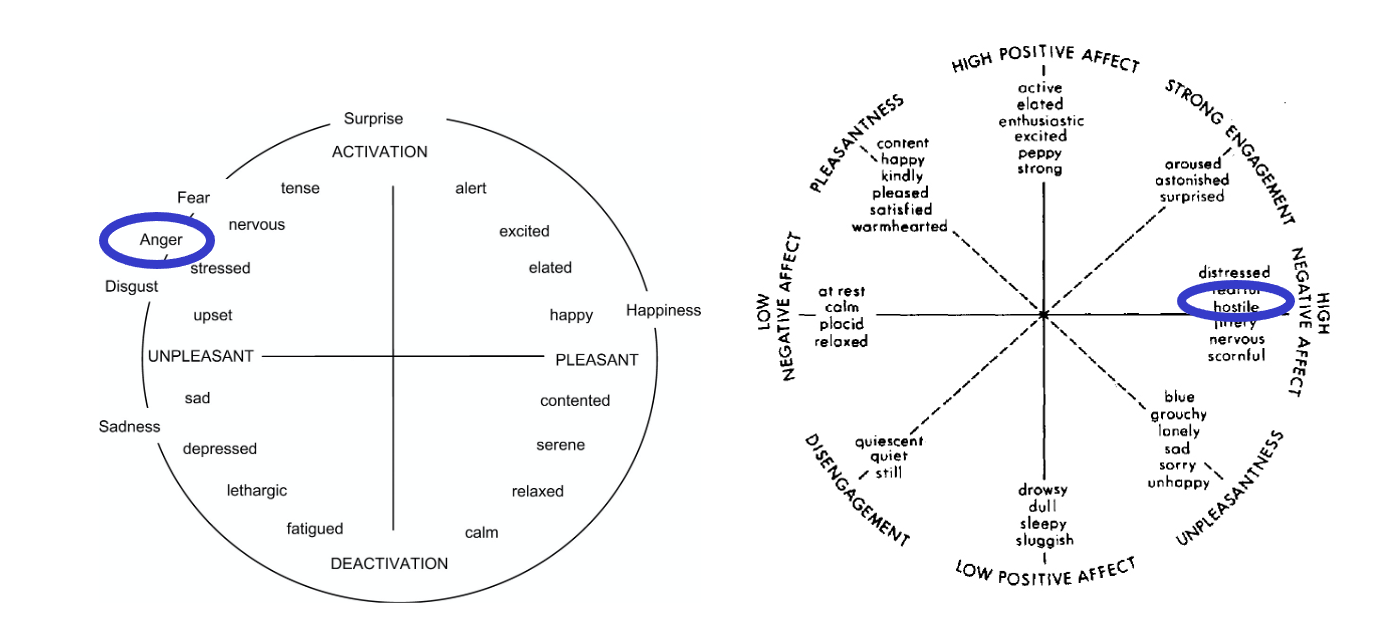
Note. Russell (1980) model is on left; Watson and Tellegen (1985) model is on right. Left figure reproduced from “Independence and bipolarity in the structure of current affect,” by L. Feldman Barrett and J.A. Russell, 1998, Journal of Personality and Social Psychology, 74(4), p. 970 (Independence and bipolarity in the structure of current affect.). Copyright 1998 by the American Psychological Association. Right figure reproduced “Toward a consensual structure of mood.,” by D.T. Watson and A. Tellegen, 1985, Psychological Bulletin, 98(2), p. 221 (Toward a consensual structure of mood.). Copyright 1985 by the American Psychological Association.
Long Description
The image features two circular diagrams side by side, each representing a different model of emotional structure.
- Left Diagram: Russell’s (1980) circumplex model of affect. It is divided into four quadrants:
- Top-left: Emotions like “Tensed,” “Nervous,” and “Stressed” representing fear.
- Bottom-left: Emotions such as “Upset,” “Sad,” and “Depressed” representing disgust/sadness.
- Bottom-right: Emotions like “Lethargic,” “Fatigued,” and “Calm” representing deactivation and pleasantness.
- Top-right: Emotions such as “Alert,” “Excited,” and “Elated” representing activation and happiness.
The horizontal axis spans from unpleasant to pleasant emotions, and the vertical axis ranges from deactivation to activation. The emotion “Anger” is circled in blue.
- Right Diagram: Watson and Tellegen’s (1985) affective structure. It also has four quadrants:
- Top-left: High positive affect and strong engagement with emotions like “Active,” “Elated,” and “Enthusiastic.”
- Bottom-left: Low positive affect and disengagement with emotions like “Drowsy,” “Dull,” “Sleepy,” and “Sluggish.”
- Bottom-right: Low positive affect and unpleasantness with emotions like “Blue,” “Grouchy,” “Lonely,” “Sad,” “Sorry,” and “Unhappy.”
- Top-right: High negative affect and strong engagement with emotions like “Nervous,” “Hostile,” and “Distressed.”
The emotion “Hostile” is circled in blue.
A note at the bottom of the image clarifies that Russell’s model is on the left and Watson and Tellegen’s model is on the right.